 Bambu Proje-Danışmanlık
Conditions for building a house in a village 2026: what is a village settlement area and how do you find out its boundary?
Anyone who owns a plot or a field in a village has heard this sentence: “You don't need a permit to build a house in a village.” The sentence is true, but incomplete. The rule applies only within the village settlement area (köy yerleşik alanı) and its surrounding area. Even there, project approval and notification to the village headman's office (muhtarlık) are compulsory. In this article we explain the village settlement area and the 300-metre issue. We then cover how to find out where your parcel lies, the dimensions allowed for a village house, and what has changed if your village has become a neighbourhood (mahalle). Finally, we show step by step where to apply for which kind of work when renovating an old village house.
Last updated: 27 November 2026. The information is based on the current texts on mevzuat.gov.tr and the original texts in the Official Gazette (Resmî Gazete); the list of sources is at the end of the article. What is described here applies where the village has no zoning plan (imar planı).
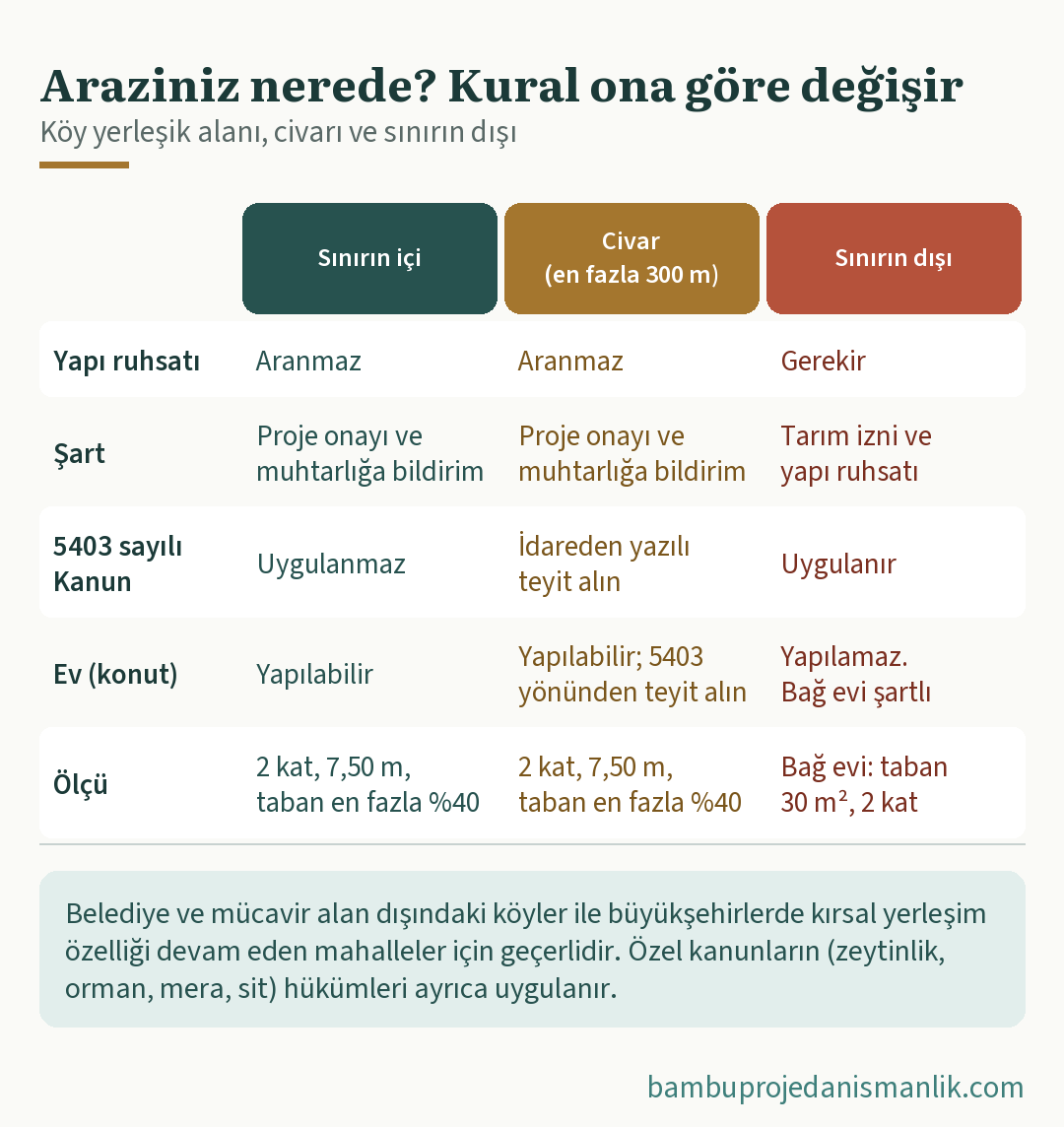
Short answer: If your village is outside municipal and adjacent area (mücavir alan) boundaries and has no zoning plan, everything depends on where your parcel lies. The parcel may be inside the village settlement area or in its surrounding area, or it may lie outside both. Inside and in the surrounding area, no building permit (yapı ruhsatı) is required for a dwelling. In provinces without a metropolitan municipality the project is approved by the Governor's Office (Valilik), through the Special Provincial Administration (il özel idaresi); in metropolitan provinces it is approved by the district municipality. After approval, written notification is made to the village headman's office. Once the house is finished, permission must be obtained from the same authority before it is used. The house may have at most 2 storeys and be at most 7.50 metres high; its footprint may not exceed 40% of the parcel; the parcel must have frontage onto a public road. These are upper limits; what counts is what is written in the zoning status certificate (imar durum belgesi). The surrounding area may extend at most 300 metres, but 300 metres does not apply automatically. On agricultural land outside the boundary and the surrounding area, however, Law No. 5403 (5403 sayılı Kanun) applies.
A video explanation of this topic is in episode 3 of the 5403 Visual Guide series:
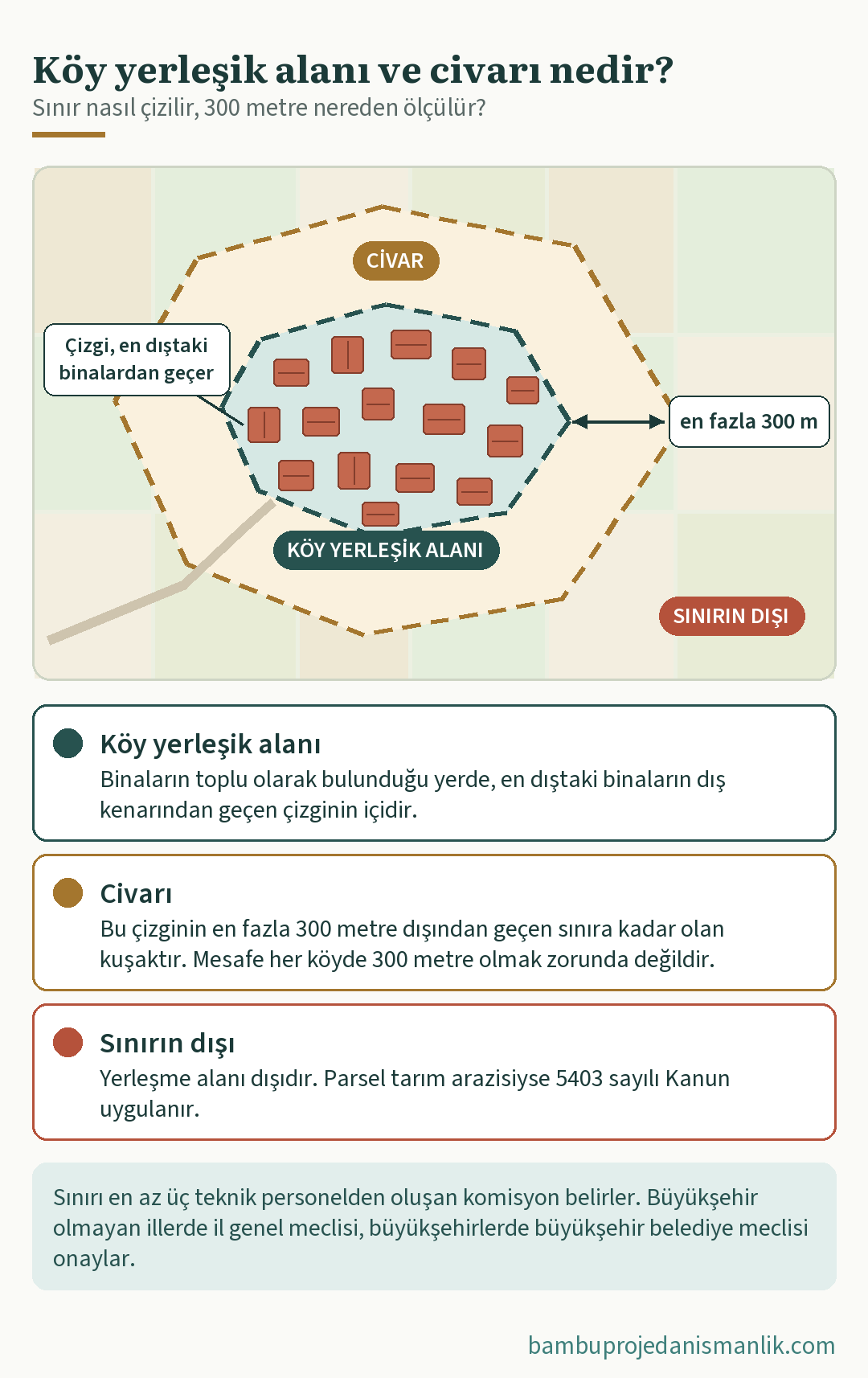
What is a village settlement area? Inside, surrounding area and outside
The village settlement area is the area inside a line drawn through the outermost of the buildings clustered together in the village. These buildings are the village's communal buildings, such as the mosque and the village guesthouse (köy konağı), and buildings that complied with the legislation in force at the time they were built (Zoning Regulation for Unplanned Areas – Plansız Alanlar İmar Yönetmeliği, Article 4). In everyday speech it is also called “köy içi” (inside the village) or “meskûn alan” (inhabited area).
This line does not come into being by itself. The existing buildings are recorded in an official report, the authority draws the line and the council approves it. Saying “my house is inside the village” is not enough; what is decisive is the approved boundary.
The surrounding area is the area inside a second boundary drawn outside this line. This creates three zones:
Inside: the village settlement area.
Surrounding area: the belt between the line and the second boundary.
Outside: the land beyond even the surrounding area. This is usually agricultural land.
In metropolitan provinces, because villages have been turned into neighbourhoods, the same area is called the rural settlement area (kırsal yerleşik alan). Previously determined village settlement area boundaries are accepted as rural settlement area boundaries (Regulation, Article 4).
How many metres is the surrounding area of a village settlement area? The 300-metre issue
A sentence is circulating online: “If it's within 300 metres of the village, you're free to build a house.” 300 is a real figure. But it does not apply to your parcel automatically.
Until 2021 the width of the surrounding area was a fixed 100 metres. On 11 July 2021 the Regulation was amended; the surrounding-area boundary may now run “at most 300 metres” outside the line. The original texts in the Official Gazette read as follows:
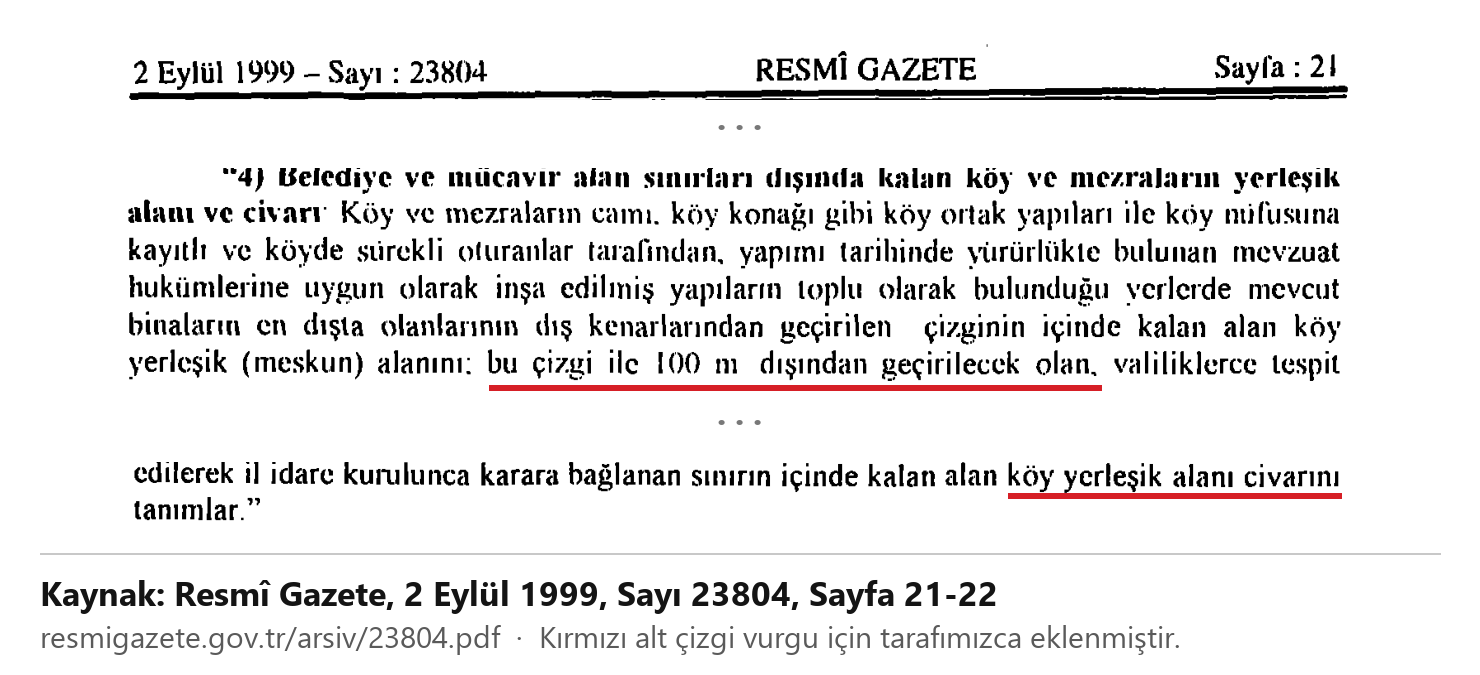
… the area lying within the boundary to be drawn 100 m outside this line, determined by governor's offices and decided upon by the provincial administrative board, defines the surrounding area of the village settlement area. (Official Gazette, 2 September 1999)
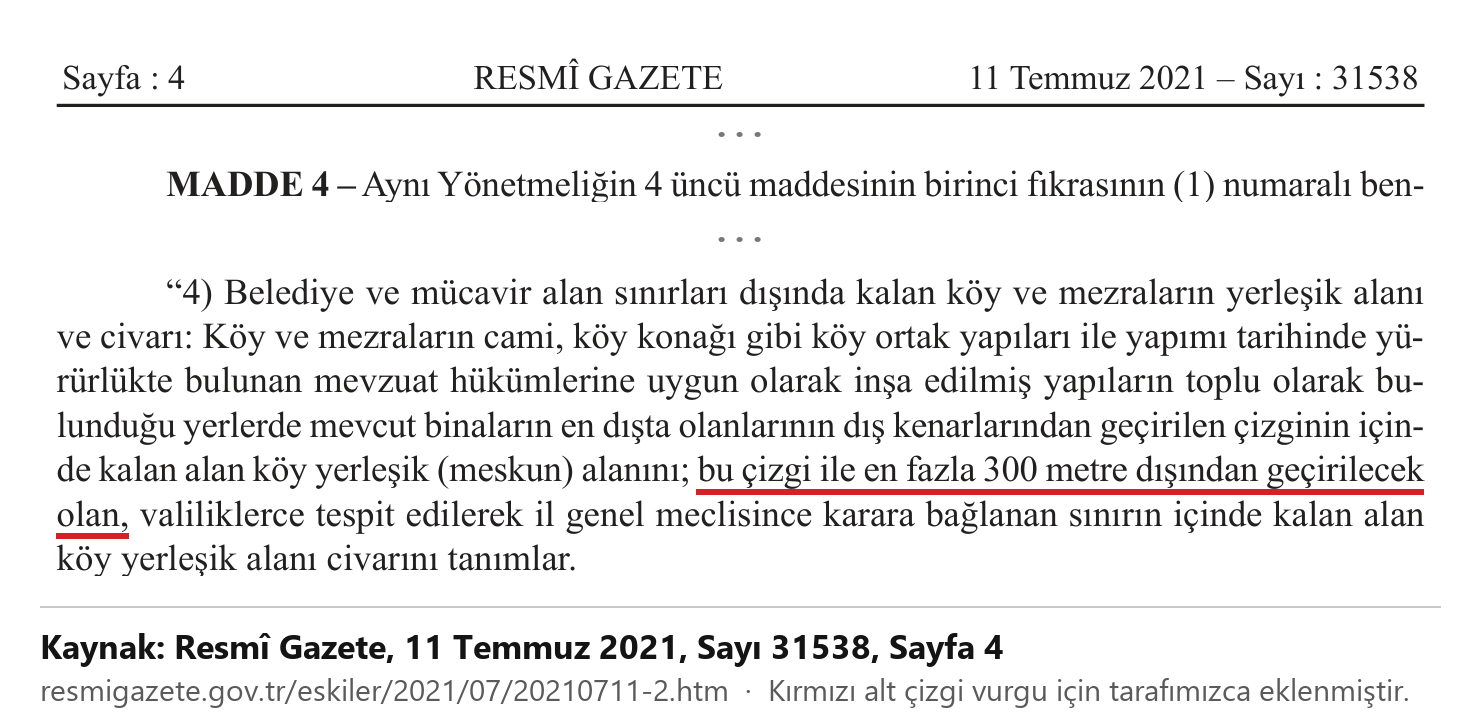
… the area lying within the boundary to be drawn at most 300 metres outside this line, determined by governor's offices and decided upon by the provincial council (il genel meclisi), defines the surrounding area of the village settlement area. (Official Gazette, 11 July 2021)
When reading this amendment, note four points:
300 metres is an upper limit. The surrounding area may be drawn at 100 metres, or at 250 metres. The boundary is drawn taking into account the pattern of land ownership, the shape of the land and natural thresholds (Regulation, Article 43).
Old boundaries remain valid. Previously approved boundaries remain in force (Regulation, Article 4). If your village's surrounding area was drawn at 100 metres, it remains 100 metres unless it is redrawn.
You do not calculate the 300 metres yourself. For it to be extended, the authority must redetermine the boundary, the permissions under Law No. 5403 must be obtained and the council must approve it.
The measurement starts from the approved line, not from your house. Saying “I'm 200 metres from the last house in the village” does not show that your land is in the surrounding area.
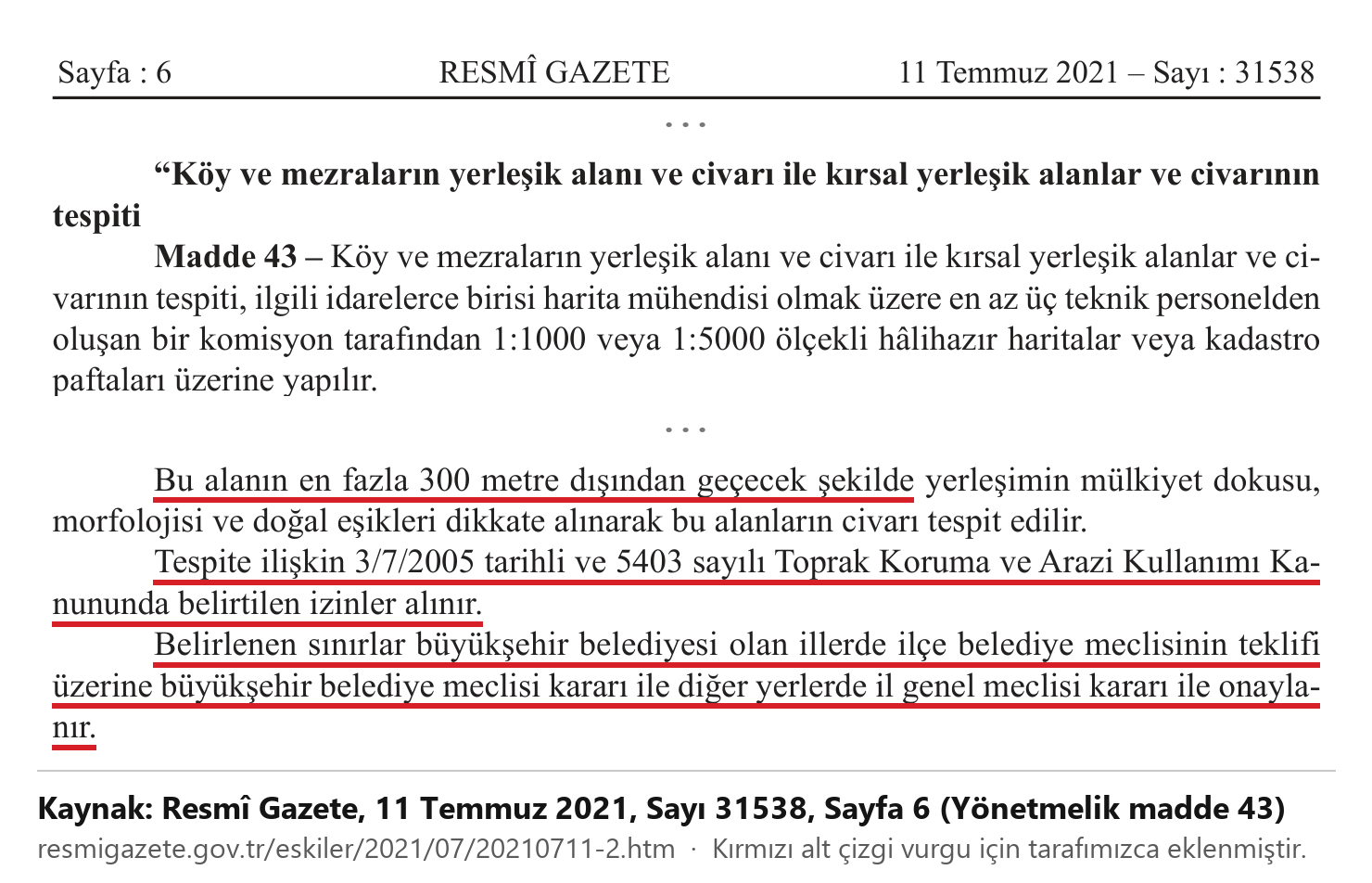
The surrounding area of these areas is determined so as to run at most 300 metres outside this area, taking into account the settlement's ownership pattern, morphology and natural thresholds.
The permissions specified in the Soil Conservation and Land Use Law No. 5403 of 3/7/2005 (5403 sayılı Toprak Koruma ve Arazi Kullanımı Kanunu) are obtained for the determination.
The boundaries so determined are approved, in provinces with a metropolitan municipality, by decision of the metropolitan municipal council on the proposal of the district municipal council, and elsewhere by decision of the provincial council. (Official Gazette, 11 July 2021, Regulation Article 43)
Who determines the village settlement area boundary? Can the boundary change?
The boundary is determined by a commission of at least three technical staff, one of whom is a surveying engineer. The council that approves the boundary is as follows (Zoning Law – İmar Kanunu, Article 27; Regulation, Article 43):
In provinces without a metropolitan municipality: the provincial council.
In metropolitan provinces: the metropolitan municipal council, on the proposal of the district municipal council.
When the boundary is drawn, particular attention is paid to the following areas (Regulation, Articles 4 and 43):
Places at risk of disasters such as floods, landslides, rockfalls and avalanches, as well as stream beds, are not included in the surrounding area. They are left outside even if they fall within the 300 metres.
For pasture, forest, protected heritage (sit) and military areas, the opinion of the relevant institution is obtained and they are marked on the map.
Agricultural land cannot be designated as settlement area or surrounding area without the permissions under Law No. 5403.
In villages where the buildings are scattered, the boundary may be drawn in several separate parts. Buildings no more than 200 metres from one another or from the village's communal buildings are included within the boundary; no separate surrounding area is designated for areas determined in this way (Regulation, Article 43).
If necessary, the boundary is redetermined using the same method. In the process it may expand, but it may also shrink. So do not rely on old information; ask the authority about the current situation.
Is my land in the village settlement area? How do I find out?
The words “tarla” (field), “bahçe” (garden) or “arsa” (building plot) on the title deed (tapu) do not tell you this. Nor is it enough that you appear to be inside the village on a map on your phone. Using the block (ada) and parcel (parsel) numbers on your title deed, request a zoning status certificate from the authority. You will learn from this certificate, or from the authority's written reply, whether the parcel is inside, in the surrounding area or outside. In practice, some authorities also ask for the title deed and a survey application sketch (aplikasyon krokisi). Where to apply:
In provinces without a metropolitan municipality: the Special Provincial Administration, on behalf of the Governor's Office.
In metropolitan provinces: the zoning department of the district municipality.
In your petition you can ask these three questions:
Is my parcel inside the village (rural) settlement area, in its surrounding area or outside it?
By which council decision, and of what date, was the boundary approved?
Is there any restriction on my parcel that prevents building? For example disaster risk, a stream bed, protected heritage status, forest or pasture.
Get the answer in writing. Do not start building on the word of a neighbour, the seller or an estate agent.
How do you get a permit for a village house? No permit, but project approval
If you are asking how to get a permit for a village house, the answer is this: in the settlement area and its surrounding area you do not obtain a building permit; you have your project approved. Under the Zoning Law, in the settlement areas and surrounding areas of villages outside municipal and adjacent area boundaries, no building permit is required for the following buildings (Zoning Law, Article 27):
dwellings;
agricultural and livestock buildings that are not integrated facilities and do not require a zoning plan;
buildings meeting the needs of village residents, such as a grocer's, greengrocer's, barber's, village bakery, village coffee house and village restaurant.
This rule applies to villages outside municipal and adjacent area boundaries. If your village is within a municipality's adjacent area, ask that municipality which rule applies. The fact that no permit is required does not mean you may build without authorisation. The procedure is as follows:
Project: The project is prepared by an architect and engineers. Responsibility for the surveys and projects lies with them. Governor's offices may, on request, provide a project suited to the locality; ask the authority about this (Regulation, Article 57).
Project approval: The law calls this “Governor's Office approval”. In provinces without a metropolitan municipality, the Special Provincial Administration approves it; in metropolitan provinces, the district municipality. The name of the document may vary from one authority to another: project approval, village permit or rural building certificate. In practice, some provincial councils require the land category on the title deed to be changed to “arsa” (building plot) before granting permission. Do not start building before the approval arrives.
Notification to the village headman's office: After approval, written notification is made to the village headman's office. The headman (muhtar) does not grant permission. Formerly, written permission was obtained from the headman's office; with Law No. 7221 (Official Gazette, 20 February 2020) this became a notification. In practice, a letter from the headman's office may still appear on some authorities' document lists. Keep a dated copy of the notification signed by the headman.
Construction: The building is constructed in accordance with the approved project. It must suit the local fabric and architecture and comply with technical, construction and health rules.
Permission for use: This dwelling in the village is not subject to a building permit or an occupancy permit (yapı kullanma izni, also called iskân). However, once the house is finished, permission must be obtained from the relevant municipality or the Governor's Office before it is used (Zoning Law, Article 30). The Governor's Office determines whether the building complies with technical and health rules (Regulation, Article 57). Electricity and water are not connected to a building without a use permit (Zoning Law, Article 31). In practice, this permission may also be issued under the name of occupancy permit or iskân.
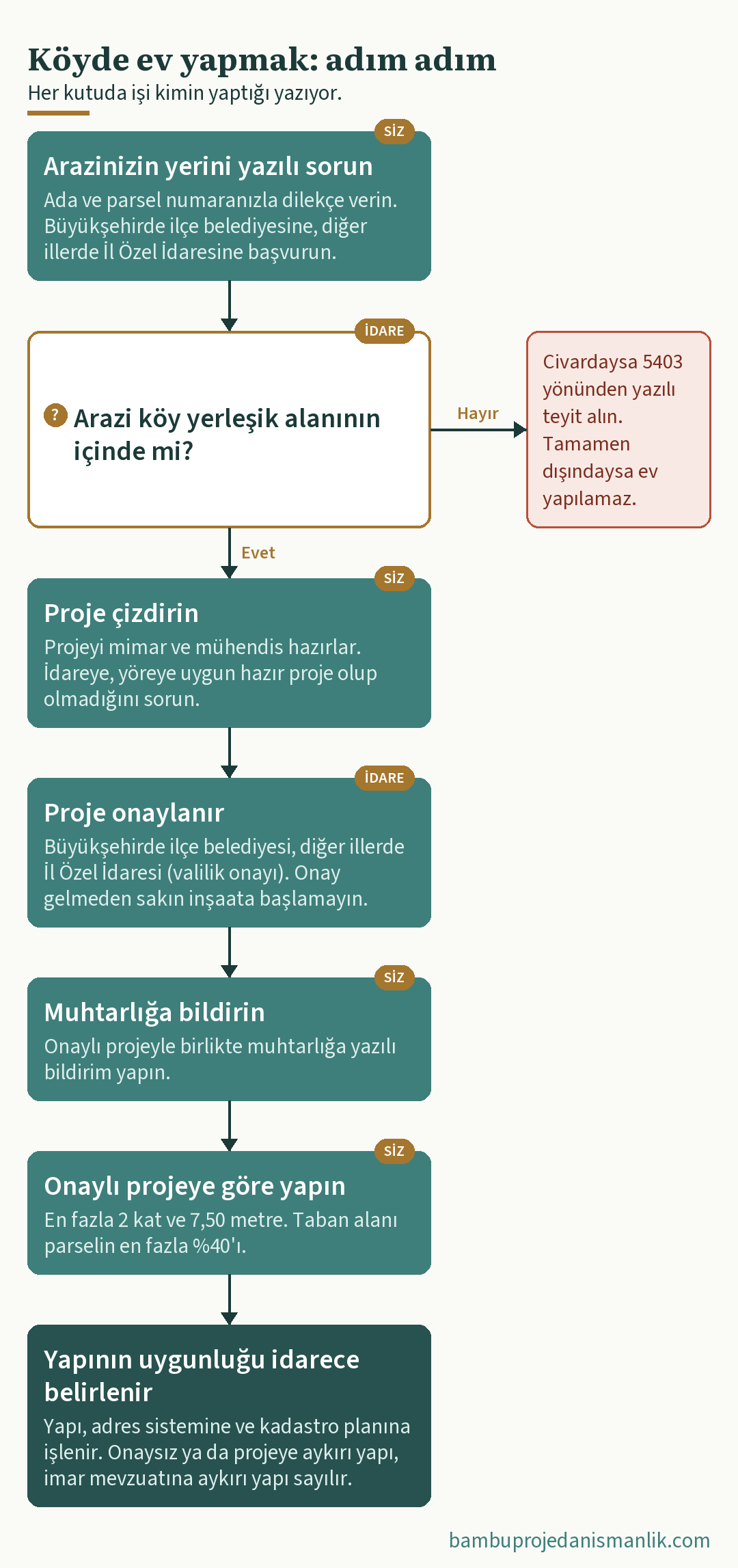
Consequences of building without approval or notification: The headman is obliged to report to the Governor's Office any building constructed without project approval and notification to the headman's office, or contrary to the project (Zoning Law, Article 27). The Zoning Law's provisions on stopping work, sealing, demolition and administrative fines apply to such buildings (Zoning Law, Articles 32 and 42). The building is sealed and the situation is entered in the declarations section of the title deed register; if it is not brought into compliance, it is demolished. The reduced fine under the Zoning Law applies only to those registered in the village's population register who live permanently in the village; for everyone else the fine is calculated in the standard way. Under a provision added in 2026, anyone who sells ready-mixed concrete for use in a building constructed without permission is also given an administrative fine of 500,000 TL (Zoning Law, Article 42; Law No. 7579).
Dimensions of a house to be built in a village
In the village settlement area and its surrounding area, the upper limits set by the Regulation are as follows (Regulation, Articles 50, 51 and 52):
At most 2 storeys and 7.50 metres. More than one storey may not be gained because of the slope of the land (Regulation, Article 52).
Footprint at most 40% of the parcel. Ancillary structures (müştemilat) such as a pantry or woodshed are also included in this calculation. Example: on a 500 m² parcel, the total area covered by the house and its ancillary structures may not exceed 200 m².
What may be built on the parcel: Unless the parcel is subdivided, no buildings other than dwellings, agricultural and livestock buildings and their ancillary structures may be built; a building may contain more than one independent unit (Regulation, Article 50).
Road frontage: No building may be constructed on a parcel that has no frontage onto a public footpath or vehicle road (Zoning Law, Article 8).
Large parcel with a shared title: On a parcel larger than 1,500 m² held under a shared title deed (hisseli tapu, where several owners hold undivided shares), more than one building may be constructed with the written consent of the co-owners, provided the number exceeds neither the number of shareholders nor 3. Each building's construction area may be at most 250 m², and the total at most 750 m². The situation on a shared parcel can be complicated; consult an expert before you start.
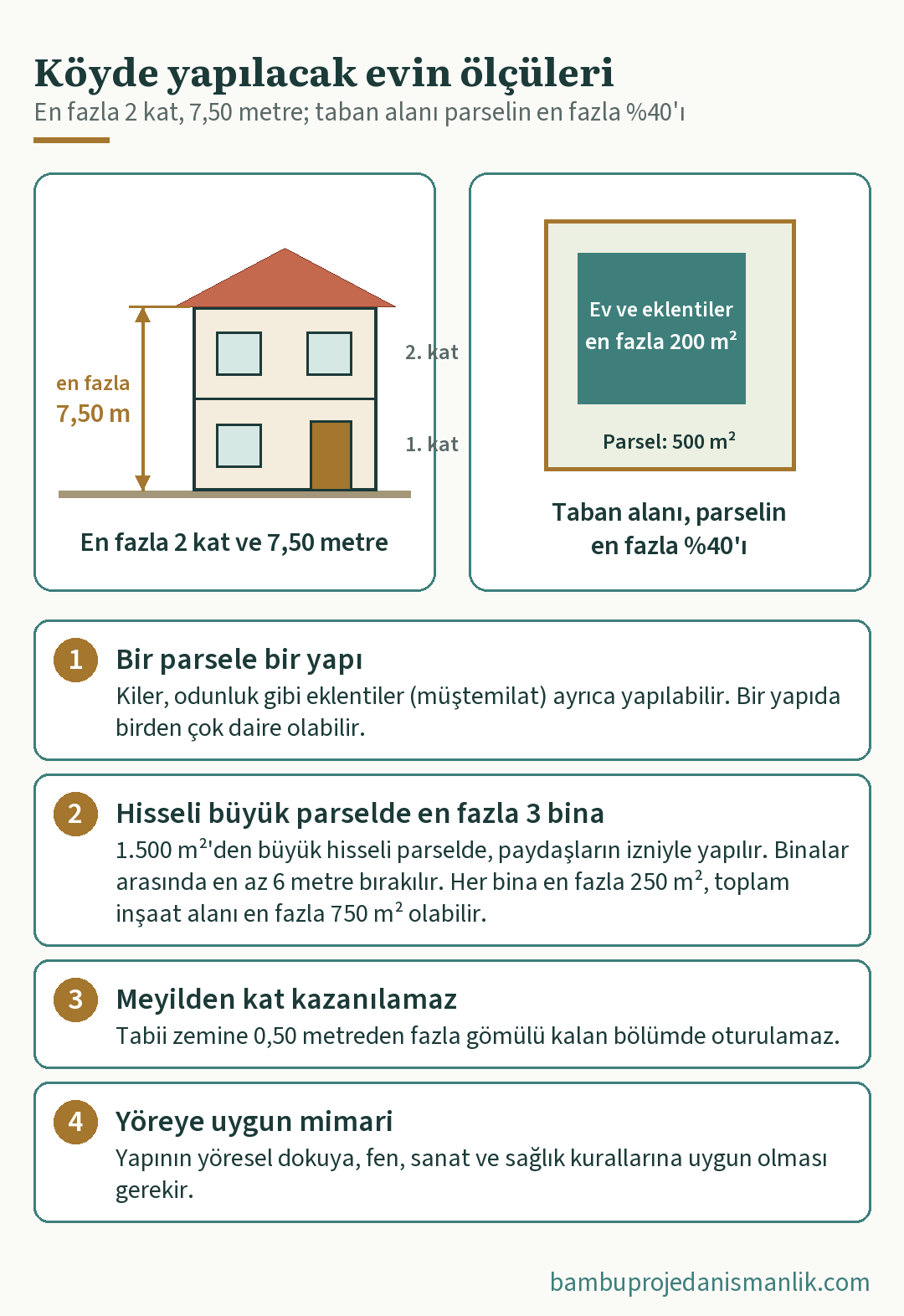
These dimensions are upper limits. The provincial council, or in metropolitan provinces the metropolitan municipal council, may separately set building and subdivision conditions for village areas and impose stricter rules (Zoning Law, Article 27). In practice, some metropolitan municipalities set lower height and area limits, and even require a building permit. What applies to your parcel is what is written in the zoning status certificate.
Does Law No. 5403 apply in the village settlement area?
It does not apply within the settlement area boundary. The Zoning Law states this explicitly (Zoning Law, Article 27):
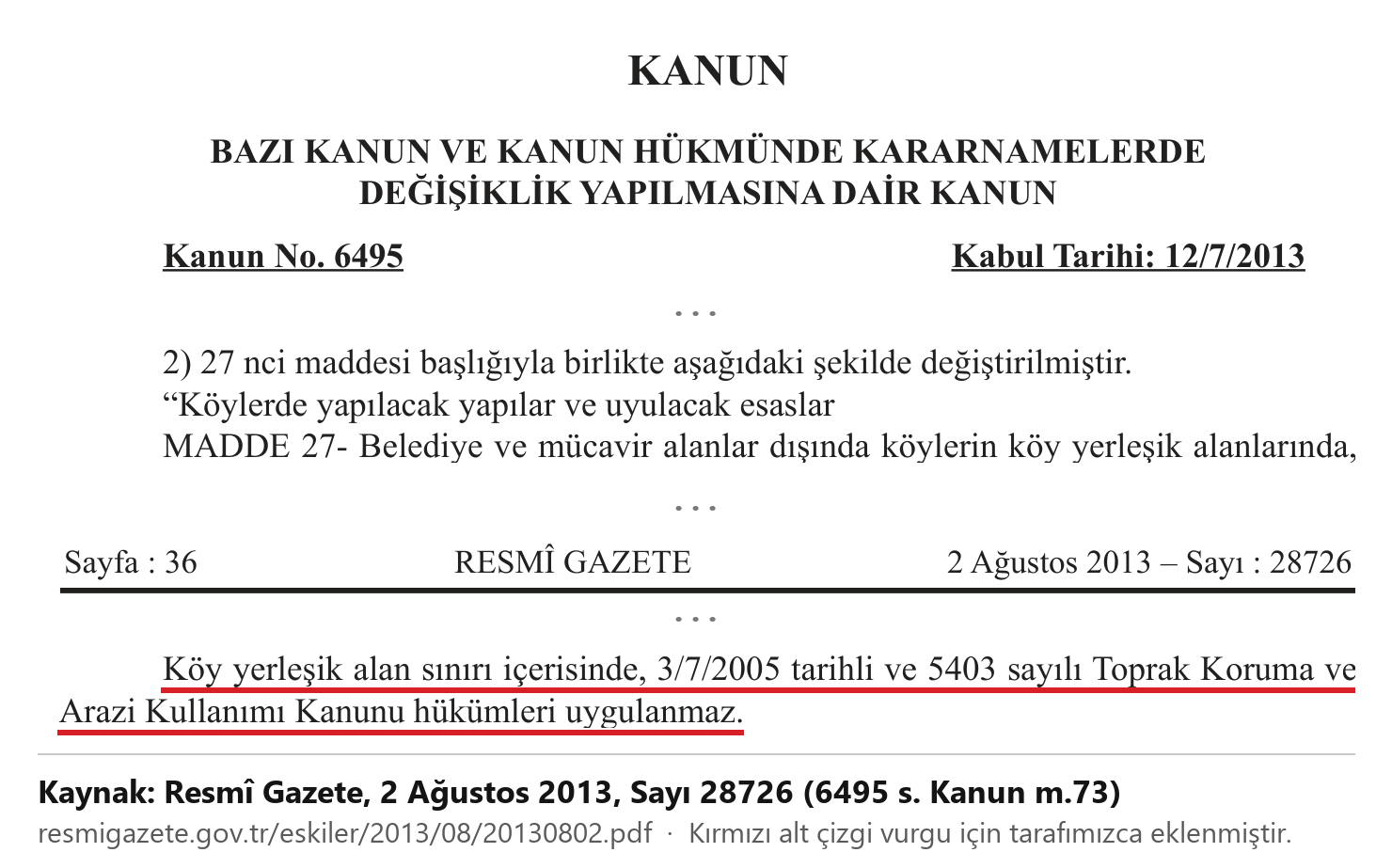
Within the village settlement area boundary, the provisions of the Soil Conservation and Land Use Law No. 5403 of 3/7/2005 shall not apply. (Official Gazette, 2 August 2013, Law No. 6495, Article 73)
Even if your parcel within the boundary is recorded as “tarla” (field) on the title deed, neither a permit for non-agricultural use (tarım dışı kullanım) nor the conditions for a vineyard house (bağ evi, a small dwelling allowed on agricultural land under strict conditions) are required for a house. If the boundary divides your parcel in two, the boundary is accepted as a parcel subdivision (ifraz) line without being subject to Law No. 5403 (Zoning Law, Article 27).
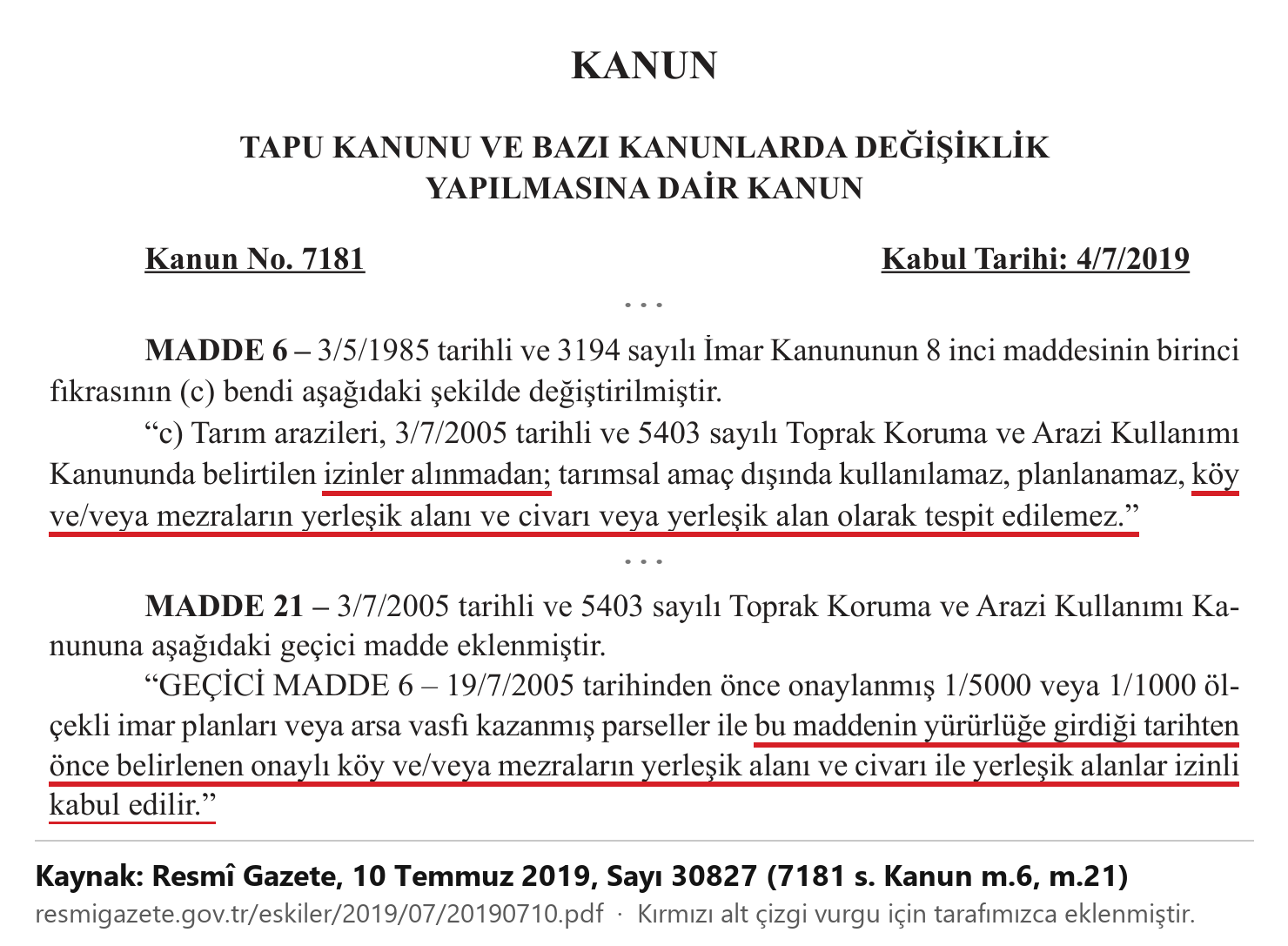
For the surrounding area the position is as follows: agricultural land cannot be designated as settlement area or surrounding area without the permissions under Law No. 5403 (Zoning Law, Article 8). Settlement areas and surrounding areas approved before 10 July 2019, however, are deemed to have been permitted (Law No. 5403, Provisional Article 6). In other words, an approved surrounding area either counts as permitted because it was approved before 2019, or the 5403 permission was obtained when it was drawn.
What changes if your village has become a neighbourhood?
In metropolitan provinces, all villages have been turned into neighbourhoods. The rule works like this: for neighbourhoods with a population below 5,000, the metropolitan municipal council decides whether their rural settlement character continues. Unless the council has decided otherwise, the village rule applies in these places until a zoning plan is made. The district municipality approves the project, after which notification is made to the headman's office (Zoning Law, Article 8).
Do not confuse the two: the municipality's “rural neighbourhood” (kırsal mahalle) decision concerns tax and fee reductions (Law No. 5216, Additional Article 3); it is not a zoning boundary. What you need is the rural settlement area and surrounding-area boundary approved by the council for zoning purposes (Zoning Law, Article 27). Ask the district municipality's zoning department about this.
Is an old village house considered illegal?
Do not immediately call an old village house “kaçak” (illegal) just because it has no permit. First, look at when and where the house was built.
Before 1975: Areas outside municipal boundaries were brought under zoning control in 47 of Türkiye's provinces in 1975, and in the other provinces later (Council of Ministers decision, Official Gazette, 10 January 1975). However, the settlement areas of villages not on the coast were exempted from construction permission (Regulation on Annexes 7-8 – Ek 7-8 Yönetmeliği, Article 8.01, Official Gazette, 18 January 1975).
Houses recognised by law: In the areas covered by that decision, buildings constructed before 10 January 1975 are, unless they are gecekondu (informal squatter houses), deemed to have been built in compliance with zoning legislation and to have obtained a use permit (Law No. 2981, Provisional Article 2).
The burden of proof is on you: Title deed records, old tax, electricity or water receipts, the electoral register, census records and headman's office records are used. Aerial photographs taken in those years can also be used.
Villages that have become neighbourhoods: If your village became a neighbourhood under Law No. 6360 of 2012, a dwelling completed by 6 December 2012 and found to comply with technical rules is deemed to have a permit (Law No. 6360, Provisional Article 1/14). The determination may be made by the municipality, the Ministry or a university; the first port of call is the district municipality.
Other cases: If your house was built after 1975, or your village is on the shore of a sea, lake or river, ask the authority about the situation in writing.
The conditions of these provisions are detailed and do not produce the same result for every house. Ask the authority in writing, enclosing your documents, which case your house falls under; do not decide on your own. Even if the old house is protected, any new work on top of it or in its place is subject to today's rules.
Renovating a village house: which work needs permission?
Not every job on an old village house goes through the same door:
Minor (ordinary) repairs: Re-laying the roof where the roof's shape, height and load-bearing structure do not change; plastering, painting, whitewashing, joinery, flooring and ceiling cladding, repairs to installations, and repairs to partition walls and garden walls are not subject to a permit (Zoning Law, Article 21; Regulation, Article 41).
Major repairs (esaslı tamir): For larger works that do not affect the building's plan, appearance and load-bearing system, an application is made to the authority; no plans or project are required (Regulation, Articles 40 and 60). Note: in some municipal texts the term “esaslı tadilat” (major alteration) means exactly the opposite: work that touches the load-bearing structure and requires a permit.
Work affecting the load-bearing structure, plan or appearance: Work that touches a load-bearing wall, column or beam, or that changes the plan or appearance of the house (for example opening a new window), is not a major repair. A project is required; approval and notification are carried out.
Adding a storey, building an extension, demolishing and rebuilding: These count as new buildings and are subject to today's rules: project approval, notification, and the 2-storey and 40% limits.
Five warnings before you start:
If the house is built of mud brick (kerpiç), no storey may be added on top. For a mud-brick building the limit is one basement and one ground floor, i.e. 3.50 metres (Regulation, Articles 22 and 61). If the footprint already exceeds 40% of the parcel, no extension can be added alongside it either.
If the house is a registered listed building or the village is in a protected heritage (sit) area, apply to the directorate of the Regional Conservation Council (koruma bölge kurulu müdürlüğü), or, where one exists, to the municipality's conservation, implementation and supervision office, before even the smallest repair; permission from the Regional Conservation Council is compulsory for major repairs and construction (Law No. 2863, Articles 9 and 65).
If the house is jointly owned by heirs, obtain the written consent of all the heirs before starting major work (Turkish Civil Code, Articles 640 and 702).
If the village is close to the sea, a lake or a river: where there is no zoning plan, no building whatsoever may be constructed in the coastal strip of at least 100 metres from the shoreline boundary (kıyı kenar çizgisi). Village houses built in compliance with the legislation before 11 July 1992 may only be repaired and strengthened in their existing form within this strip; no new building may be constructed (Coastal Law, Articles 4 and 8 and Additional Article 3).
If the house was built without permission when permission was required, repairs and alterations will not be permitted until it has been brought into compliance with the rules (Regulation, Article 10).
If you are not sure which group your work falls into, ask the Special Provincial Administration, or in metropolitan provinces the district municipality, in writing; start only once you have received the answer.
What happens if I'm outside the boundary?
If you are outside the settlement area and the surrounding area, the village rules do not apply. If the land is agricultural land, Law No. 5403 applies:
Permission for a dwelling on agricultural land is subject to very narrow conditions; often the only route, if the conditions are met, is a vineyard house. For details, see our article conditions for building a house on a field.
Agricultural buildings such as barns and storehouses are built with a building permit after agricultural permission has been obtained (Zoning Law, Article 27).
Containers, prefabricated houses and tiny houses also require permission. For details, see our article is it forbidden to put a container on a field?
For unauthorised use, an administrative fine of 2,500 TL is imposed per square metre of the area used (2026 amount; it rises every year by the revaluation rate). On large plains (büyük ova) it is doubled. If no permit application is made within one month of notification, or if permission is not granted, 2 months are given to remove the building; if it is not removed within this period, a second fine of three times the first is imposed. Electricity, water and natural gas are not connected to an unauthorised building (Law No. 5403, Article 21).
Example: two neighbours in the same village
Ayşe Hanım has a 600 m² parcel in the village; the title deed says “tarla” (field). She requested a zoning status certificate, and the certificate stated that the parcel was inside the settlement area. She had an architect design a two-storey house, planned so that its footprint would not exceed 600 × 40% = 240 m². The authority approved the project, Ayşe Hanım made a written notification to the headman's office and began building. Because her parcel lies inside the boundary, no agricultural permission was required.
In the same village, Mehmet Bey has a field of 8 dönüm (8 decares) = 8,000 m² (0.8 hectares), but the field lies outside even the surrounding area. Law No. 5403 applies here. It is very difficult to obtain permission for a house on this field; nor does it meet the requirement of 20 dönüm (20 decares) = 20,000 m² (2 hectares) for a vineyard house. If Mehmet Bey relies on the saying “you don't need a permit in a village” and builds a house using 100 m² of land, he will be fined 100 × 2,500 = 250,000 TL. If he does not remove the building within the time given, a second fine of 750,000 TL follows. Electricity and water will not be connected to this building either.
The only difference between the two parcels is which side of the approved boundary they fall on. That is why the first step is to ask about the boundary in writing.
Frequently asked questions
Did our village's surrounding area automatically become 300 metres in 2021?
No. The 2021 amendment raised the upper limit from 100 metres to “at most 300 metres”. For the surrounding area to expand, the boundary must be redetermined, the 5403 permissions must be obtained and the council must approve it. If this has not been done, the previously approved boundary remains valid.
Can someone who is not registered in the village's population register build a house in the village?
Yes. The phrase “by those registered in the village population register and living permanently in the village” in Article 51 of the Regulation was removed on 11 July 2021. Article 27 of the Zoning Law does not impose any such condition either. However, the reduced fine for a building without approval applies only to those registered in the village's population register who live permanently in the village (Zoning Law, Article 42).
The title deed says “tarla” (field). If I'm inside the boundary, can I build a house?
Yes. Law No. 5403 does not apply within the settlement area boundary. The parcel's dimensions and road frontage must comply with the rules, the project must be approved and notification must be made to the headman's office. In practice, some provincial councils require the land category on the title deed to be changed to “arsa” (building plot) before granting permission; ask the authority about this.
Can I put a container on my plot in the village?
A container also falls within the legal definition of a building. The Zoning Law defines a building as “permanent or temporary … fixed and movable installations” (Zoning Law, Article 5). Even in the settlement area and its surrounding area, project approval and notification to the headman's office are required.
Can I build a barn or a storehouse on my parcel inside the boundary?
Agricultural and livestock buildings that are not integrated facilities and do not require a zoning plan are subject to the same rule as dwellings: no building permit is required, but project approval and notification to the headman's office are compulsory. The same dimensions apply.
Do I get an occupancy permit (iskân) when the house is finished?
This dwelling in the village is not subject to an occupancy permit (iskân). However, permission must be obtained from the relevant municipality or the Governor's Office before it is used (Zoning Law, Article 30; Regulation, Article 57). Without this permission, electricity and water are not connected (Zoning Law, Article 31).
What happens if an olive grove, forest, pasture or protected heritage area lies within the boundary?
The provisions of special laws are reserved (Zoning Law, Article 27). When the boundary is determined, these areas are marked on the map after the opinions of the relevant institutions have been obtained (Regulation, Article 43). For parcels classed as olive groves, the restrictions of Law No. 3573 also apply.
Can I run a guesthouse in my house in the village?
In village dwellings, home guesthouse operation (ev pansiyonculuğu) is permitted once a business opening and operating licence has been obtained (Zoning Law, Article 8).
Can the village settlement area boundary be extended?
If necessary, the boundary can be redetermined by the same method and by council decision; it may expand, but it may also shrink. This is not a procedure an individual can have carried out on their own; the decision rests with the authority and the council.
Sources
Every piece of information in this article is based on the official texts below. The current texts were taken from mevzuat.gov.tr, and the original versions of the amendments from the Official Gazette.
Zoning Law No. 3194, current text (Articles 5, 8, 21, 27, 30, 31, 32 and 42).
Soil Conservation and Land Use Law No. 5403, current text (Article 21 and Provisional Article 6).
Zoning Regulation for Unplanned Areas, current text (Articles 4, 10, 22, 40, 41, 43-52, 57, 60 and 61).
Official Gazette, 2 September 1999, issue 23804: former definition of the surrounding area (100 m).
Official Gazette, 2 August 2013, issue 28726: Law No. 6495, Article 73 (Zoning Law, Article 27).
Official Gazette, 10 July 2019, issue 30827: Law No. 7181, Articles 6 and 21.
Official Gazette, 20 February 2020, issue 31045: Law No. 7221, Article 8 (notification instead of the headman's permission).
Official Gazette, 22 May 2026, issue 33261: Law No. 7579 (Zoning Law, Article 42, ready-mixed concrete fine).
Coastal Law No. 3621, current text (Articles 4 and 8 and Additional Article 3).
Metropolitan Municipality Law No. 5216, Additional Article 3.
Official Gazette, 11 July 2021, issue 31538: amendment to the Zoning Regulation for Unplanned Areas (at most 300 metres; removal of the population register requirement).
Official Gazette, 17 October 2024, issue 32695: amendment to the Regulation (disaster-risk areas and stream beds).
Official Gazette, 10 January 1975, issue 15114 (Council of Ministers decision 7/9163) and 18 January 1975, issue 15122 (Regulation on Annexes 7-8).
Law No. 2981, Provisional Article 2 (Official Gazette, 8 March 1984, issue 18335).
Law No. 6360, Provisional Article 1.
Law No. 2863 on the Conservation of Cultural and Natural Property, Articles 9 and 65; Turkish Civil Code, Articles 640 and 702.
The red underlining in the extracts has been added by us for emphasis. This article has been prepared for general information purposes. Each village's boundary and council decision are different; the final decision is made by the relevant authorities.