 Bambu Proje-Danışmanlık
Are hobby gardens legal? Why are they banned, what are the penalties, and will there be an amnesty? (2026)
Short answer: In the form in which they are sold today, usually not. Growing vegetables on a field is not prohibited. The problem is that the field is divided into small plots without being recorded on the title deed (tapu) and transferred via a cooperative or company, and that unauthorised houses, containers and pergolas are put up on these plots. Law No. 5403 (5403 sayılı Kanun) exists to prevent the division of agricultural land. Anyone who transfers a field in de facto plots via a cooperative or company, thereby causing it to be divided and used for non-agricultural purposes, and anyone who acts as an intermediary in this, faces imprisonment; unauthorised buildings attract a fine per square metre and demolition. Since June 2026, unauthorised buildings cannot be given electricity, water or natural gas connections. As of November 2026, there is no regulation in force that legalises existing structures.
Last updated: 25 November 2026
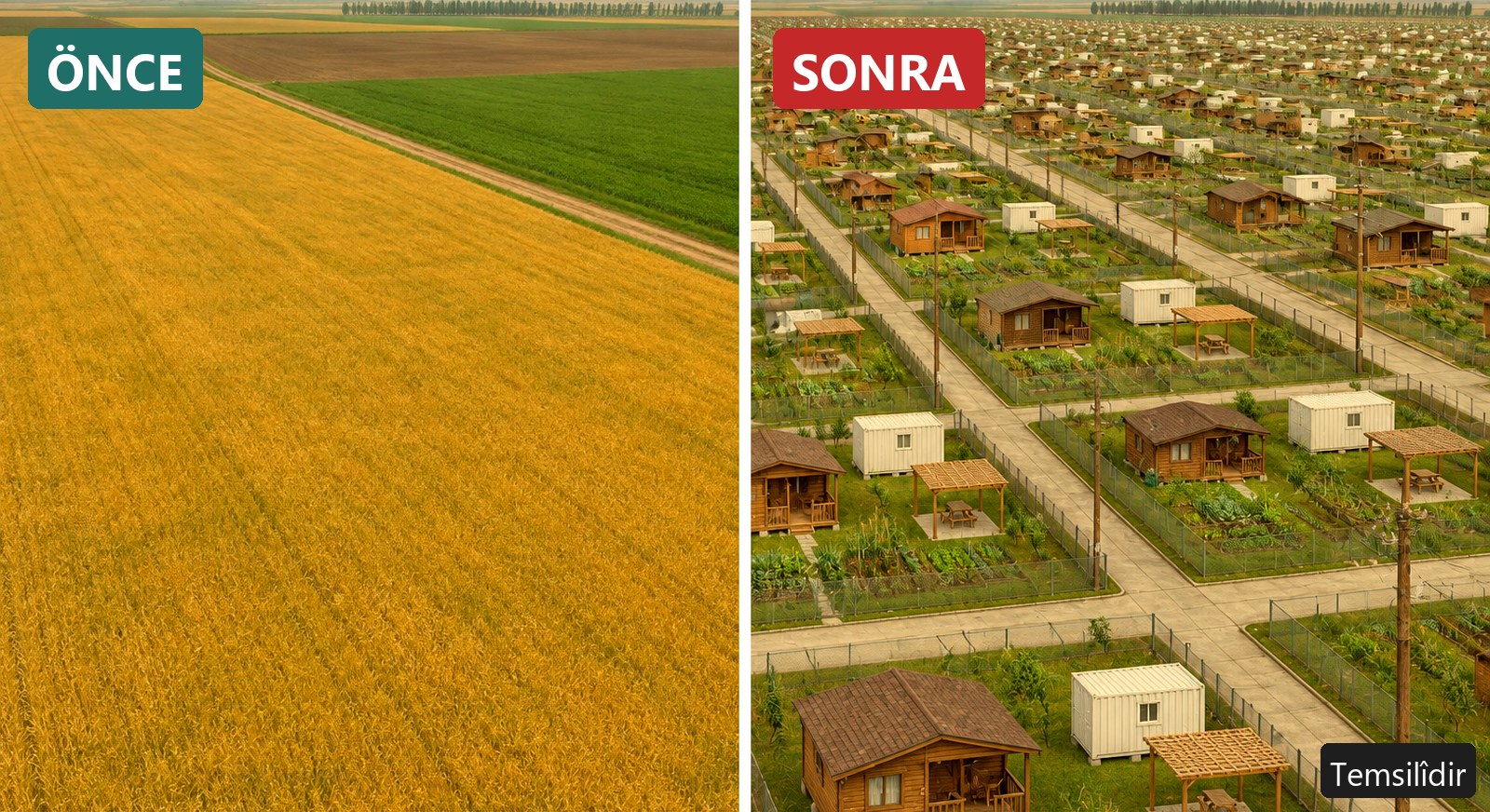
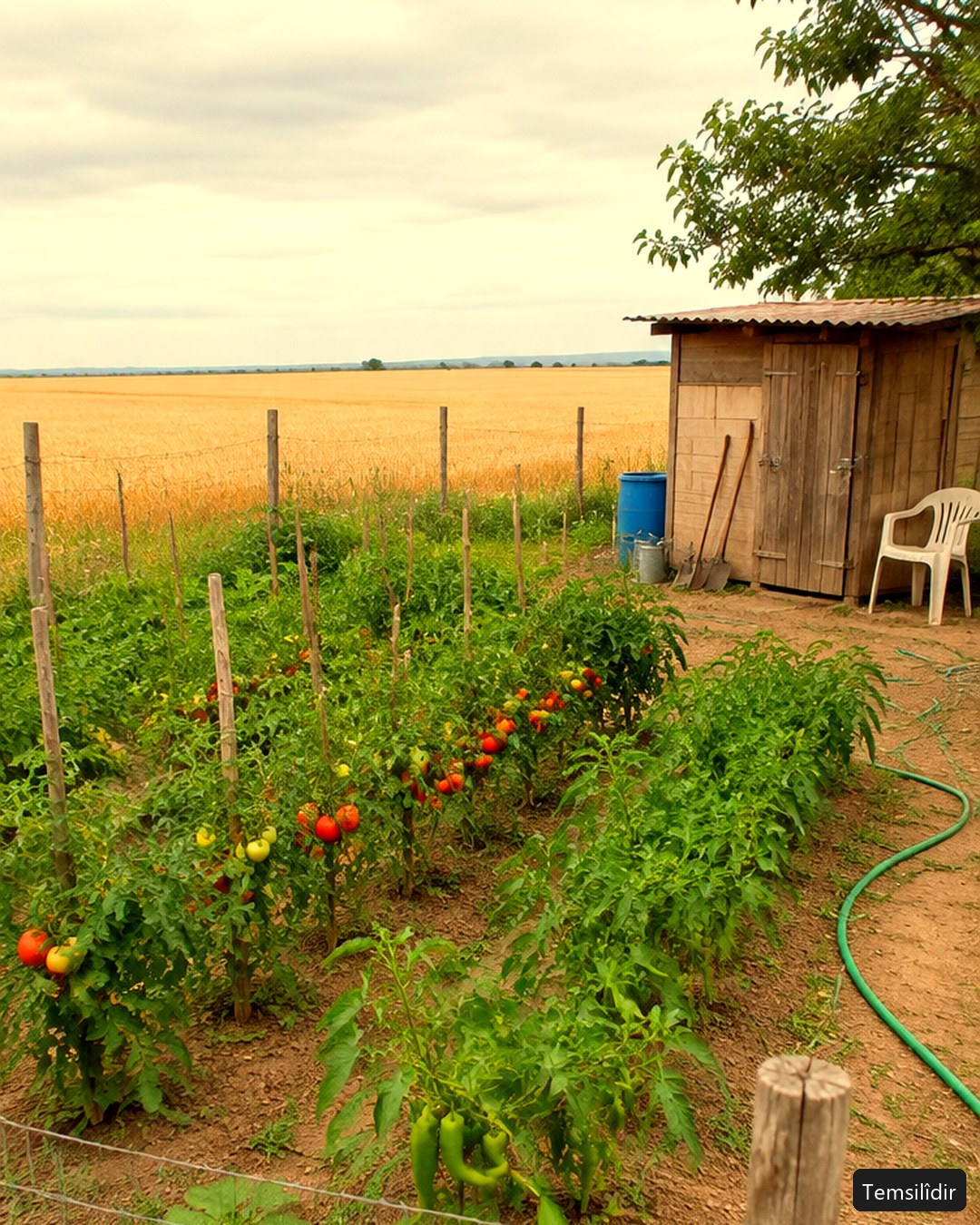
Escaping the city at the weekend to touch the soil, showing a child how a tomato ripens on the vine… That is where the appeal of the hobby garden (hobi bahçesi) idea comes from, and there is nothing wrong with this wish. The problem lies in the arrangement through which this wish is sold. In this article we explain, in the law's own words, why hobby gardens are banned, what the penalties are, the latest position in Parliament and at the Ministry, and why this arrangement has ceased to be an "innocent tomato garden".
What this article covers: the "hobby garden" arrangement in which agricultural land subject to Law No. 5403 is de facto divided and sold. Gardens that municipalities rent out on their own land, or sites designated for a different use in a zoning plan (imar planı), are not the subject of this article; you can find out the status of your parcel by obtaining its zoning status (imar durumu) from the municipality.
Are hobby gardens legal?
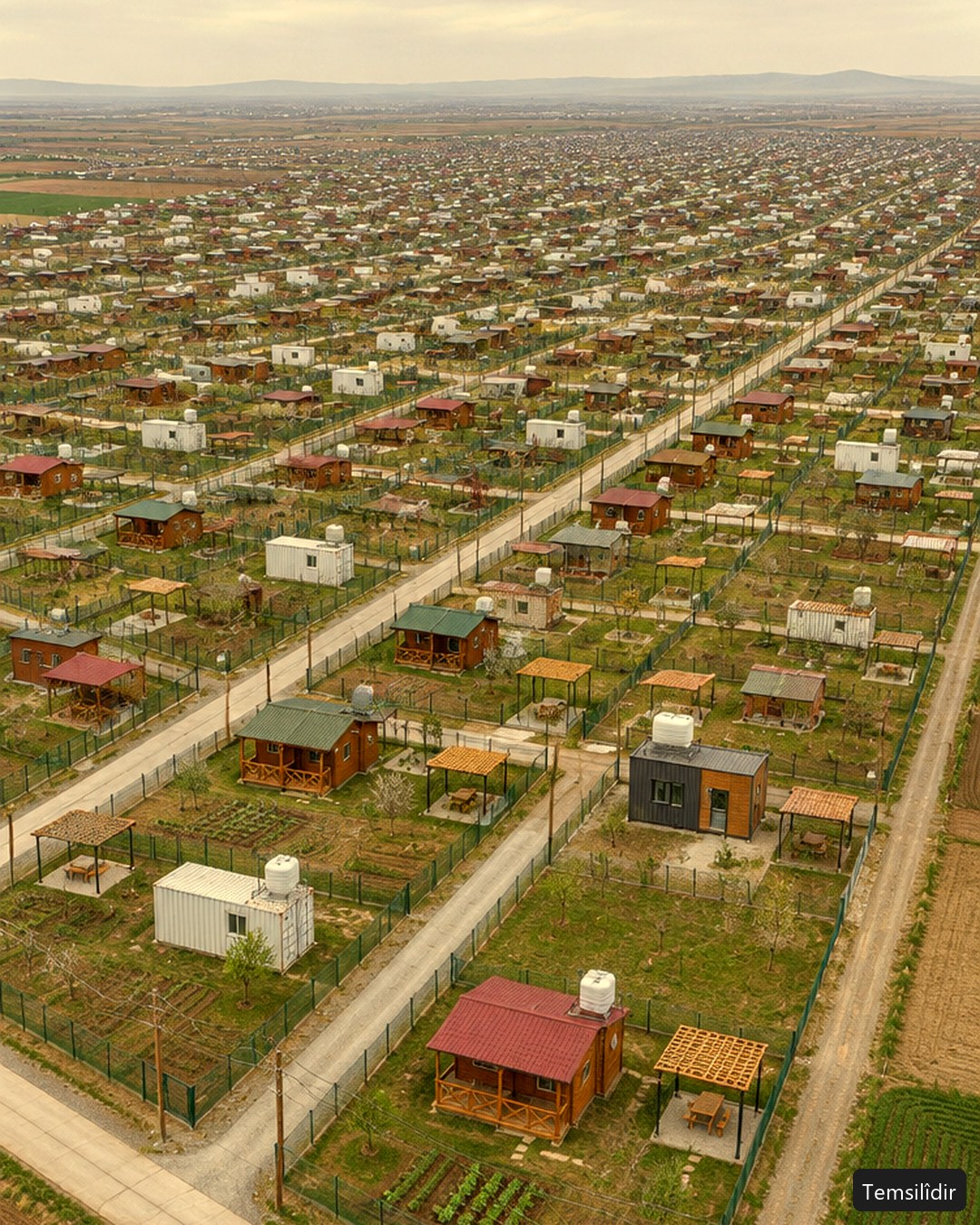
The concept of a "hobby garden" does not appear in the law; the term is found neither in Law No. 5403 nor in the Regulation on the Protection and Use of Agricultural Land (Tarım Arazilerinin Korunması ve Kullanılması Hakkında Yönetmelik). Whatever it is called, the law looks at how agricultural land is used. Growing vegetables and fruit on a field is an agricultural activity, and nobody needs permission for it. The arrangement sold under the name "hobby garden", however, usually consists of three steps:
A field that is a single parcel on the title deed is divided with wire fencing into plots of 300–500 square metres.
These plots are transferred without being separate parcels on the title deed: through cooperative membership or a company partnership, or by selling shares in the whole field.
Huts, containers, pergolas, concrete bases and water tanks are put up on the plots; then road access, electricity and water are requested.
The law puts an obstacle in front of every step of this arrangement: it prohibits dividing land on the title deed and creating shares below certain sizes, makes the transfer of de facto plots via a cooperative or company a criminal offence, and sanctions unauthorised buildings with fines and demolition. The Kastamonu Governor's Office (Valilik) reached the same conclusion in its 2023 public announcement: it is "not legal" for agricultural land acquired without permission in the name of legal entities such as cooperatives and companies to be "de facto divided and made available for use" with permanent structures (Kastamonu Governor's Office information notice).
Why are hobby gardens banned? The reasoning behind the law
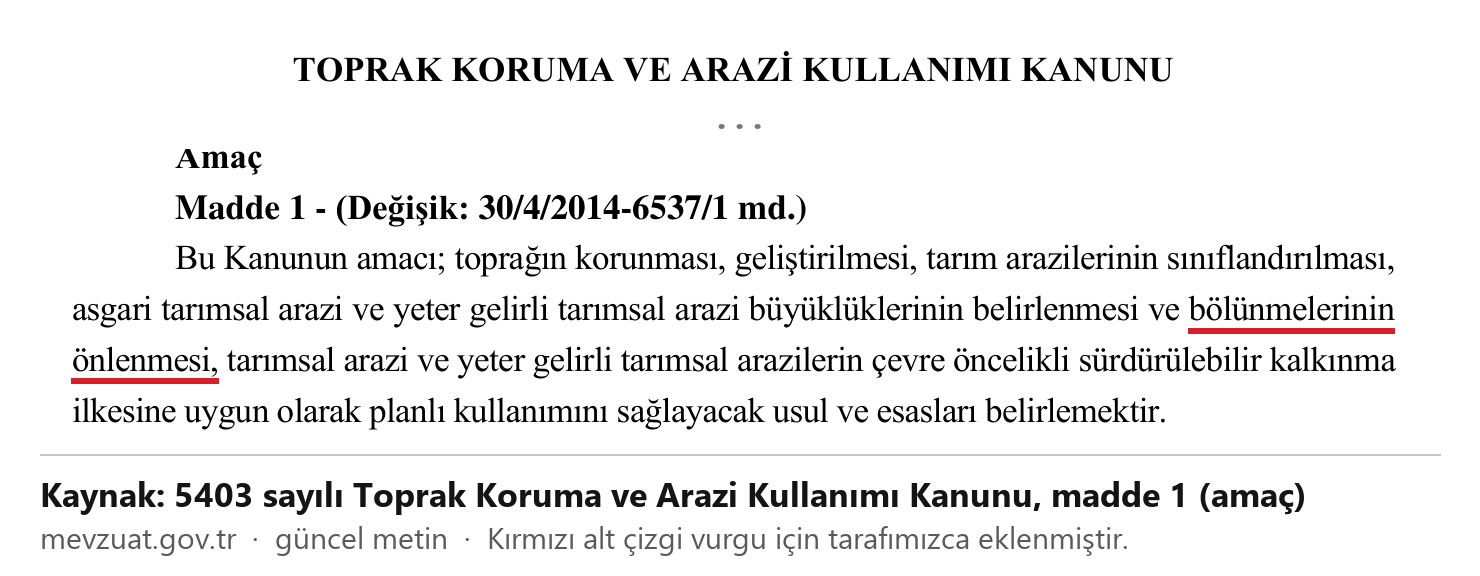
The answer is written in the very first article of the Soil Conservation and Land Use Law No. 5403 (5403 sayılı Toprak Koruma ve Arazi Kullanımı Kanunu). The purpose of the Law is to conserve soil, classify agricultural land, determine the minimum agricultural land size and the agricultural land size sufficient for an adequate income, and "prevent the division" of such land.
Why does division matter so much? Because a field that has become smaller never grows again. On land that is fragmented a little further with each generation through inheritance and sale, efficient mechanised production is impossible; the smaller the plot, the less likely it is that the field will remain a field. That is why the Law treats agricultural land that has reached a certain size as "indivisible property".
Below what size can a field not be divided into shares? Shares and subdivision are not the same thing
Under Article 8 of Law No. 5403, the minimum agricultural land size cannot be set below 2 hectares (20 dönüm; 1 dönüm = 1,000 m²) for absolute, marginal and special crop agricultural land (in everyday language, fields), 0.5 hectares (5 dönüm) for planted land such as vineyards and orchards, and 0.3 hectares (3 dönüm) for land under cover such as greenhouses; the Ministry may raise these limits. The Law states that agricultural land below these sizes "cannot be subdivided or divided into shares", and that the number of shares and shareholders cannot be increased.
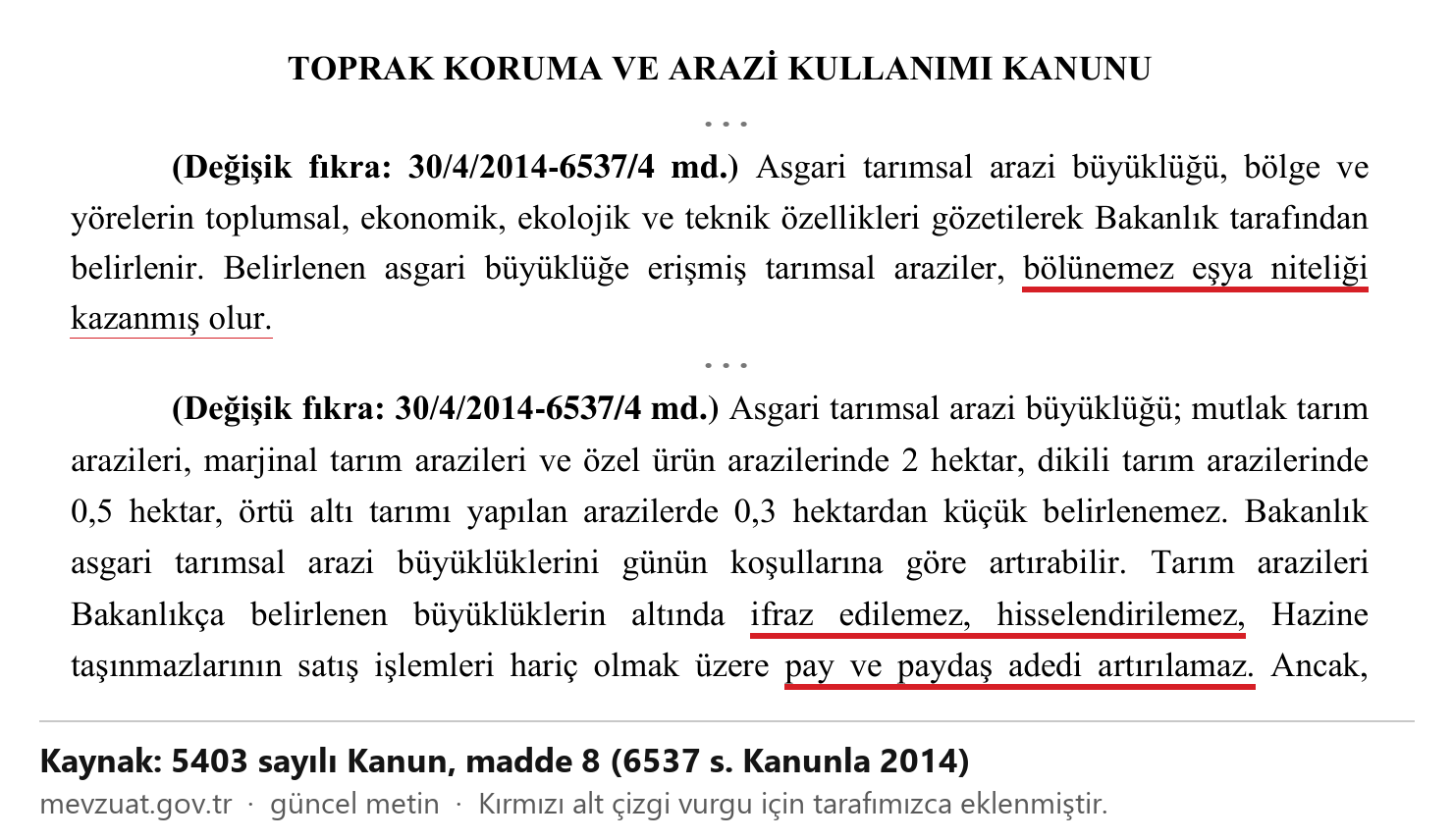
However, the yardstick for dividing a field into separate parcels on the title deed (parcel subdivision, ifraz) is not 20 dönüm: under Article 8/A of the Law, agricultural land cannot be subdivided below the agricultural land size sufficient for an adequate income (yeter gelirli tarımsal arazi büyüklüğü), which varies by district and is larger than these limits. Creating shares does not depend solely on 20 / 5 / 3 dönüm either; if the land is below the district's adequate-income size, it cannot be divided into shares (Article 6/5 of the Regulation on the Transfer of Ownership of Agricultural Land – Tarımsal Arazilerin Mülkiyetinin Devrine İlişkin Yönetmelik). Subdivision, division into shares and assignment of shares in agricultural land are subject to the Ministry's permission (Law No. 5403, Art. 8/B).
Note: 20 / 5 / 3 dönüm are the minimum agricultural land sizes in Article 8 of the Law and serve as the yardstick for shares. Both creating shares on the title deed and subdivision (dividing on the title deed) require the Ministry's permission and are subject to further conditions such as the district's adequate-income land size; the conditions for the two procedures are not identical. If you are going to carry out a procedure for your own field, consult an expert.
When a 20-dönüm field on a hobby garden site is divided into 40 plots, the 500 square metres each family receives is one fortieth of the smallest share size the Law sets for fields. A field that cannot be divided on the title deed ends up de facto divided by wire fencing.
Sales via a cooperative or company: who faces imprisonment?
The legislator anticipated this route too. Under a provision added to Article 21 of Law No. 5403 in 2020, those who create de facto shares in agricultural land that cannot be registered and transfer the use (possession) of these portions by establishing a membership or partnership relationship with a cooperative, company or other private-law legal entity, or who act as intermediaries in such dealings, face imprisonment of one to three years and a judicial fine if they have caused the integrity of the land to be broken up and the land to be used for purposes other than those intended. The legal entity is also given an administrative fine of between 50,000 and 250,000 TL as stated in the Law; these amounts were written in 2020 and are applied increased each year by the revaluation rate. If the integrity of the agricultural land is restored and the land is made suitable for agricultural production again, no prosecution is brought, and any case already opened is dropped.
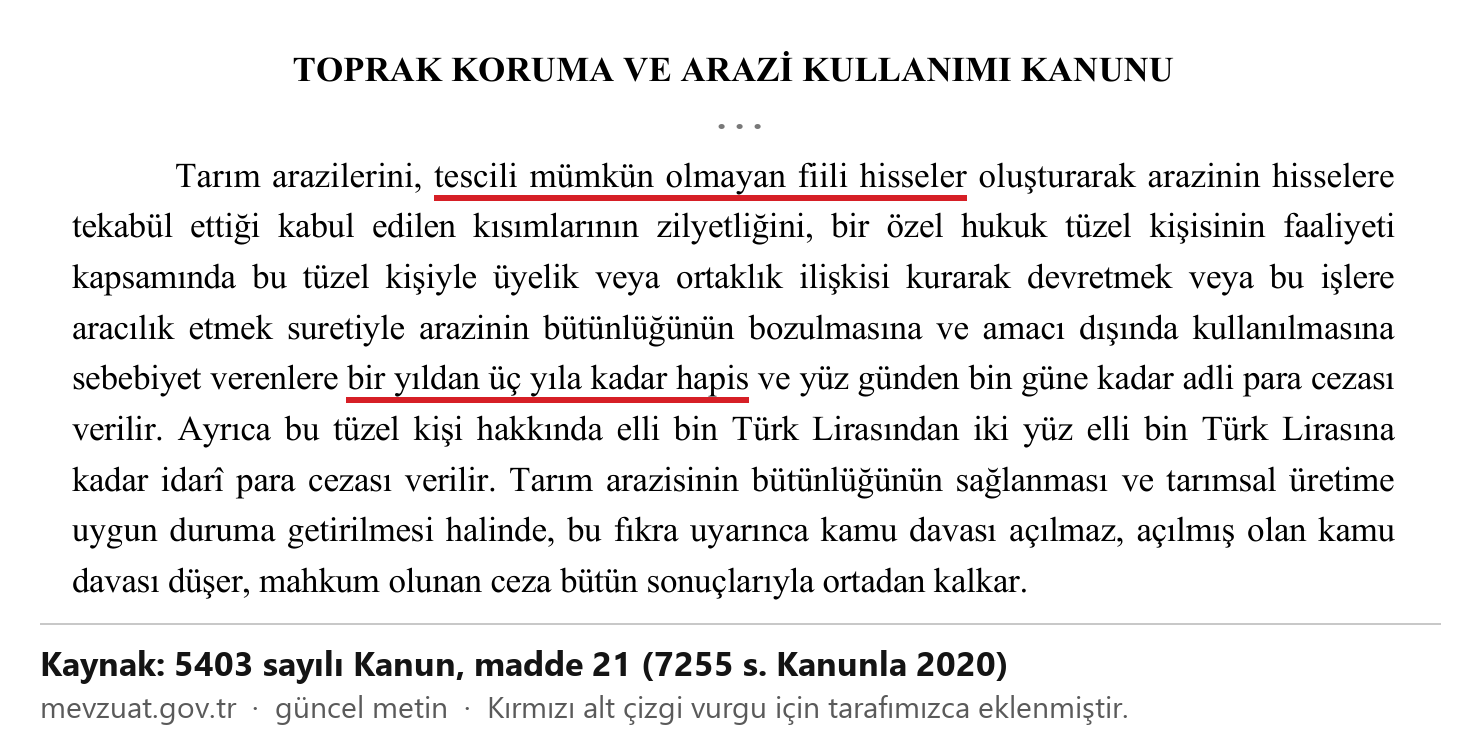
The wording of the provision matters: this prison sentence is aimed at those who divide and transfer land in this way and those who act as intermediaries. If you were sold a plot through cooperative membership, your name may not be on the title deed; on cooperative land, the owner is the cooperative. Check the title deed record to see whether what you bought is a share on the title deed or merely a membership. If you transfer the plot you bought to someone else in the same way, or act as an intermediary in a sale, you too may fall within the scope of this provision.
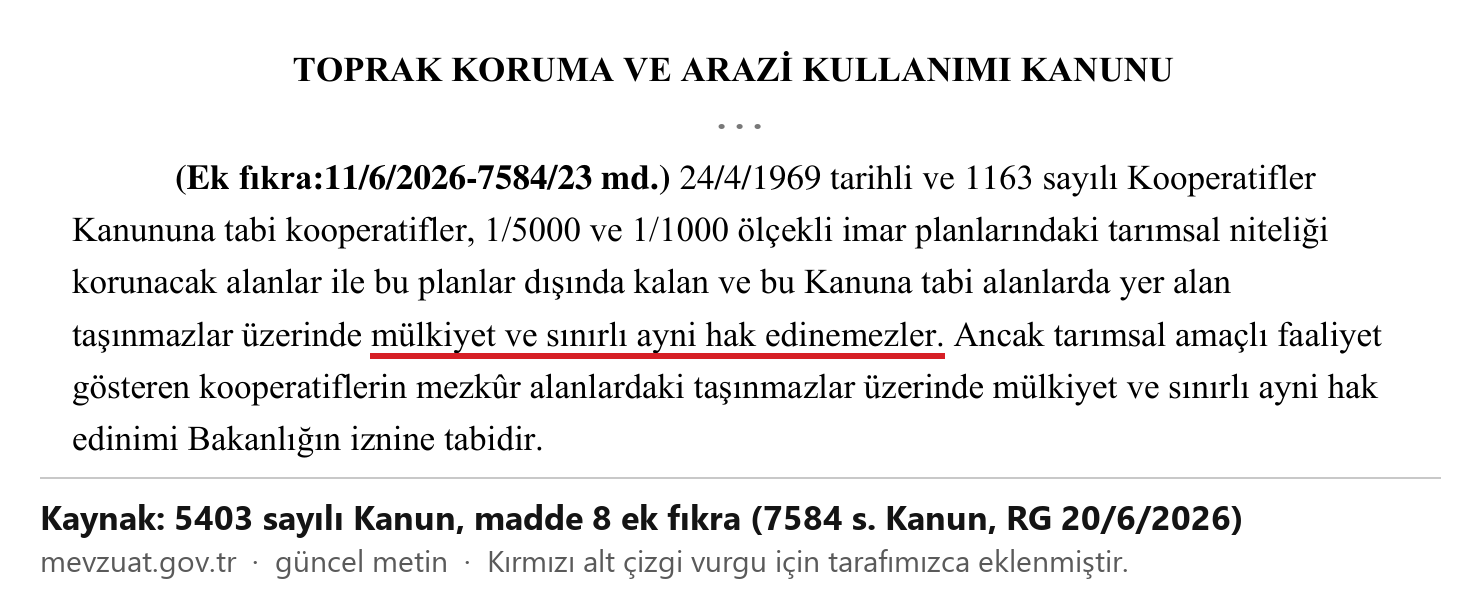
A further step was taken in June 2026: under a paragraph added to Article 8 of Law No. 5403 by Law No. 7584, cooperatives cannot acquire ownership or limited rights in rem over immovable property in areas whose agricultural character is to be preserved under zoning plans or in areas subject to Law No. 5403. Cooperatives engaged in agricultural activities may acquire them only with the Ministry's permission. This ban does not cover companies and introduces no separate provision for land already acquired; but transferring de facto plots via a cooperative or company is already an offence under Article 21.
Can you build a house, container or pergola on a hobby garden? What is the penalty?
Agricultural land may not be put to non-agricultural use without permission. A house, container, pergola, concrete base or pool takes the soil out of production; containers, tiny houses and prefabricated buildings also count as buildings. Unauthorised use is identified by the Provincial or District Directorate of Agriculture and Forestry (İl/İlçe Tarım ve Orman Müdürlüğü). Under Article 21 of Law No. 5403, if work is started without permission, the Governor's Office halts it; if the work has been completed, it does not allow it to be used, and the landowner or the person who has damaged the land is given an administrative fine of 2,500 TL for each square metre of the area used or damaged; in a large plain protection area (büyük ova koruma alanı) this fine is doubled. The fine is imposed by the local administrative authority, i.e. the provincial governor (vali) or district governor (kaymakam) (Art. 22). This is the 2026 amount, and it rises each year by the revaluation rate.
The fine is not calculated solely on the footprint of the house; the "area used" may also include the pergola, concrete base and road. Even a thirty-square-metre hut put up after June 2026 means 75,000 TL on its own.
Fifteen days: An application against an administrative fine imposed by the provincial or district governor may be made to the criminal court of peace (sulh ceza mahkemesi) within fifteen days of service at the latest; once this period has passed, the fine becomes final (Misdemeanours Law – Kabahatler Kanunu, Art. 27). An application for permission does not stop this period. Check the exact deadline in the notice served on you.
One month: An application for permission may be made within one month after the fine is served; within municipal boundaries and adjacent areas (mücavir alan) the application is made to the municipality, and outside them to the provincial special administration (il özel idaresi) (Regulation, Art. 5/2). Permission may be granted on condition that the permission under Article 13 or 14 of the Law is obtained; this is at the authority's discretion, and even if permission is granted, the fine is not cancelled. In practice, permission is not granted for a house on a hobby garden (see the vineyard house section below).
Two months: Those who do not apply, or whose permission is not approved, are given two months to remove the structures and make the land suitable for agriculture again.
Afterwards: If this is not done within the period, the activity is halted, a new fine of three times the first fine is imposed, and the municipality or provincial special administration demolishes the structures within one month; in metropolitan provinces there is no provincial special administration, so the municipality carries out the demolition. The cost of demolition and clearance is recovered from the person responsible.
The zoning side: A building without a building permit (yapı ruhsatı) is also given a zoning fine under Zoning Law No. 3194 (3194 sayılı İmar Kanunu); the deadline for bringing a case against the municipality's zoning fine and demolition order is, as a rule, sixty days from service, and the case is brought before the administrative court (Administrative Procedure Law – İdari Yargılama Usulü Kanunu, Art. 7; check the exact deadline in the notice served on you). Within municipal boundaries or in places subject to a special zoning regime, anyone who constructs an unlicensed building or has one constructed, even a buyer, also faces imprisonment under Article 184 of the Turkish Penal Code (Türk Ceza Kanunu). In metropolitan provinces, the boundary of the metropolitan municipality is the provincial boundary (Law No. 5216, Art. 3/a).
Is a municipal permit enough? No. On agricultural land, any agricultural or non-agricultural use first requires permission under Law No. 5403; the application is made to the municipality or the provincial special administration and is forwarded via the TAD Portal to the Provincial Directorate of Agriculture and Forestry (Regulation, Art. 5/2). A building permit issued without this permission does not replace the permission under Law No. 5403.
What will happen to structures built before June 2026?
The amount of 2,500 TL was introduced by Law No. 7584 in June 2026; the previous text stated "ten" lira per square metre. That amount was also applied increased each year by revaluation: the fine imposed in 2025 in the Kuyucak case below works out at roughly 75 TL per square metre. Under Article 21 of the Regulation on the Protection and Use of Agricultural Land, the administrative fine is applied on the basis of the date on which the misdemeanour was committed; if that date cannot be determined, the date of detection is used. So if your structure was built before June 2026, the lower amount in force at that time should apply; if the date it was built cannot be determined, the new amount may come into play. It is not certain that the old amount will apply to additions made after June 2026. That is why it is important to keep documents showing when the structure was built (invoices, contracts, dated photographs). This does not mean the structure is legal; it only affects the amount of the fine.
Are these penalties actually enforced?
Yes. For example, in the case that was the subject of the decision of the Court of Jurisdictional Disputes (Uyuşmazlık Mahkemesi) of 13 April 2026, on the grounds that a livestock facility, a storage building, a residential structure and a road had been built on 8,977 square metres of jointly owned agricultural land in the Kuyucak district of Aydın, one of the co-owners was fined in 2025 for the 980 square metres corresponding to their share: 74,051 TL at the old rate and then, when this was not rectified within the period, three times that amount, 222,152 TL. The co-owner objected, saying there was no structure on the land that they had built. The court only decided which jurisdiction these cases should be heard in (the ordinary courts); whether the fine was justified was not examined in that decision (Court of Jurisdictional Disputes, E.2026/134, K.2026/165). This is an example showing that, on a field with shared ownership, the other co-owners may also face the risk of a fine because of one co-owner's structure.
Demolitions have also begun on the ground. According to press reports, demolition of hobby gardens began in Polatlı, Ankara, on 29 July 2026 (Yeni Ankara); demolitions were also carried out in Mudanya, Bursa, in April 2026 (Cumhuriyet).
Can a hobby garden be connected to electricity and water?
No new connections are granted. Under a paragraph added to Article 21 of Law No. 5403 by Law No. 7584, no electricity, water or natural gas connection or subscription is to be provided to any building or facility constructed without permission under this Law. An institution that provides a subscription in breach of this paragraph is fined per subscriber; if the subscription is not cancelled within thirty days after the fine is served, a further fine is imposed for each month the subscription continues. The Law contains no separate transitional provision for subscriptions set up before June 2026. For details, see our article "Can a field be connected to electricity?".
Can't you get permission for a vineyard house on a hobby garden?
The known legal route for a house on agricultural land is the vineyard house (bağ evi; a small dwelling that may be permitted on agricultural land). Under Annex 1 of the Regulation, a vineyard house may be permitted on land of 2 hectares (20 dönüm) or more for absolute, special crop and marginal agricultural land, 1 hectare (10 dönüm) or more for planted land, and 0.3 hectares (3 dönüm) or more for land under cover, with a footprint of 30 square metres and two storeys. Only one vineyard house may be permitted on each parcel, and one vineyard house per family in the same district; on a jointly owned parcel the consent of the other co-owners is required. On a field shared by forty families, these conditions are not met. Details of the vineyard house conditions can be found in our article "Conditions for building a house on a field 2026".
We explained in our article "Is it forbidden to put a container, prefabricated house or tiny house on a field?" that containers, tiny houses and prefabricated buildings also count as buildings.
Will there be an amnesty for hobby gardens? The latest in Parliament and at the Ministry (November 2026)
Law No. 7584, adopted by Parliament in June 2026, raised the amount in Law No. 5403 and added the utility connection ban for unauthorised structures and the acquisition ban for cooperatives; it introduced neither an amnesty nor a new mass demolition provision for existing structures. According to a statement by the Minister of Agriculture and Forestry reported in the press on 5 May 2026, "There is no such thing as a hobby garden; there is illegal construction", and these places will not be given legal status (Halk TV, 5.5.2026; 24 Saat, 7.5.2026). On 6 November 2026 the Minister also said that the issue was "actually a zoning problem", that zoning was not his area of responsibility, and that a law had been passed by Parliament to prevent agricultural land from being spoilt by illegal construction (Yeniçağ, 6.11.2026; Diken, 6.11.2026).
According to press reports, various formulas for existing gardens, as well as proposals for a new model on the zoning side and for a Building Registration Certificate (Yapı Kayıt Belgesi), were discussed during 2026 (Habertürk, 23.4.2026); as of November 2026, none of these has become law. Neither Law No. 5403 nor Zoning Law No. 3194 contains any provision in force that legalises existing structures on hobby gardens. The last regulation in the nature of a zoning amnesty (imar affı), the so-called "zoning peace" (imar barışı), covered only structures built before 31 December 2017, and its application period ended long ago. If a new regulation is introduced, what it will cover cannot be known today.
The gecekondu lesson: what have amnesties taught us?
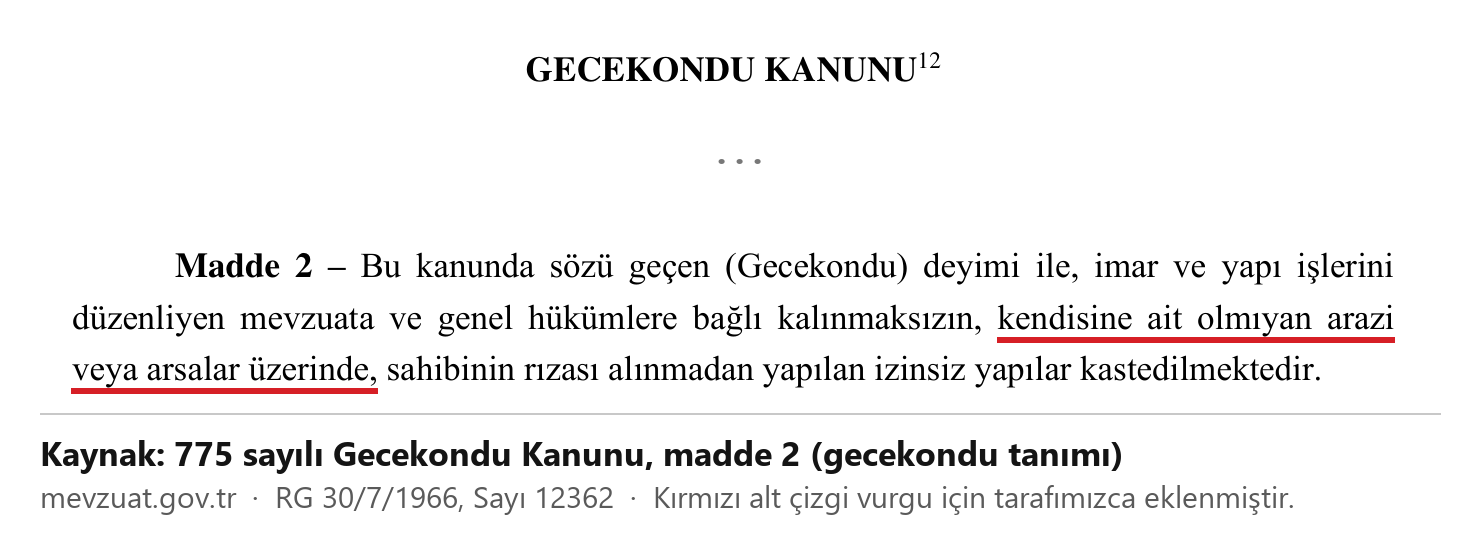
Legally, a hobby garden is not a gecekondu (informal squatter housing). The Gecekondu Law No. 775 of 1966 defines a gecekondu as an unauthorised building constructed in breach of zoning legislation "on land or plots not belonging to them", without the owner's consent. The family on a hobby garden, by contrast, is usually a co-owner of the land or is there with the consent of the cooperative or company that owns it.
The law is different, but the method is the same: first the unauthorised building, then the demand for services, and finally the expectation of legalisation. With gecekondu, the official skeleton of this path can be read in the legislation:
1966: Law No. 775 was passed with three aims: the improvement of existing gecekondu, their clearance, and "preventing the construction of new gecekondu" (Art. 1).
1984: Law No. 2981 introduced a new arrangement for buildings in breach of zoning and gecekondu legislation; this law opened the way to title allocation certificates (tapu tahsis belgesi) (as referenced in Provisional Article 16 of Law No. 3194).
2018: Provisional Article 16, added to Law No. 3194, granted Building Registration Certificates to unlicensed buildings constructed before 31 December 2017; it stated that these buildings "may be temporarily connected to water, electricity and natural gas".
Each arrangement had a cut-off date, and buildings constructed after it remained unauthorised. After the 1966 law, which was passed with the aim of prevention, new arrangements were needed again in 1984 and 2018.
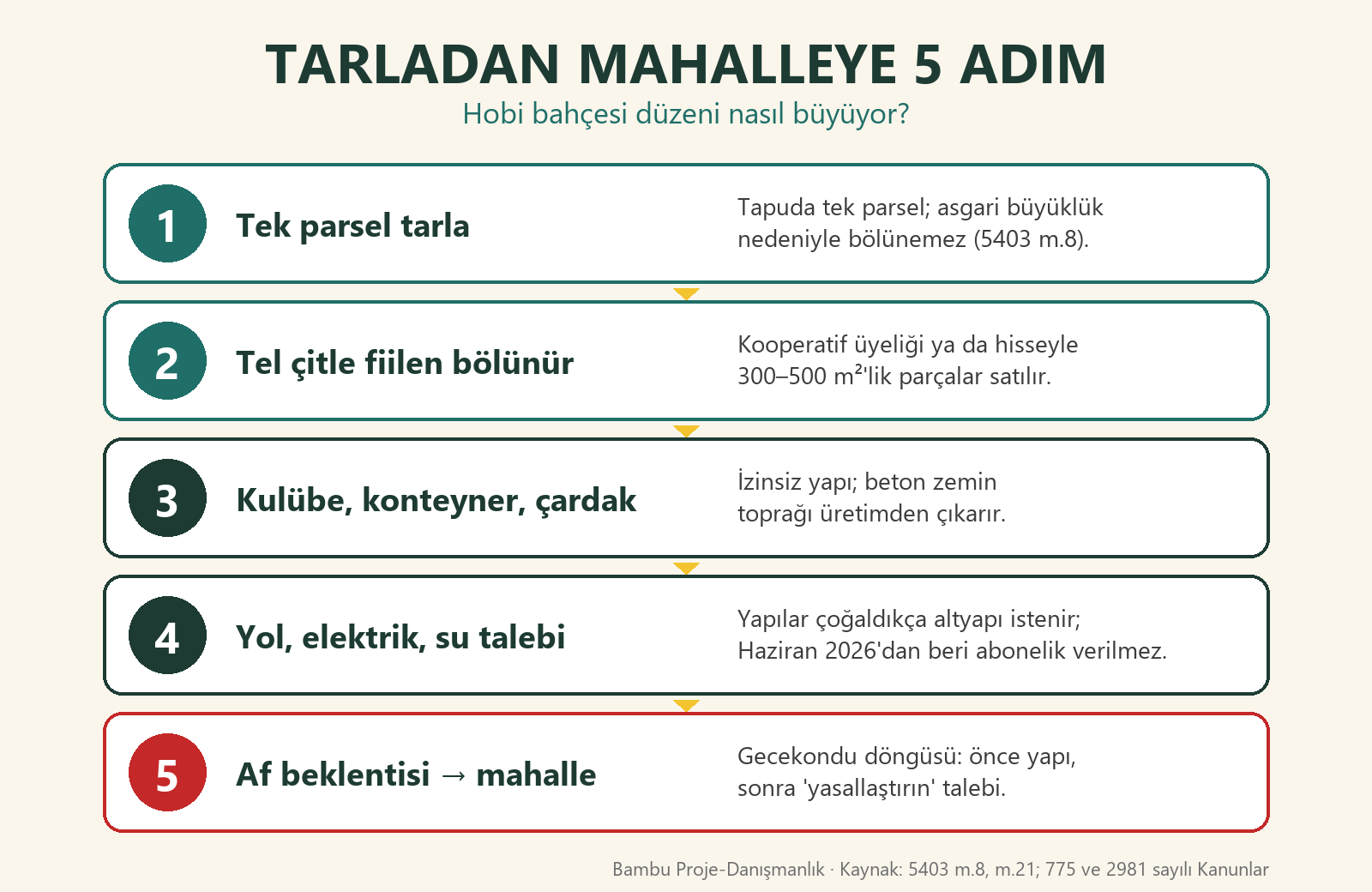
With hobby gardens, each of these steps is documented today: fields divided into plots with wire fencing, huts and containers and, as in Kuyucak, houses, storage buildings and roads; the utility connection ban added to the Law in 2026, and the legalisation proposals discussed for existing gardens. The 2026 cooperative ban and the utility connection ban target two links in this cycle: the sale of plots and the connection of services.
What should you do if you have a hobby garden or are thinking of buying one?
Before buying: If an advert says "with title deed", this often means a shared title deed (hisseli tapu; a share in a parcel that is not physically divided): your name is entered on the title deed, but what you have bought is a share in the whole field; the corner fenced off for you is not yours on the title deed, and you may also be fined because of another co-owner's structure. With cooperative or company membership, your name may not be on the title deed at all. Ask the seller for an up-to-date title deed record: if the annotations section (beyanlar hanesi) states "used for purposes other than the purpose of Law No. 5403", a breach has already been recorded on that land (Regulation, Art. 20/4). Promises such as "electricity will come" or "there will be an amnesty" are not a legal guarantee.
Do not put up new structures or enlarge existing ones: Every new square metre increases the area on which the fine is calculated.
Removing the structure reduces the penalty: If a structure is removed in time, the second fine of three times the amount and the cost of demolition do not apply.
Keep your documents: Contracts, payment receipts, and invoices and photographs showing when the structure was built can affect the amount of the fine.
Seek advice before submitting a petition: A petition submitted to the authorities may trigger the inspection process. Consult a lawyer or a specialist in the field before taking any step.
If a fine has been served, do not miss the deadlines: The deadline for objecting to an agricultural land fine imposed by the provincial or district governor is fifteen days from service, and the objection is made to the criminal court of peace. The deadline for bringing a case against the municipality's zoning fine and demolition order is, as a rule, sixty days, and the case is brought before the administrative court. Check the exact deadline in the notice served on you and consult a lawyer immediately.
Conclusion: this is not an innocent tomato garden
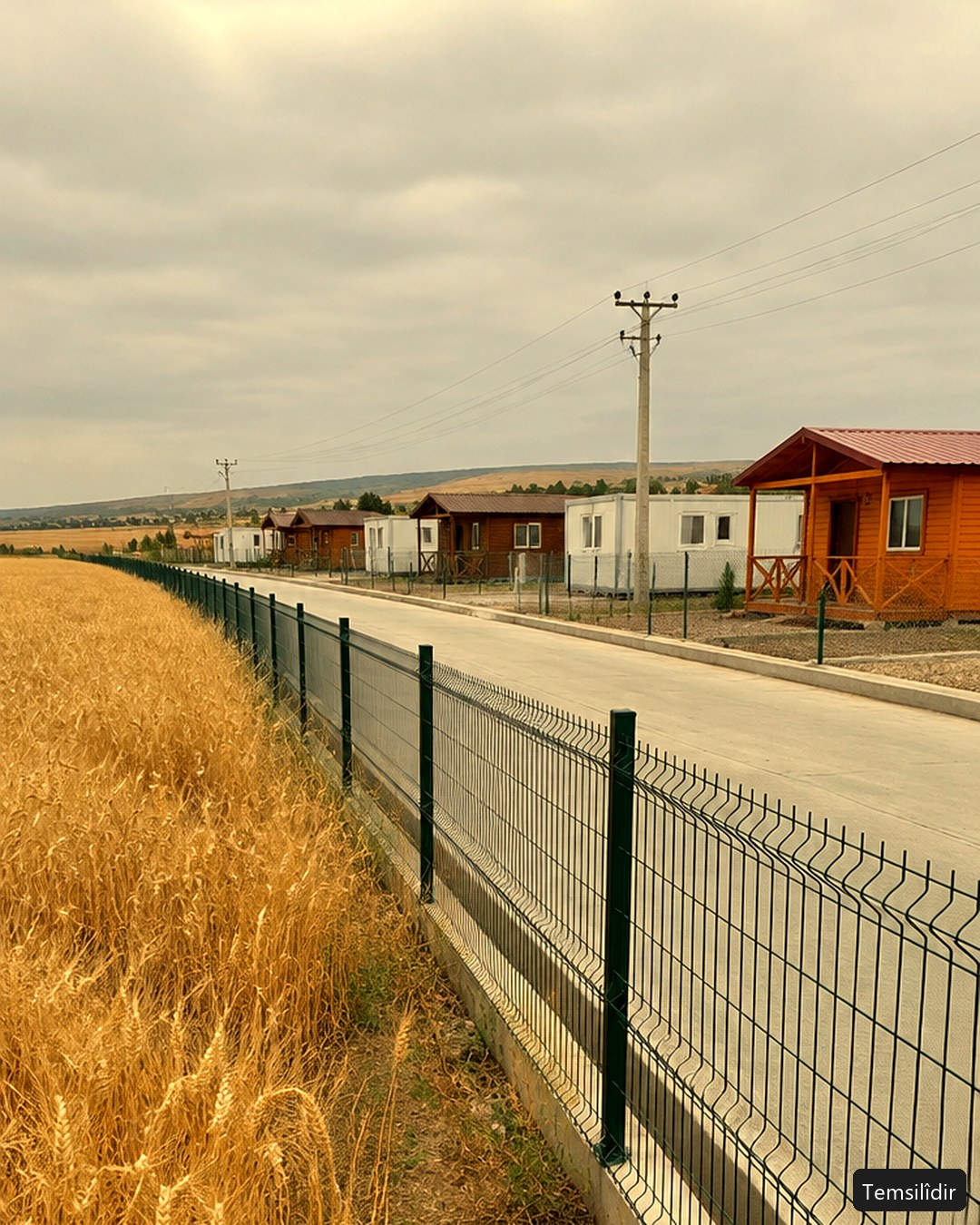
Forgive us for being blunt, but it needs to be said plainly: the arrangement sold today under the name "hobby garden" is not innocent tomato growing. The wish of families who want to touch the soil is innocent; the arrangement that sells that wish is not.
This arrangement divides, without recording it on the title deed, the very field that the Law seeks to keep from being divided. It usually sells families a membership or a share in the whole field rather than a separate parcel on the title deed, and with it comes the expectation that "electricity will come, and one day there will be an amnesty". Legally it is not a gecekondu, but the method is the same: settle first, then demand services, and finally wait for legalisation. Every step of this path is documented today: in Kuyucak, a house, a storage building and a road were built on a field; in 2026 a provision banning utility connections for unauthorised structures was added to the Law; and legalisation proposals were discussed for existing gardens. The Minister of Agriculture and Forestry had reached the same conclusion: "There is no such thing as a hobby garden; there is illegal construction." Türkiye has seen a similar path with gecekondu: unauthorised building was first banned, and then obtained documents and utility connections through date-limited arrangements.
The figures for the land are striking too. According to a table published by the Ministry of Agriculture and Forestry using TÜİK (Turkish Statistical Institute) data, the area of sown and planted agricultural land (excluding meadows and pastures) fell from about 26.4 million hectares in 2001 to about 24.0 million hectares in 2024; most of the decrease is in fallow land. There is no official data showing how much of this loss is due to construction. But a field that is not sown can be sown again; a parcel divided by wire fencing and covered in concrete does not easily return to agriculture.
The law that bans hobby gardens is not hostile to families who want a weekend garden. What it is trying to protect is the soil in which the bread on that family's table is grown. Instead of fuelling the expectation of an amnesty, those who want a garden need to be told about the legal routes: land that meets the vineyard house conditions, a rented field that is farmed without putting up any structures, or a village settlement area (köy yerleşik alanı; the designated built-up area of a village – see What is a village settlement area?). For those who already have a plot, the way forward is also clear: do not put up new structures, keep your documents and seek advice before taking any step.
Frequently asked questions
Is it forbidden to grow vegetables in a hobby garden?
No. What is forbidden is the de facto division of a field and its transfer plot by plot via a cooperative or company, and putting up unauthorised structures on the plots.
I bought a hobby garden – could I go to prison?
The prison sentence in Article 21 of Law No. 5403 is aimed at those who transfer land in de facto shares via a cooperative or company and those who act as intermediaries; if you transfer your membership or share to someone else in the same way, you too may fall within its scope. In addition, within municipal boundaries – which in metropolitan provinces means the entire provincial territory – anyone who constructs an unlicensed building or has one constructed faces imprisonment under Article 184 of the Turkish Penal Code. An administrative fine may also be imposed on the landowner or the person who damaged the land for an unauthorised structure put up on your parcel. Consult a lawyer about your own situation.
I have no structure on a jointly owned field – could I still be fined?
You could. In the Kuyucak case, a co-owner who said they had no structure of their own on the land was also fined in proportion to their share. The Court of Jurisdictional Disputes only decided that this case should be heard by the ordinary courts; whether the fine was justified was not examined in that decision.
Is it enough if I have a permit from the municipality?
No. Agricultural land requires permission under Law No. 5403, and a municipal permit does not replace this permission. If you have a permit, check whether the file contains the permission or a favourable opinion from the directorate of agriculture and forestry.
Do pergolas and concrete bases count towards the fine too?
The fine is calculated on every square metre of the area used or damaged; pergolas, concrete bases and roads may be included in this area.
Can I get an electricity connection for my hobby garden?
No. Since June 2026, unauthorised structures cannot be given electricity, water or natural gas subscriptions; if a subscription granted in breach of the Law is not cancelled, the provider is fined every month. The Law contains no separate transitional provision for subscriptions opened before June 2026.
Will there be an amnesty for hobby gardens?
As of November 2026, there is no regulation in force that legalises existing structures. The Minister has said that legal status will not be granted. If a regulation is introduced, what it will cover cannot be known today; building in the expectation of an amnesty is risky.
Is it safe to buy a hobby garden from a cooperative?
With cooperative membership, your name may not be on the title deed; on cooperative land, the owner is the cooperative. Since June 2026, cooperatives cannot acquire ownership or limited rights in rem over agricultural land subject to Law No. 5403; only agricultural cooperatives may do so, with the Ministry's permission. This ban does not cover companies; but transferring de facto plots via a cooperative or company is already an offence.
Sources
Soil Conservation and Land Use Law No. 5403, current text: Articles 1, 8 (including the additional paragraph introduced by Law No. 7584), 8/A, 8/B, 13, 21, 22 (Law No. 7584, Official Gazette (Resmî Gazete) 20/6/2026).
Regulation on the Protection and Use of Agricultural Land, Official Gazette 4/4/2026, No. 33214 (as amended on 4/8/2026, No. 33330): Articles 5/2, 20/4, 21; Annex 1, vineyard house.
Regulation on the Transfer of Ownership of Agricultural Land, Article 6/5 (amendment in the Official Gazette of 8/12/2021; current text on mevzuat.gov.tr).
Zoning Law No. 3194: Article 42; Provisional Article 16 (Law No. 7143, Official Gazette 18/5/2018, No. 30425).
Gecekondu Law No. 775, Official Gazette 30/7/1966, No. 12362: Articles 1, 2.
Law No. 2981 on Certain Procedures to Be Applied to Buildings in Breach of Zoning and Gecekondu Legislation and on the Amendment of an Article of Zoning Law No. 6785, Official Gazette 8/3/1984, No. 18335.
Misdemeanours Law No. 5326, Articles 17/7, 27.
Administrative Procedure Law No. 2577, Article 7.
Turkish Penal Code No. 5237, Article 184.
Metropolitan Municipality Law No. 5216, Article 3/a.
Court of Jurisdictional Disputes, 13/4/2026, E.2026/134, K.2026/165.
Ministry of Agriculture and Forestry, Agricultural Areas of Türkiye 2001-2024 (source: TÜİK).
Kastamonu Governor's Office, information notice on hobby gardens (3/1/2023).
Press: Halk TV, 5/5/2026; 24 Saat, 7/5/2026; Yeniçağ, 6/11/2026; Diken, 6/11/2026; Habertürk, 23/4/2026; Yeni Ankara, Polatlı; Cumhuriyet, Mudanya.
The photographs in this article are illustrative; they do not show a real location. This article is for general information only and does not constitute legal advice. For the specific situation of your land, consult a lawyer or a specialist in the field.