 Bambu Proje-Danışmanlık
What is a large plain conservation area? Houses, vineyard houses, barns, fines and the list of 468 plains (2026)
Last updated: 23 November 2026. The information is based on the current text of the law on mevzuat.gov.tr, the 2026 regulations and the designation decisions published in the Official Gazette (Resmî Gazete). A list of sources is given at the end of the article.
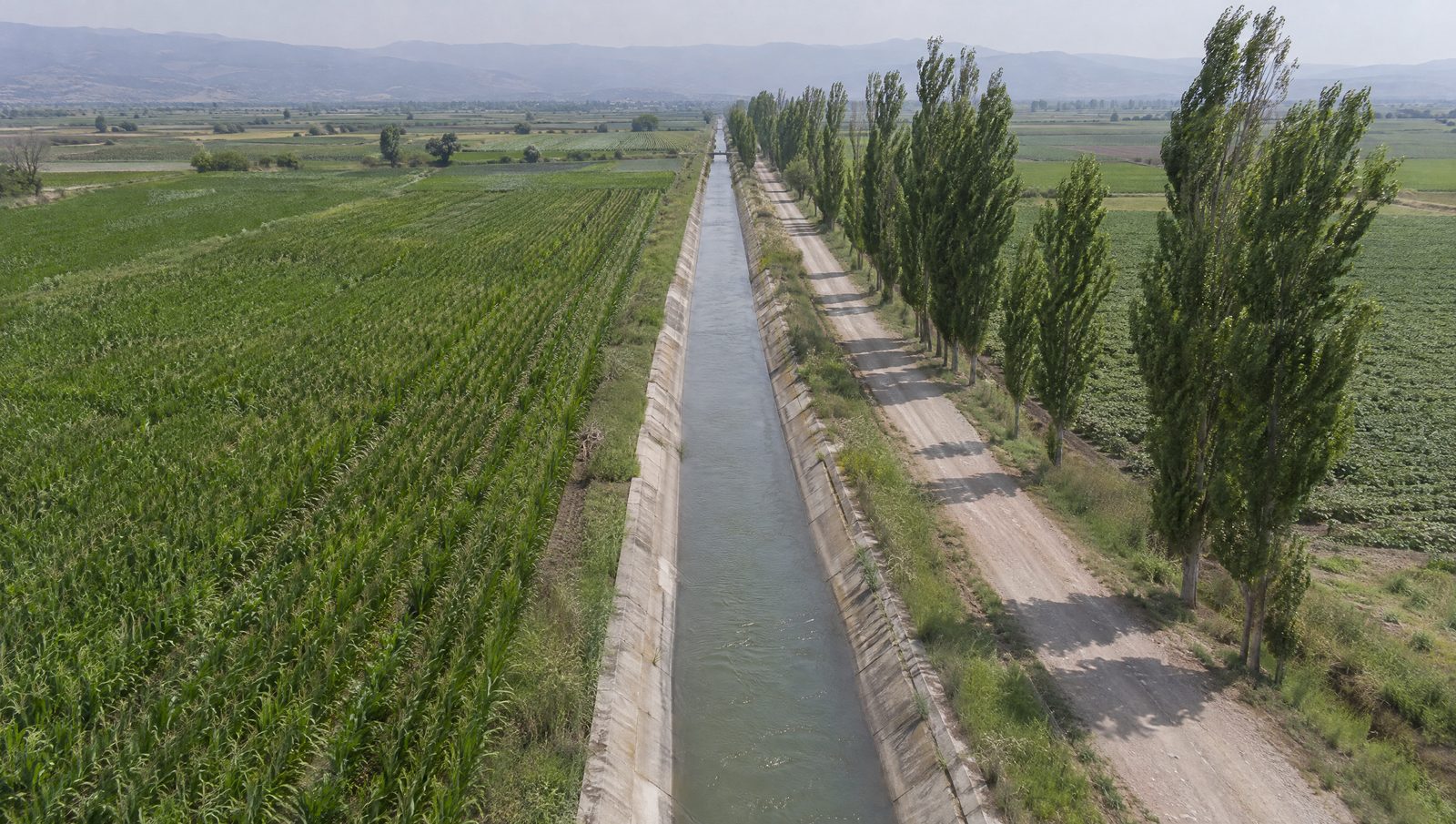
Short answer: A large plain conservation area (büyük ova koruma alanı) is a protection zone designated by Presidential Decision. It covers a plain whose soil loss is accelerating despite its high production capacity. Agricultural land in a large plain may not be used for any other purpose under any circumstances (Law No. 5403, Article 14). For this reason, no house may be built in a large plain. Agricultural buildings (tarımsal amaçlı yapılar) such as barns, storehouses, greenhouses and vineyard houses (bağ evi, a small dwelling permitted on farmland) may, however, be built with the permission of the Ministry of Agriculture and Forestry if the Soil Conservation Board (Toprak Koruma Kurulu) approves. For barns and storehouses, there is an additional condition that no other suitable site is available. The fine for an unauthorised building in a large plain is doubled: 5,000 TL per square metre instead of 2,500 TL.
What is a large plain conservation area?
Article 14 of the Soil Conservation and Land Use Law No. 5403 (5403 sayılı Toprak Koruma ve Arazi Kullanımı Kanunu) defines a large plain as a plain with high agricultural production potential where soil loss and land degradation are nevertheless accelerating. The causes include erosion, pollution, use for other purposes and improper use. After the Soil Conservation Board has given its opinion, these plains are designated "large plain conservation areas" by Presidential Decision. Until 2018 these decisions were made by the Council of Ministers; since then they have been made by the President.
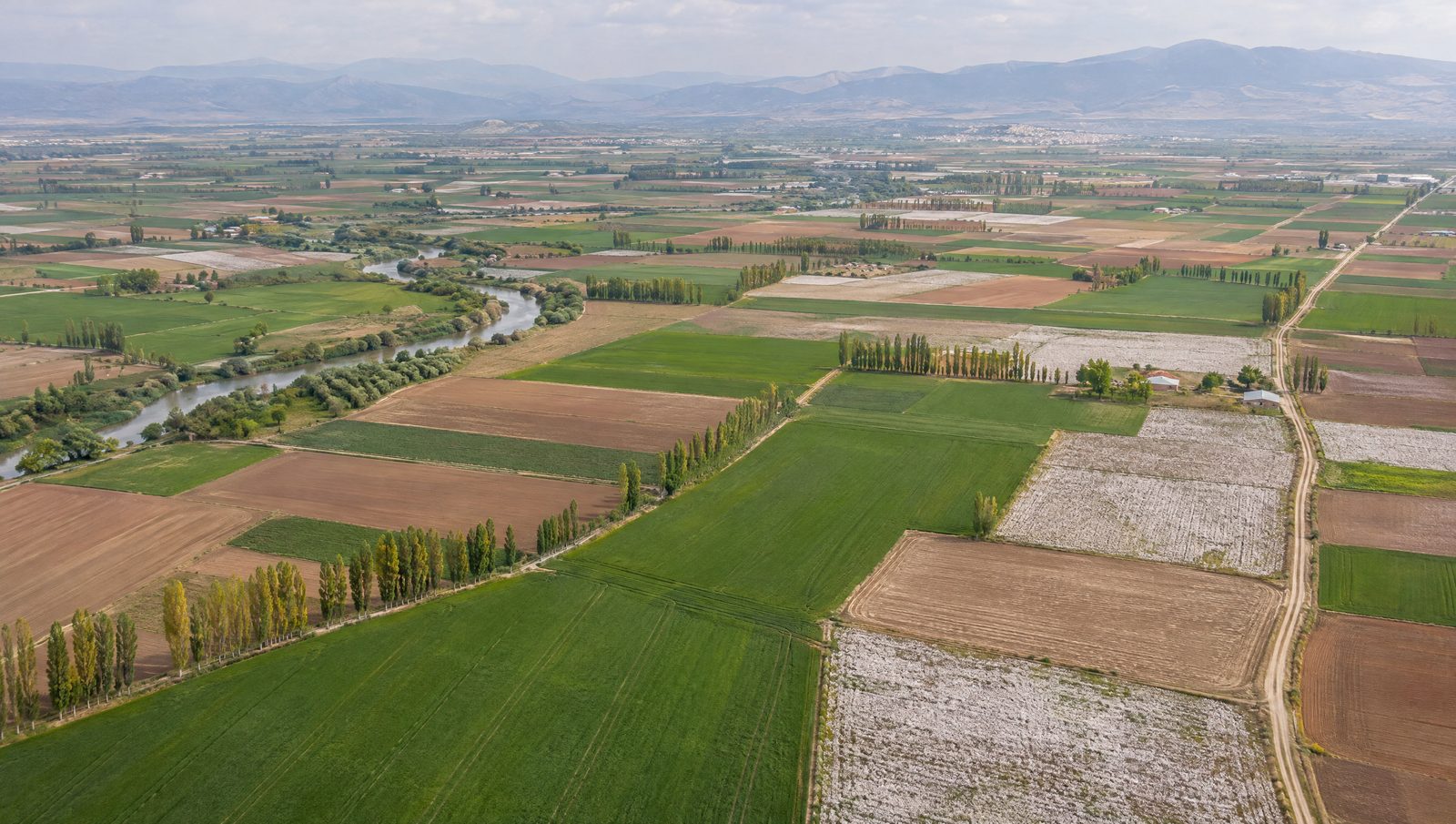
The aim is simple: to stop fertile plains from being lost to construction piece by piece. Imagine every parcel owner putting up whatever building they liked on their field in the plain. Within a few decades the plain would become a jumble of buildings with fields left in between. That is why the Law steers construction away from large plains.
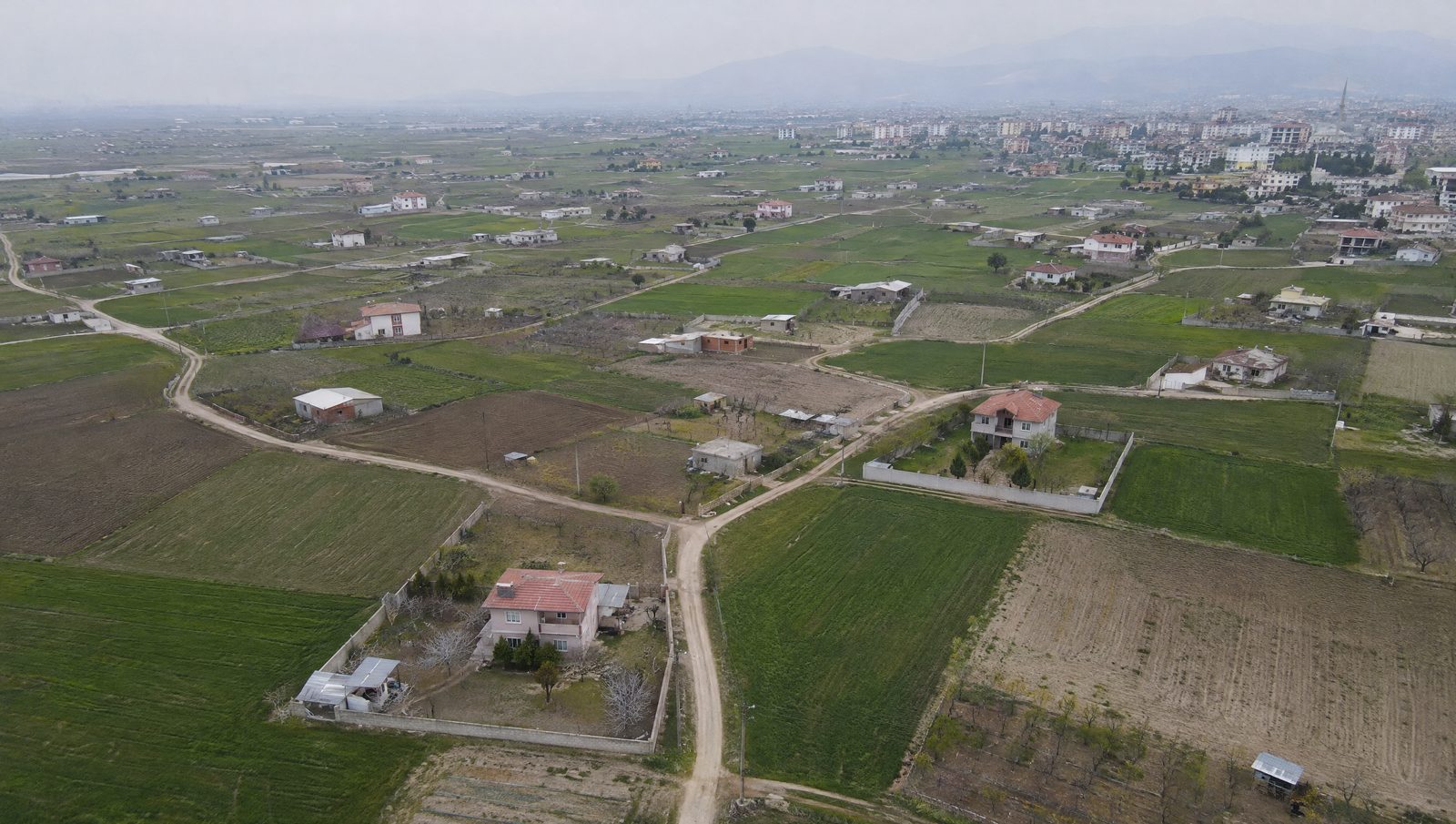
According to the Ministry of Agriculture and Forestry's 2025 Annual Administrative Activity Report, 468 large plains have been designated in 73 provinces, covering a total of 9,448,055 hectares. The full province-by-province list appears further down.
Who designates large plains? The first decision in the Official Gazette
The first large plain designation was Council of Ministers Decision No. 2016/9620 of 12 December 2016. It was published in the Official Gazette on 21 January 2017 and designated the plains shown in its annexed list and maps as large plain conservation areas. New plains were added in later years, and the boundaries of some plains were changed.
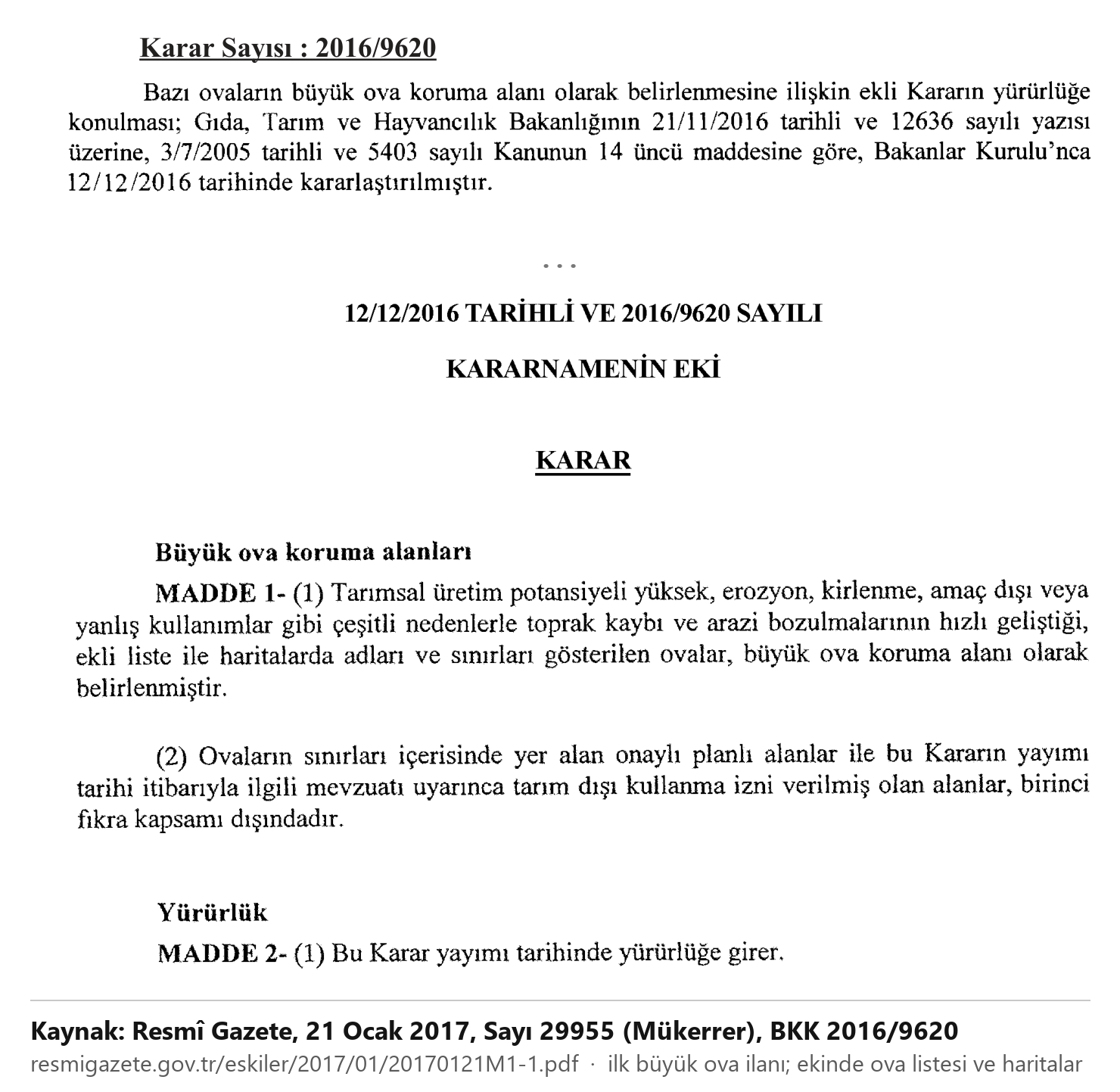
…the plains whose names and boundaries are shown in the attached list and maps have been designated as large plain conservation areas.
(2) Approved planned areas within the boundaries of the plains, and areas for which permission for non-agricultural use had been granted under the relevant legislation as of the date of publication of this Decision, fall outside the scope of the first paragraph.
The second paragraph is important. Some areas are exempt from this restriction even if they lie within a plain's boundary: areas with an approved zoning plan (imar planı), and areas that already had permission for non-agricultural use (tarım dışı kullanım) on the date the decision was published.
What does a "large plain conservation area" annotation on the title deed mean?
The Regulation on the Implementation of Land Use Planning (Official Gazette, 4 April 2026, No. 33214, Article 13/2) covers parcels within a large plain boundary. For these parcels, the Governor's Office (Valilik) asks the land registry office to place an annotation in the declarations section of the land register stating that the parcel falls within the large plain area. If your title deed (tapu) carries a declaration such as "lies within a large plain conservation area", your parcel is inside the boundary of a designated plain.
This annotation does not prevent sale or inheritance: you can sell the land, leave it to your heirs and farm it. What is restricted is how you use the land. If you want to use it for non-agricultural purposes or build on it, the strict rules below apply.
Is my land in a large plain? How can I find out?
Check the declarations section of the title deed record. If there is a large plain annotation, it will be shown there. The annotation may not have been entered yet, however, so its absence alone is not conclusive.
Ask the Agricultural Infrastructure Branch of the Provincial Directorate of Agriculture and Forestry (İl Tarım ve Orman Müdürlüğü). The Agricultural Infrastructure Branch of the Provincial Directorate responsible for your area can tell you the current plain boundaries. Submit a petition giving your block and parcel numbers and ask whether the land lies within a large plain conservation area. This is the most reliable answer.
Look at the decision maps in the Official Gazette. Each designation decision has an annexed map, with scale and coordinates, showing the plain boundary (links in the list below). The maps are small-scale and cannot be read at parcel level. For parcels near the boundary, you need to ask the Agricultural Infrastructure Branch.
Can you build a house in a large plain?
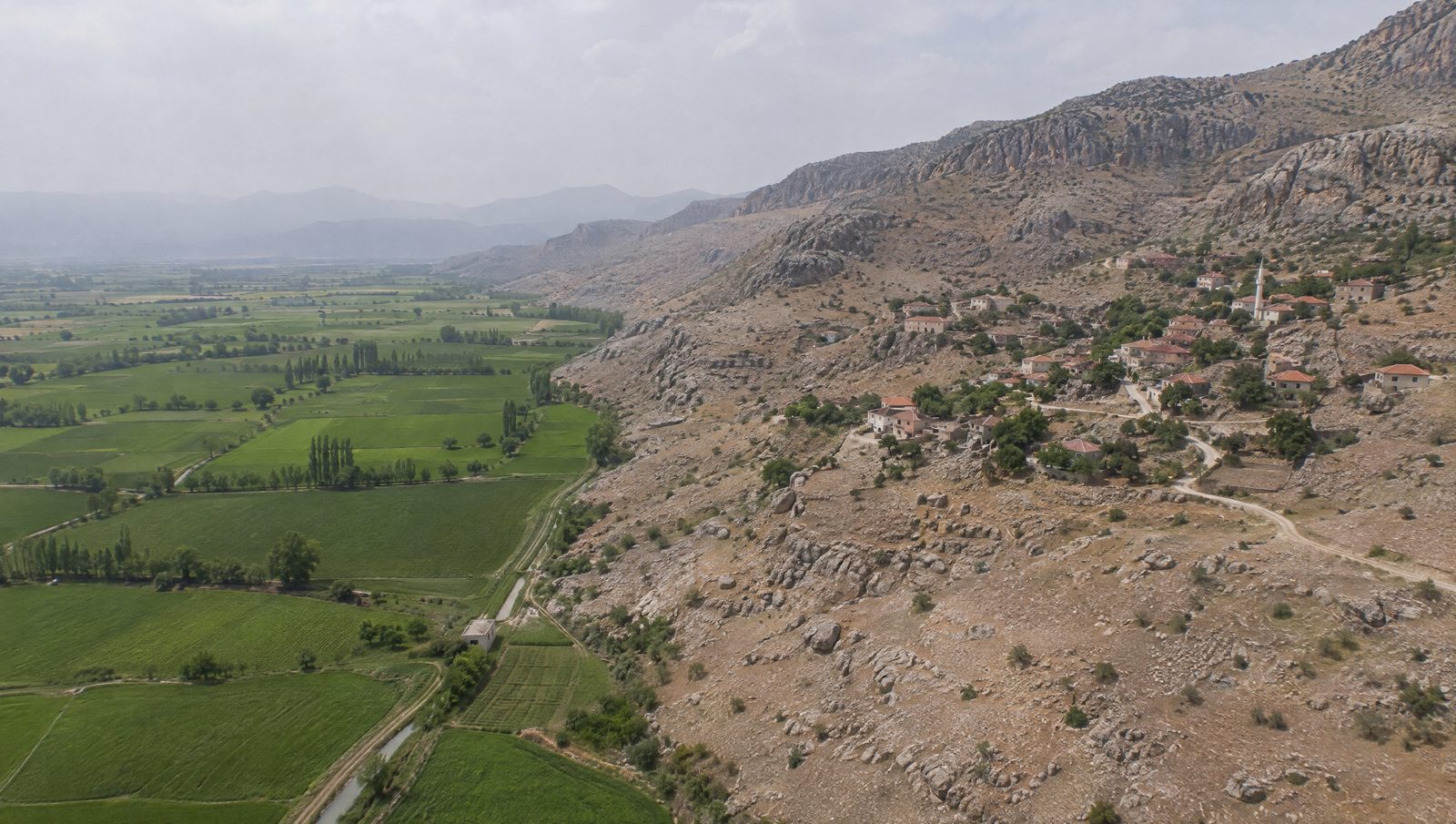
No. A dwelling is not an agricultural building. The Law allows only two exceptions for non-agricultural use in large plains, and neither covers a private dwelling:
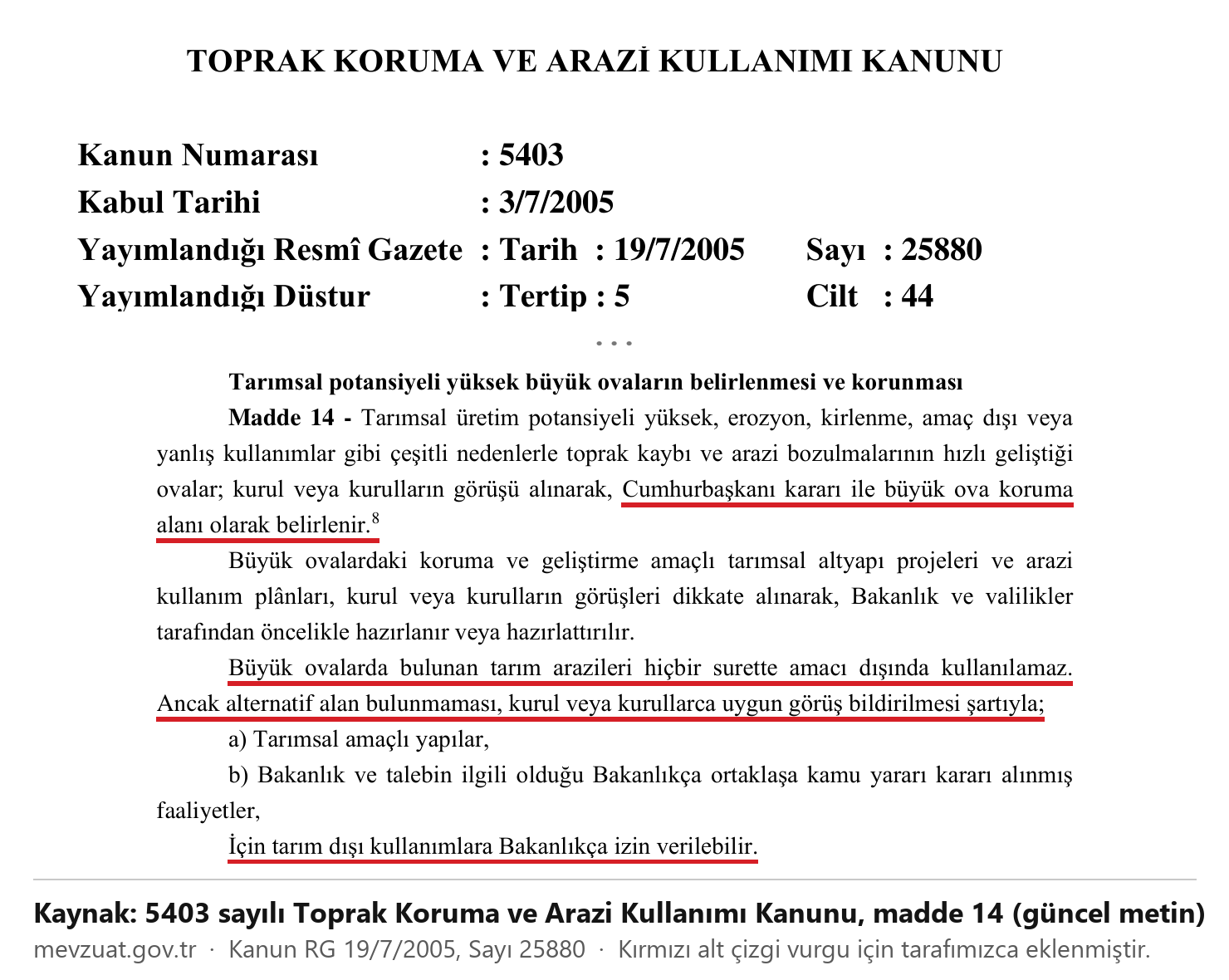
Agricultural land in large plains may not be used for any other purpose under any circumstances. However, provided that no alternative site is available and the board or boards give a favourable opinion, the Ministry may grant permission for non-agricultural use for: a) agricultural buildings, b) activities for which a joint public interest decision has been taken by the Ministry and the Ministry to which the request relates.
Containers, prefabricated houses and tiny houses also count as buildings if they are fixed to the ground, connected to water, electricity or a septic tank, or intended for permanent residence (Zoning Law No. 3194, Article 5: "fixed and movable installations"). They therefore fall under this rule. Whether a caravan counts as a building is a separate, disputed question. For details, see our article on containers and tiny houses on farmland and our caravan article.
The exception is the village settlement area (köy yerleşik alanı, the officially approved built-up area of a village). Two kinds of area fall outside this restriction: land within village settlement area boundaries approved by the provincial administrative board, and areas with a zoning plan in force that was approved with permits in accordance with the Zoning Law (Regulation on the Protection and Use of Agricultural Land, Article 15/2). For the rules on building a house within a village, see our article on village settlement areas.
Can you build a vineyard house in a large plain?
Under the 2026 Regulation, a vineyard house counts as an agricultural building. It is therefore not prohibited in a large plain, but obtaining permission involves a stricter procedure:
The minimum land size is the same as outside the plain. What counts is the class of the land, not the land type recorded on the title deed: at least 20 dönüm (1 dönüm = 1,000 m²; 2 hectares) on absolute, special crop and marginal agricultural land; at least 10 dönüm (1 hectare) on planted agricultural land (vineyards, orchards); and at least 3 dönüm (0.3 hectares) under cover. The footprint is 30 m², with a maximum of two storeys. Irrigated agricultural land does not appear in this list. Irrigated land is common in large plains, so find out your land's class in advance.
The application goes on the agenda of the Soil Conservation Board. Permission is granted by the Ministry of Agriculture and Forestry, not by the Governor's Office.
No alternative site is required for vineyard house and greenhouse applications (Regulation, Annex 1).
All the requirements and application steps for a vineyard house are set out in our article on the conditions for building a house on farmland.
Can you build a barn, storehouse, greenhouse or farm in a large plain?
Yes, but the conditions are stricter than for land outside the plain. For agricultural buildings such as barns, sheep pens, produce stores and equipment sheds, all three of the following conditions must be met:
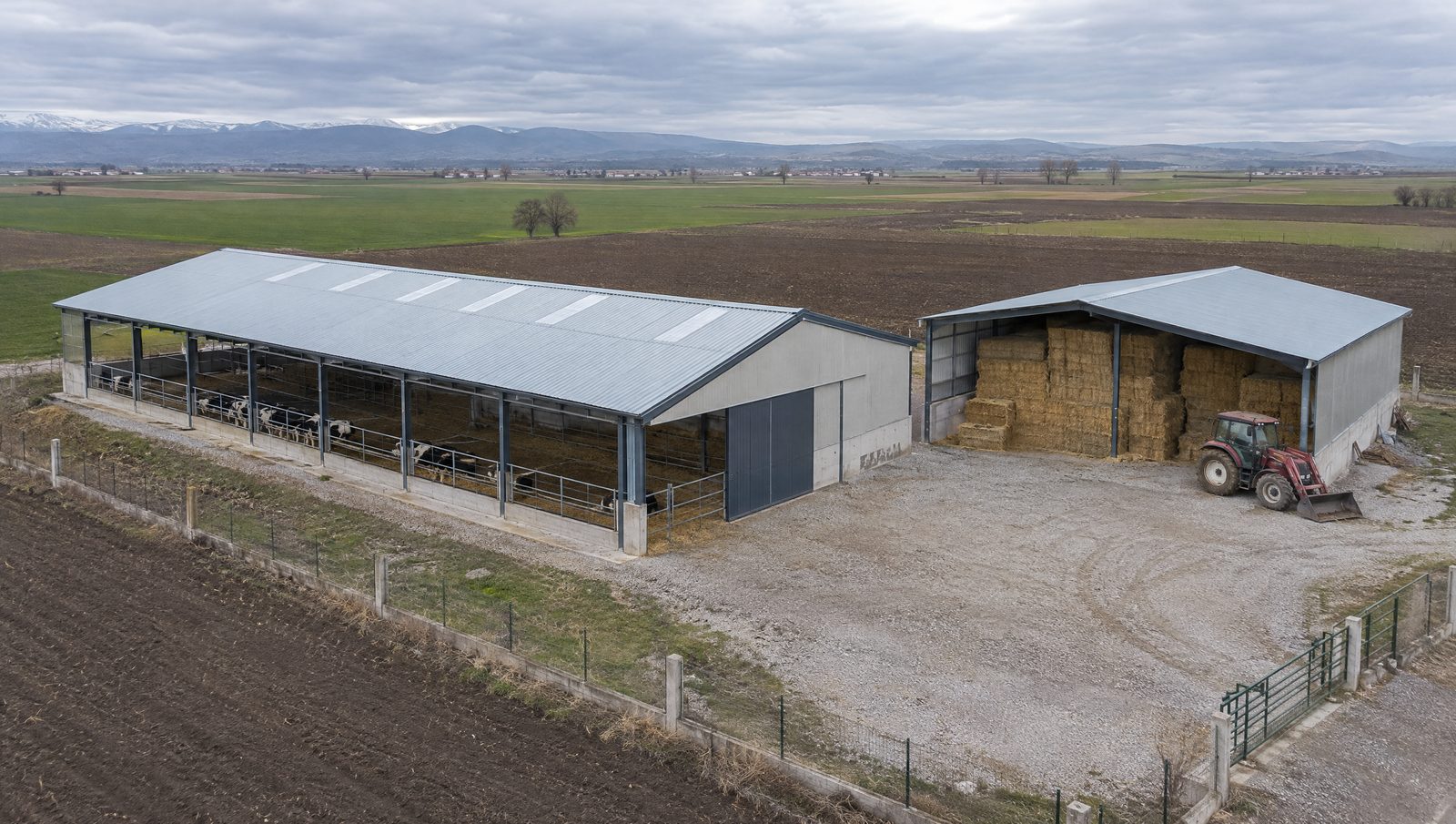
No alternative site is available. The authorities first try to meet the need from your family's land outside the plain or from the agriculture-based specialised organised industrial zone in the same district. To do this, they check the family's land holdings on the TAD Portal. No alternative site is deemed to exist if the same district has neither land outside the large plain nor low-productivity land within it. Parcels held under a shared title deed (hisseli tapu, co-ownership of undivided shares) do not count as alternatives.
A favourable opinion from the Soil Conservation Board. Requests for agricultural buildings outside the plain are decided by the Governor's Office without going to the board. Requests in large plains, by contrast, are placed on the board's agenda (Regulation, Article 12).
Permission from the Ministry of Agriculture and Forestry. Permission is granted by the Ministry, not by the Governor's Office.
For greenhouse and vineyard house applications, however, the Regulation does not require an alternative site (Annex 1). For these, the board's favourable opinion and Ministry permission are enough. Article 14 of the Law applies the alternative site requirement to all agricultural buildings, so this concession comes from the Regulation, not the Law.
Livestock facilities such as barns and sheep pens may also include a caretaker's house as an ancillary building. Under Annex 1, for a barn of 550–1,500 m², the caretaker's house may not exceed a footprint of 75 m² or a total floor area of 150 m². For larger barns these limits are 150 and 300 m². Similar rules apply to sheep pens and aquaculture facilities. A caretaker's house is not a separate dwelling but part of the livestock facility. In a large plain, it goes through the same permission procedure as the facility.
If part of your land lies outside the plain boundary, the two parts are assessed separately. If the building can be accommodated on the part outside the plain, it must be built there (Regulation, Article 15/5). If someone leases your land in order to build on it, additional conditions apply: for example, the lease must run for at least ten years and be registered on the title deed.
For the project and permission process for such buildings, see the examples in our article on Law No. 5403.
Fine for unauthorised building in a large plain: why double?
Under Article 21 of Law No. 5403, an unauthorised building incurs an administrative fine of 2,500 TL for every square metre of the area used. In large plain conservation areas this fine is doubled.
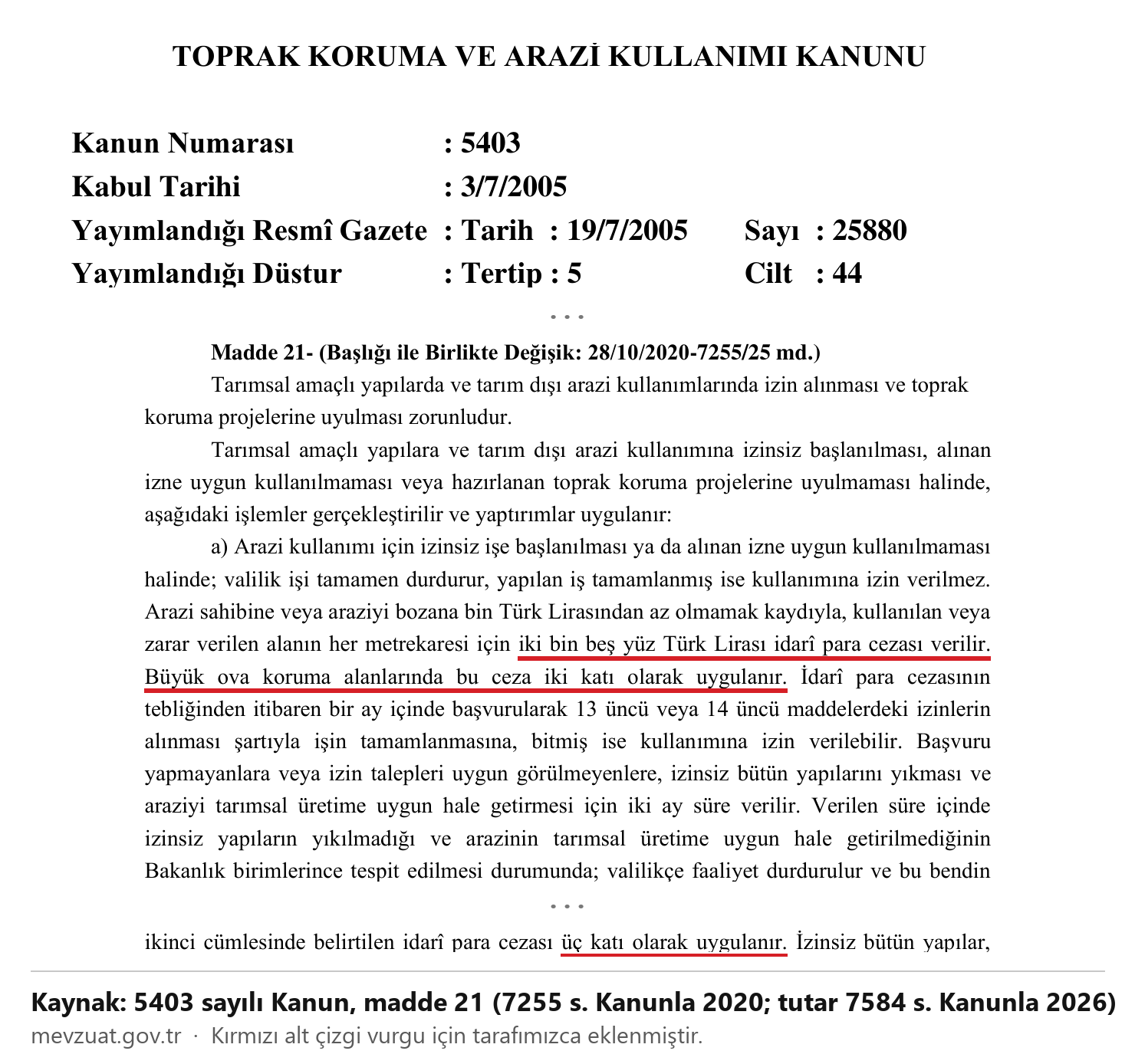
…an administrative fine of two thousand five hundred Turkish lira is imposed for each square metre of the area used or damaged. In large plain conservation areas this fine is applied at double the amount.
The 2,500 TL amount was introduced by Law No. 7584, which entered into force on 20 June 2026. The previous amount in the text of the Law was 10 TL per square metre, increased each year in line with the revaluation rate:
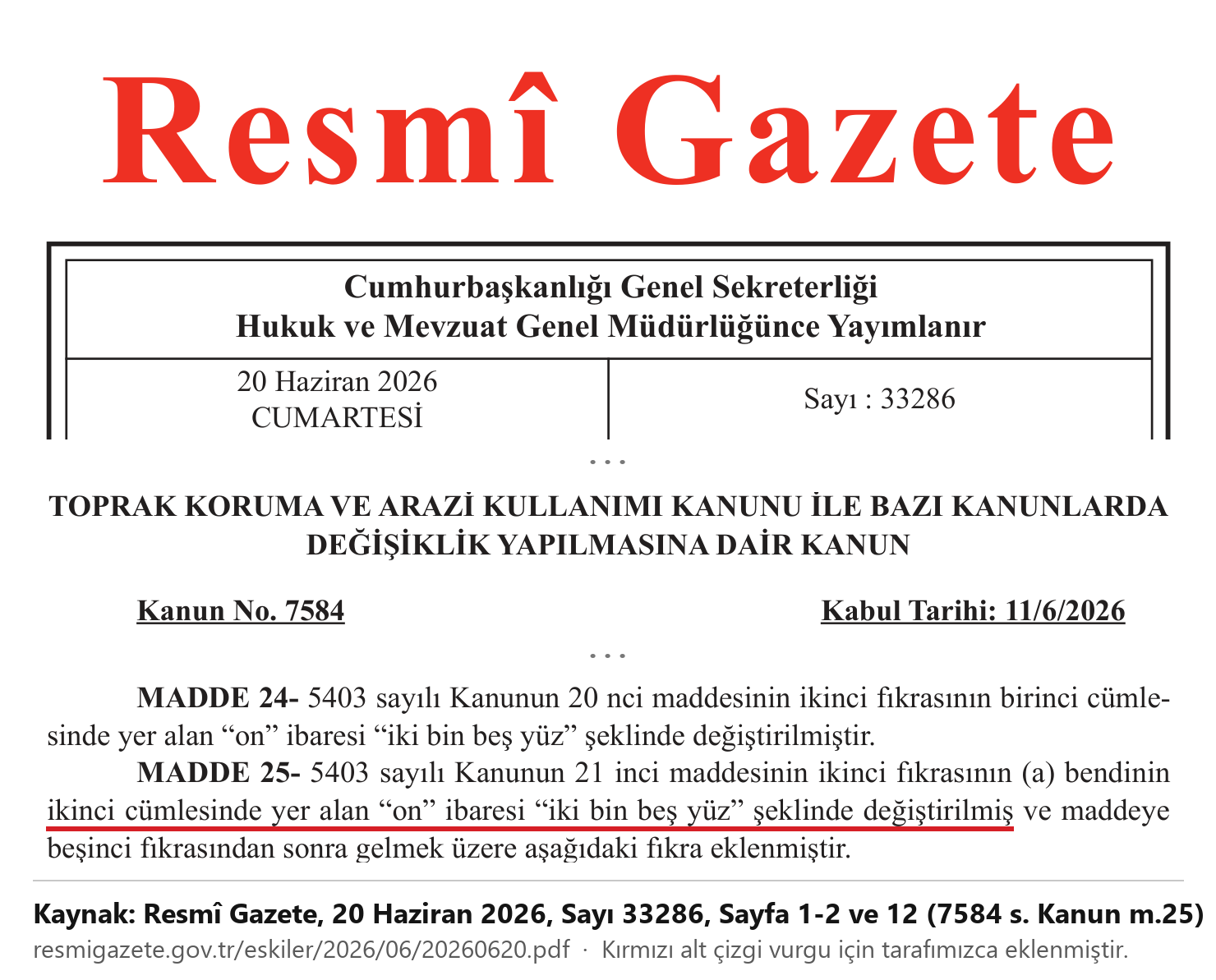
ARTICLE 25- In the second sentence of subparagraph (a) of the second paragraph of Article 21 of Law No. 5403, the word “ten” has been changed to “two thousand five hundred”…
Example: for an unauthorised 100 m² house, the fine is 250,000 TL outside the plain and 500,000 TL in a large plain. The process then works as follows:
If the person applies within one month of being notified of the fine and can obtain permission under Article 13 or 14 of the Law, they may be allowed to complete the work or use the building. In a large plain, this permission is not granted for a dwelling.
Those who do not apply, or whose application is rejected, are given 2 months to demolish the building and restore the land to a condition suitable for farming.
If the building is not demolished within this period, the activity is stopped and the administrative fine is tripled. The municipality or the special provincial administration then demolishes the building and recovers the costs from those responsible.
Unauthorised buildings cannot be connected to electricity, water or natural gas, and no utility subscription is granted.
The 2,500 TL rate applies to violations committed after 20 June 2026. For unauthorised buildings built earlier, the old amount applies, because misdemeanours are subject to whichever law is more favourable (Misdemeanours Law No. 5326, Article 5). Administrative fines are increased at the start of each calendar year in line with the revaluation rate (Article 17/7). Paying the fine does not make the building legal.
Can a large plain conservation area be opened to development?
Not at the request of the parcel owner. The Law states that agricultural land in a large plain may not be used for any other purpose "under any circumstances". It adds that even land that has received permission may not be used or planned for another purpose without fresh permission (Article 14, paragraph added in 2020). Nor can permission for non-agricultural use be granted on the basis of an environmental plan (Regulation, Article 16/1-c).
Zoning plans that are in force and were approved with permits in accordance with the Zoning Law are, however, exempt from this restriction (Regulation, Article 15/2). A plain's boundaries can also be changed by Presidential Decision. Some of the decisions designating new plains also changed the boundaries of several previously designated plains. One decision removed the map of the Tokat Plain (Tokat Ovası) and designated five new plains in Tokat in its place (Presidential Decision 204, Official Gazette, 25 October 2018).
Can the large plain annotation be removed?
The legislation provides no procedure for a parcel owner to apply to have the annotation removed. The annotation shows that the parcel lies within the boundary of a designated plain. It remains valid unless a Presidential Decision changes the boundary so that the parcel falls outside it. If you believe your parcel was wrongly included within the boundary, write to the Agricultural Infrastructure Branch of the Provincial Directorate of Agriculture and Forestry and ask about your case.
Large plain conservation areas in Türkiye: full list by province (468 plains)
The list below has been compiled from the plain lists annexed to the 13 designation decisions published in the Official Gazette since 2017. It contains 468 plains in 73 provinces, exactly matching the figure published by the Ministry. The former Tokat Plain, removed in 2018, is not on the list, but the five plains designated in its place are. The year each plain was designated is given in brackets. Names are spelt as in the decision lists, and the suffix "Ovası" (Plain) has been omitted for brevity. As of 23 November 2026, the most recent designation decision dates from November 2024.
Adana (1): Çukurova (spelt "Çukuroava" in the Official Gazette list) (2017).
Adıyaman (10): Adıyaman, Beşyol, Kahta, Keysun, Kızılin, Merg, Samsat, Turuş, Yeşilova (2018); Bölükyayla (2021).
Afyonkarahisar (9): Afyonkarahisar, Çöl, Sandıklı, Sinanpaşa, Şuhut (2017); Akharım, Emirdağ, Karaadilli (2021); Başmakçı (2022).
Ağrı (3): Ağrı (2017); Patnos, Tutak (2022).
Aksaray (5): Aksaray, Gülağaç (2017); Akhisar, Harmandalı (2021); Babakonağı (2024).
Amasya (5): Amasya, Merzifon, Suluova (2017); Ballıdere, Eskikızılca (2022).
Ankara (13): Çubuk, Haymana, İlhanköy, Polatlı, Sarayköy, Sarıyar, Şereflikoçhisar (2017); Gölbaşı, Kahramankazan (2018); Evren, Polatlı (Girmeç-Poyraz) (2021); Acıkuyu, Türkhöyük (2024).
Antalya (14): Bozova, Demre, Kınık, Kumluca, Manavgat, Serik, Söğüt, Zümrütova (2018); Ayanlar, Bahçeyaka, Gökpınar, Karataş, Kırkpınar, Korkuteli (2021).
Ardahan (4): Ardahan, Göle (2017); Samandöken (2020); Çıldır (2024).
Aydın (5): Aydın, Davutlar, Karpuzlu (2017); Buharkent, Geyre (2021).
Balıkesir (17): Altınova, Balıkesir, Bandırma, Gönen, Manyas (2017); Bigadiç, Burhaniye, Gökçeyazı, Sındırgı (2018); Buğdaylı, İvrindi, Kirazlı, Mutlu, Savaştepe, Selimağa, Şahinler, Şamlı (2021).
Bartın (1): Bartın (2021).
Batman (2): Batman (2017); Gercüş (2020).
Bayburt (4): Aydıntepe, Beşpınar, Demirözü, Yazıbaşı (2020).
Bilecik (4): Bozüyük, Gölpazarı, Gölpazarı Karaağaç (2017); Pazaryeri (2021).
Bingöl (2): Bingöl (2017); Solhan (2018).
Bitlis (4): Aydınlar, Bitlis Taşharman, Bitlis Tatvan, Yassıca (2021).
Bolu (3): Bolu (2018); Gerede Dörtdivan (2021); Sazakiçi (2024).
Burdur (8): Çeltikçi, Eğneş, Erle, Gölhisar, Karamanlı-Tefenni, Öteyüz (2017); Bucak (2021); Yazı (2024).
Bursa (9): Bursa, İnegöl, Karacabey, Yenişehir (2017); Güllüce, İznik, Melik, Orhaneli, Orhangazi (2020).
Çanakkale (15): Biga Bakacak, Biga Taşoluk, Çokal, Ezine Bayramiç, Kumkale, Tuzla, Umurbey (2017); Bayramiç Yiğitler, Çan Terzialan, Gelibolu Demirtepe, Merkez Özbek-Yapıldak, Yenice Akcakoyun, Yenice Davutköy, Yenice Gündoğdu, Yenice Merkez (2021).
Çankırı (4): Kızılırmak (2017); Çankırı Merkez, Eldivan (2021); Çerkeş (2024).
Çorum (8): Alaca, Kargı, Osmancık (2017); Çayyaka, Çorum, Kızılırmak, Sungurlu, Tozluburun (2021).
Denizli (11): Sarayköy (2017); Acıpayam, Çivril (2018); Alikurt, Barza, Çameli, Denizli Medele, Denizli Ovacık, Denizli Tavas, Hambat, Kızılca (2021).
Diyarbakır (3): Bismil, Dicle, Ergani (2017).
Düzce (1): Düzce (2017).
Edirne (7): Edirne (2017); Havsa (2018); Edirne Türkobası (2021); İpsala, Keşan, Küçükdoğanca, Tunca (2024).
Elazığ (4): Kuzova, Uluova (2017); Karakoçan, Kovancılar (2020).
Erzincan (5): Çayırlı, Erzincan, Tercan (2017); Yurtbaşı (2021); Otlukbeli (2024).
Erzurum (5): Erzurum, Pasinler (2017); Hınıs, Horasan (2022); Ünlükaya (2024).
Eskişehir (11): Alpu, Günyüzü Ayvalı, İnönü (2017); Beylikova, Gökçekuyu, Kaldırımköy, Karaören, Kavacık, Kümbet, Mahmudiye, Uluçayır (2021).
Gaziantep (12): Araban, Barak (Nizip), Gaziantep, İslahiye, İslahiye Nurdağı, Nurdağı, Oğuzeli, Şahinbey, Yavuzeli (2017); Bağlıca, Nurdağı Emirler, Polatbey (2020).
Gümüşhane (3): Kelkit, Köse, Şiran Sarıca (2021).
Hakkari (2): Yüksekova (2017); Aksu (2021).
Hatay (3): Amik, Arsuz (2017); Erzin-Dörtyol (2018).
Iğdır (1): Iğdır (2017).
Isparta (4): Boğazova, Gelendost, Isparta, Senirkent (2017).
İstanbul (5): Ağva, Çeltik, Değirmenköy, Gümüşyaka, Yolçatı (2018).
İzmir (10): Aliağa, Bakırçay, Kemalpaşa, Menemen (Gediz), Ödemiş (Küçükmenderes) (2017); Selçuk (2018); Kiraz, Menderes, Oğlananası, Selçuk / Çamlık (2021).
Kahramanmaraş (8): Elbistan, Kahramanmaraş, Narlı, Türkoğlu (2017); Afşin, Göksun (2018); Altınyayla, Yeşilova (2020).
Karabük (2): Eflani, Karahasanlar (2021).
Karaman (4): Çakırbağ, Karaman, Karaman Yollarbaşı (2017); Kazım Karabekir (2021).
Kars (6): Arpaçay Kuyucuk, Kağızman Akçakale, Meydancık (2017); Kars Akyaka Demirkent, Kars Merkez Dikme, Kars Susuz (2020).
Kastamonu (4): Akmescit, Kadirbey, Taşköprü (2017); Ortalıca (2021).
Kayseri (7): Develi-Yahyalı, Güneşli, Yeşilhisar (2017); Erciyes, Sarıoğlan, Yamula-Elmalı (2018); Bünyan (2024).
Kırıkkale (4): Bozköy, Kavurgalı (2021); Hamzalı, Ocakbaşı (2024).
Kırklareli (9): Babaeski, Evrensekiz, Kırklareli, Lüleburgaz, Pancarköy-Sarıcaali, Pehlivanköy, Pınarhisar, Vize (2018); İnece (2021).
Kırşehir (3): Karacaören, Malya, Yeniköy (2021).
Kilis (1): Kilis (2017).
Konya (14): Akören, Akşehir, Altınekin, Beyşehir, Cihanbeyli, Derbent, Ereğli, Gembos, Güneysınır, Kadınhanı, Konya, Kulu, Suğla, Yunak (2017).
Kütahya (13): Altıntaş, Aslanapa, Çavdarhisar, Simav, Tavşanlı (2017); Ahiler, Aksu, İhsaniye, Karaağaç, Kirazpınar, Kütahya Karacaören, Kütahya Merkez, Yoncalı (2021).
Malatya (21): Erkenek, Fındıkköy, Kurucaova (2018); Doğanşehir, Malatya, Yazıhan (2019); Balaban, Başdirek, Çömlekoba, Eymir Kızık, Güzelköy, İçmece, Kale, Kaynarca, Ormaniçi, Yavuzlar, Yenice, Yeşiltaş, Yolkuru, Yukarı Selimli, Yuvalı (2020).
Manisa (4): Akhisar, Kırkağaç, Manisa (2017); Güneşli (2021).
Mardin (5): Kızıltepe (2017); Derik, Mazıdağı, Midyat, Nusaybin (2018).
Mersin (6): Anamur, Mersin, Silifke (2017); Akdeniz, Mut-Elbeyli, Mut-Kışlaköy (2021).
Muğla (10): Dalaman, Gökova, Köyceğiz (2017); Ağaçlıhüyük, Çamurköy, Gölbent, İncealiler, Milas, Pınarlıbelen (2021); Kuzyaka (2024).
Muş (4): Muş (2017); Bulanık, Liz, Malazgirt (2020).
Nevşehir (5): Acıgöl (2017); Derinkuyu, Hacıbektaş (2020); Ovaören, Tepeköy (2024).
Niğde (6): Altunhisar-Çukurkuyu, Çiftlik, Emen, Misli (2017); Eminlik, Hacıbeyli (2020).
Osmaniye (1): Düziçi (2018).
Sakarya (13): Aşağı Karasu, Ferizli, Pamukova, Sakarya, Söğütlü (2017); Ahiler, Bacıköy, Eşme, Geyve, Gökçeören, Hendek, Kaynarca, Kemaliye (2021).
Samsun (4): Bafra, Çarşamba, Vezirköprü (2017); Ladik (2021).
Siirt (1): Kurtalan (2024).
Sinop (3): Sinop Saraydüzü Cuma (2021); Gökırmak, Karasu (2024).
Sivas (7): Gemerek, Suşehri, Şarkışla (2017); Hafik, Ulaş (2022); Kocakurt, Tekmen (2024).
Şanlıurfa (9): Birecik, Bozova, Ceylanpınar, Halfeti, Harran, Siverek, Suruç, Viranşehir, Yaylak (2017).
Şırnak (2): Cizre, Silopi (2017).
Tekirdağ (14): Balabancık, Çorlu, Edir, Ergene, Hayrabolu, İbrice, Karacakılavuz, Karaevli, Kızılcaterzi, Muratlı, Naip, Saray, Semetli, Yoncalı (2017).
Tokat (8): Erbaa, Niksar (2017); Çamlıbel, Gözova, Kazova, Maşat, Zile (2018); Artova (2024).
Tunceli (3): Ovacık (2017); Eğripınar, Karasar (2022).
Uşak (10): Baltalı, Banaz, Sivaslı, Uşak (2017); Eşme, Gedikler (2018); Büyükkayalı, Hasköy, Ortaçeşme (2020); Ulubey (2024).
Van (16): Erciş, Erciş Keklik (2017); Akdamar, Çaldıran, Muradiye (2018); Alabayır, Edremit-Gevaş, Gürpınar, Tuşba (2019); Beyarslan, Değirmigöl, Erçek, Saray, Sarımehmet (2020); Çolpan, Hasantimur (2024).
Yozgat (4): Boğazlıyan (2017); Aydıncık, Sarıkaya-Karayakup, Şefaatli-Paşaköy (2021).
Even when a plain has the same name as a district, the plain boundary does not cover the whole district, only the area drawn on the decision map. In İzmir, "Selçuk" (2018) and "Selçuk / Çamlık" (2021) appear as separate entries in two different decisions. The boundaries of some plains were changed by later decisions. The maps showing the plain boundaries are annexed to the following decisions:
Council of Ministers Decision 2017/10001, Official Gazette 2 June 2017, No. 30084
Council of Ministers Decision 2018/11231, Official Gazette 16 March 2018, No. 30362
Council of Ministers Decision 2018/11338, Official Gazette 17 March 2018, No. 30363
Council of Ministers Decision 2017/11414, Official Gazette 31 March 2018, No. 30377
Presidential Decision 204, Official Gazette 25 October 2018, No. 30576
Presidential Decision 774, Official Gazette 22 February 2019, No. 30694
Presidential Decision 3111, Official Gazette 22 October 2020, No. 31282
Presidential Decision 3199, Official Gazette 25 November 2020, No. 31315
Presidential Decision 3977, Official Gazette 8 May 2021, No. 31478
Presidential Decision 4304, Official Gazette 16 July 2021, No. 31543
Presidential Decision 6405, Official Gazette 11 November 2022, No. 32010
Presidential Decision 9141, Official Gazette 15 November 2024, No. 32723
What happens to olive groves, pastures or forests in a large plain?
Some land within a large plain boundary is assessed under its own legislation (Regulation on the Implementation of Land Use Planning, Article 13/3). This covers pastures (Law No. 4342), forests (No. 6831), olive groves (No. 3573), aquaculture areas (No. 1380), national parks (No. 2873) and places covered by other special laws. For example, an olive grove in a large plain is also subject to the Olive Growing Law No. 3573. For details, see our article on whether you can build a house in an olive grove.
Frequently asked questions
What does large plain conservation area mean?
It is a plain that is fertile but losing soil at an accelerating rate, and which has therefore been placed under protection by Presidential Decision. Agricultural land in these plains may not be used for any other purpose. The Ministry may grant permission only for agricultural buildings and for works covered by a joint public interest decision.
Can land in a large plain conservation area be sold?
Yes. Designation as a large plain does not prohibit sale or inheritance; it restricts how the land is used. Like all agricultural land, however, it is subject to the rules on subdivision and shared ownership.
Can you build a farmhouse in a large plain conservation area?
A farmhouse as a separate dwelling does not count as an agricultural building, so permission cannot be obtained. However, if you are setting up a livestock facility such as a barn or sheep pen, a caretaker's house sized to the facility's capacity may be built as an ancillary building (for a barn of 550–1,500 m², a footprint of 75 m² and a total floor area of 150 m²). This requires that no alternative site is available, that the board gives a favourable opinion and that the Ministry grants permission. If the vineyard house requirements are met, a vineyard house can also be permitted through the same procedure.
Can you build a greenhouse in a large plain?
A greenhouse is an agricultural building, so it may be built with the board's favourable opinion and Ministry permission. No alternative site is required for greenhouse applications (Regulation, Annex 1).
When will large plain conservation areas be opened to development?
The Law sets no period after which a large plain designation automatically ends. An area can only be removed from a plain if a new Presidential Decision changes the plain's boundaries.
How much is the fine for unauthorised building in a large plain in 2026?
For violations after 20 June 2026, it is 5,000 TL per square metre (double the normal amount of 2,500 TL). For a 100 m² building, that comes to 500,000 TL. If the building is not demolished within the 2-month period given, the fine is tripled and the building is demolished.
Where is the large plain boundary map?
The maps are annexed to each designation decision. You can find them through the decision links below the province list above. The Agricultural Infrastructure Branch of the Provincial Directorate of Agriculture and Forestry responsible for your area can tell you the current plain boundaries.
Sources
Soil Conservation and Land Use Law No. 5403, current text (Articles 3, 14 and 21). Official Gazette 19/7/2005, No. 25880.
Law No. 7584, Official Gazette 20/6/2026, No. 33286 (Article 25: 2,500 TL per square metre).
Regulation on the Protection and Use of Agricultural Land, Official Gazette 4/4/2026, No. 33214 (Articles 9, 12, 15, 16 and Annex 1).
Regulation on the Implementation of Land Use Planning, Official Gazette 4/4/2026, No. 33214 (Articles 12 and 13: title deed annotation).
Council of Ministers Decision No. 2016/9620, Official Gazette 21/1/2017, No. 29955 (Duplicate issue): the first large plain designation.
Presidential Decision 204, Official Gazette 25/10/2018, No. 30576 (removal of the Tokat Plain map).
Ministry of Agriculture and Forestry 2025 Annual Administrative Activity Report (468 large plains, 73 provinces).
Misdemeanours Law No. 5326, Article 17/7.
This article is for general information only. For advice on your own land, consult the Provincial Directorate of Agriculture and Forestry or an agricultural engineer.