 Bambu Proje-Danışmanlık
Rules for building a house on a field in 2026: how many dönüm of land do you need for a vineyard house (bağ evi)?
The question agricultural landowners ask most often is: "Can I build a house on my field?" In this article we answer it in plain language, step by step. The information is based on the regulation in force in 2026.
Short answer: You cannot build a house (dwelling) on a field to live in. However, a vineyard house (bağ evi) can be built under certain conditions. You need at least 20 dönüm (20 decares), i.e. 20,000 m² of land on a field, and at least 10 dönüm (10 decares), i.e. 10,000 m² in a vineyard or orchard. The footprint of a vineyard house may be no more than 30 m² and its height no more than 2 storeys. A vineyard house may not be lived in permanently or let out.
Can you build a house on a field?
No. Building a house on a field to live in means putting the land to non-agricultural use (tarım dışı kullanım). The Soil Conservation and Land Use Law No. 5403 (5403 sayılı Toprak Koruma ve Arazi Kullanımı Kanunu) allows this only in very special cases. Three conditions must all be met: there must be no other suitable site, the Soil Conservation Board (Toprak Koruma Kurulu) must give a favourable opinion, and the request must fall under one of the exceptions listed in Article 13 of the Law. A request along the lines of "let me build myself a house" is not among these exceptions.
In other words, you cannot build a detached house, a holiday home or a villa on a field. What can be built is a small structure that serves farming work: a vineyard house.
What is a vineyard house?
A vineyard house is a small structure built so that a producer working in a field, vineyard or orchard can rest, stay during the harvest, and store tools and produce. The Regulation classifies the vineyard house as an "agricultural building" (tarımsal amaçlı yapı).
A vineyard house is not a holiday home. It may not be lived in permanently or let out. If there is no production on the land, no vineyard house permit is granted either.
How many dönüm of land do you need for a vineyard house?
The required land size depends on the type of land (Regulation, Annex 1, item 6):
Field (absolute, special crop and marginal agricultural land): the land must be at least 20 dönüm (20 decares) = 20,000 m² (2 hectares).
Land with trees, such as vineyards and orchards (planted agricultural land): the land must be at least 10 dönüm (10 decares) = 10,000 m² (1 hectare). In addition, the type of land recorded on the title deed (tapu) must be vineyard, orchard, walnut orchard, apple orchard or similar.
Greenhouse (protected cultivation): the land must be at least 3 dönüm (3 decares) = 3,000 m² (0.3 hectares). If a vineyard house is wanted on greenhouse land, the greenhouse is built first (Annex 1, item 3.4).
If your land is smaller than these sizes, you cannot build a vineyard house.
Have the vineyard house rules changed in the Official Gazette (Resmî Gazete)?
Yes, they changed twice in 2026. In the end, the requirement for fields stayed the same as before, while for vineyards and orchards it became stricter:
Previous rules (Circular No. 2023/6): 20 dönüm of land was required on fields, 5 dönüm in vineyards and orchards and 3 dönüm for greenhouses; the footprint of a vineyard house could be 75 m².
Regulation of 4 April 2026: the size required on fields was raised to 50 dönüm (5 hectares), and in vineyards and orchards to 10 dönüm; the footprint was reduced to 30 m².
Amendment of 4 August 2026 (Official Gazette No. 33330): the size required on fields went back to 20 dönüm (2 hectares). The 10 dönüm for vineyards and orchards and the 30 m² footprint remained unchanged.
The figure of "5 dönüm" mentioned in some news reports is wrong for fields; 5 dönüm was the size required for vineyards and orchards under the old rules.
How many square metres can a vineyard house be?
The footprint is at most 30 m².
At most 2 storeys may be built.
Only 1 vineyard house may be built on each parcel.
A family is granted a permit for only 1 vineyard house in the same district.
Who cannot build a vineyard house?
Owners of small plots: no vineyard house may be built on land that does not meet the size requirement above.
Owners of olive groves: olive groves are separately protected under Olive Growing Law No. 3573 (3573 sayılı Zeytincilik Kanunu). In practice, no building permit, including for a vineyard house, is granted on olive groves.
Tenants: you cannot build a vineyard house on land you rent. Only the title deed holder can apply.
People who already have a vineyard house: if your family has another vineyard house on the same parcel or in the same district, a second vineyard house will not be permitted.
Can a vineyard house be built on a field with a shared title deed (hisseli tapu, land held in undivided co-ownership)?
Yes, but it is mandatory to obtain a notarised letter of consent (muvafakatname) from every other co-owner on the title deed. If even one of the co-owners refuses, the application cannot be made.
Do the same rules apply to bungalows and hobby gardens?
Yes. The small structures referred to in the news as "bungalows" are also subject to the vineyard house rules on agricultural land. A "hobby garden", on the other hand, is not a separate status in the legislation; if the parcel is agricultural land, the rules are the same. Building a bungalow to let out or to use for holidays is a non-agricultural use, and no permit can be obtained for it.
Where do you get a vineyard house permit?
The application is made to the municipality. If the land lies outside municipal boundaries, the application is made to the Special Provincial Administration (İl Özel İdaresi). The municipality sends your file online (via the TAD Portal) to the Provincial Directorate of Agriculture and Forestry (İl Tarım ve Orman Müdürlüğü); you do not carry out this step yourself. A site survey is carried out on the land. If the Provincial Directorate approves, you obtain a construction permit (building permit, yapı ruhsatı) from the municipality.
Vineyard house permit step by step
In the diagram below, each box shows who does the work: you, the municipality or the Provincial Directorate. Follow the arrows according to your answers to the questions. If you reach a red box, a vineyard house permit cannot be obtained for that land.
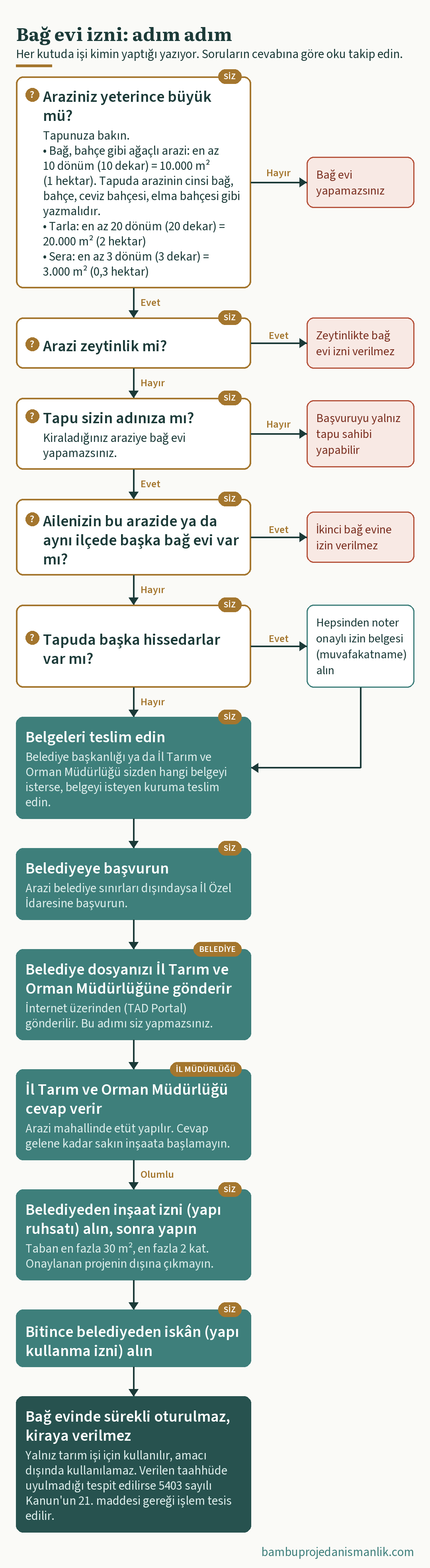
The same steps in writing:
Check your title deed. Is your land large enough? You need at least 20 dönüm (20 decares) on a field, at least 10 dönüm (10 decares) in a vineyard or orchard, and at least 3 dönüm (3 decares) for a greenhouse.
Is the land an olive grove? No vineyard house permit is granted on an olive grove.
Is the title deed in your name? Only the title deed holder can apply.
Does your family have another vineyard house? If there is one on the same land or in the same district, a second one will not be permitted.
Are there other co-owners on the title deed? If so, obtain a notarised letter of consent (muvafakatname) from all of them.
Submit the documents. Whichever document the municipality or the Provincial Directorate of Agriculture and Forestry asks you for, submit it to the authority that requested it.
Apply to the municipality. If the land lies outside municipal boundaries, the application is made to the Special Provincial Administration.
The municipality sends your file. The municipality sends your file online (via the TAD Portal) to the Provincial Directorate of Agriculture and Forestry. You do not carry out this step yourself.
Wait for the response. The Provincial Directorate of Agriculture and Forestry reviews your file; a site survey is carried out on the land. Under no circumstances start building before the response arrives.
If the response is positive, obtain a construction permit (building permit) from the municipality and only then build the vineyard house. Do not deviate from the approved project.
Once it is finished, obtain an occupancy permit (iskân, yapı kullanma izni) from the municipality.
A vineyard house may not be lived in permanently or let out. A vineyard house is used only for farming work and may not be used for any other purpose. If it is found that the undertaking given has not been complied with, action is taken under Article 21 of Law No. 5403.
What documents do you need for a vineyard house?
The documents are requested by the municipality and the Provincial Directorate of Agriculture and Forestry. Submit each document to whichever authority asks for it. The documents most often requested are:
Notarised undertaking (taahhütname): a signed pledge that you will use the vineyard house only for farming work and will not subdivide the land or convert it into a building plot (Regulation, Annex 7). Click on it to see a sample.
Letter of consent (muvafakatname): if there are other co-owners on the title deed, the notarised consent of all of them (Regulation, Annex 17).
Title deed and ÇKS (Farmer Registration System) record: these show that the land belongs to you and that you farm it.
Location and photographs of the land: together with a simple site plan showing where on the land the vineyard house will be built.
Other documents the authority may request depending on your file.
What should you bear in mind once you have a vineyard house permit?
The notarised undertaking you submit with your application and the permit letter contain the following rules (Regulation, Article 4):
The vineyard house may not be built larger than, or differently from, the approved project.
The vineyard house is used only for farming work; it may not be used as a home or as a holiday let.
The vineyard house may not be used as grounds for subdividing the land.
The land may not be converted into a building plot.
If it is found that these rules have not been complied with, the permit is revoked and action is taken under Article 21 of Law No. 5403.
What happens if I build a house without a permit?
If construction is still under way, the Governor's Office (valilik) stops it. If the building is finished, its use is not permitted.
An administrative fine of 2,500 TL for every square metre of the area used is imposed (Law, Article 21). For example, the fine for an unauthorised 30 m² building is 75,000 TL.
You are given 2 months to demolish the building and restore the land to its former state. If you do not demolish it, the fine is tripled and the building is demolished by the municipality or the special provincial administration, with the costs recovered from you (Law, Article 21).
In large plain protection areas, fines are applied at double the amount.
Buildings constructed without a permit are not connected to electricity, water or natural gas, and no utility subscription is granted (Law, Article 21).
Buildings started on the assumption that "an amnesty will come anyway" are today ending in demolition and fines. There is no provision in the legislation that supports any such expectation of an amnesty.
If your plot lies within the village settlement area (köy yerleşik alanı, the built-up area of a village), the situation is different: Law No. 5403 does not apply there and the vineyard house requirements do not apply; a house requires project approval and written notification to the office of the village headman (muhtarlık) (Zoning Law, Article 27). For details, see our article on the rules for building a house in a village and the 5403 Visual Guide, Part 3 video.
Frequently asked questions
Can I put a container, a prefabricated house or a tiny house on a field?
No. Even if it is prefabricated, on wheels or portable, a unit that stands permanently on the land and is lived in is treated as an unauthorised building; saying "it has wheels" will not protect you.
Can I put a small hut in my hobby garden?
If the land is agricultural land, the rules are the same. A vineyard house that serves farming work and meets the conditions can be built with a permit; a hut to live in cannot be built.
My neighbour has built a house on their field – why is nothing happening to them?
The building may not have been detected yet. Once it is detected, the same fine and demolition process will apply to them as well.
Can I have electricity and water connected to my vineyard house?
For a permitted vineyard house with a building permit, subscriptions are obtained from the relevant providers. In the undertaking you also pledge not to use agricultural electricity for any other purpose. Buildings constructed without a permit, however, are not connected to electricity, water or natural gas, and no subscription is granted (Law, Article 21).
I want a building to store my produce – should I build a vineyard house?
No. If the only purpose is to store produce and tools, the correct application is not for a vineyard house but for an agricultural storage building. Applying under the correct heading prevents your file from being sent back.
I am going to buy a field with a house on it – what should I check?
Ask for the house's permit and building permit documents, have the records of the municipality and the Provincial Directorate checked, and compare the land type on the title deed with the actual condition of the land. With an unauthorised building, the risk of fines and demolition passes to the new owner.
Example: the stone building in the vineyard
Let us imagine a producer in Denizli who has a 12-dönüm (12-decare) vineyard and whose title deed records the land type as "vineyard". The producer wants a small single-storey building to stay in during the harvest and to store tools and produce. As the land is larger than 10 dönüm (10 decares) and the title deed records the land type as vineyard, the size requirement is met. The producer applies to the municipality and submits the requested documents to the authority that requested them. The municipality sends the file via the TAD Portal to the Provincial Directorate of Agriculture and Forestry, and a site survey is carried out on the land. Once a positive response arrives, the producer obtains a building permit and builds the vineyard house.
If the same producer wanted "a two-storey house I will also live in during the winter", it would not be a vineyard house but a dwelling. Requests for dwellings on agricultural land are not permitted. The difference between the two requests is not the number of walls but whether the building serves farming work.
This article has been prepared for general information purposes on the basis of the Soil Conservation and Land Use Law No. 5403 (including the amendments made by Law No. 7584, published in the Official Gazette of 20 June 2026, No. 33286), Law No. 3573 on the Improvement of Olive Growing and the Grafting of Wild Olives, the Regulation on the Protection and Use of Agricultural Land published in the Official Gazette of 4 April 2026, No. 33214, and the amendment to this Regulation published in the Official Gazette of 4 August 2026, No. 33330. Every plot of land is different; the final decision is made by the relevant authorities.
Bambu Proje-Danışmanlık is based in Denizli, and we provide project preparation services (Project Technical Report – Proje Teknik Raporu – and Soil Conservation Project – Toprak Koruma Projesi) for requests from all provinces of the Aegean Region (Denizli, İzmir, Manisa, Aydın, Muğla, Uşak, Kütahya and Afyonkarahisar). We send your signed and stamped report by courier to you and/or to the engineer responsible for your file at the relevant Provincial Directorate of Agriculture and Forestry. To find out whether your land meets the vineyard house requirements, you can contact us via our contact page or take a look at our service regions.