 Bambu Proje-Danışmanlık
Can electricity be connected to a field? How to get electricity to agricultural land in 2026
‘How do I get electricity to my field?’ is a question we hear most often from people who want to put a house, a container or a storage building on their field. The answer depends on what the electricity is to be connected to. Electricity is connected not to the field itself but to a building or facility on the field. If that building has a permit, it can be connected; if it does not, it has not been possible to connect it since 20 June 2026. In this article we explain in plain language which buildings can be connected to electricity, which permits and documents are needed, and what is required for an irrigation well pump.
Last updated: 18 November 2026. The information is based on the current texts published on mevzuat.gov.tr.
Short answer: On agricultural land, no building or facility constructed without a permit may be connected to electricity, water or natural gas, and no subscription is granted for it (Law No. 5403 [5403 sayılı Kanun], Article 21). This rule came into force on 20 June 2026. The body that makes the connection is given an administrative fine of 100,000 TL per subscriber. Permitted buildings can be connected to electricity: agricultural buildings such as barns and storage buildings, a permitted vineyard house (bağ evi) and the pump of an irrigation well. To do this, you first obtain the permit and the building permit (ruhsat) for the building, then apply to the electricity distribution company in your area. For a well pump, the Groundwater Use Certificate (Yeraltısuyu Kullanma Belgesi) issued by DSİ, the State Hydraulic Works, is also mandatory.
Can electricity be connected to a field?
Yes, but only to a permitted building or facility. On agricultural land, agricultural buildings and non-agricultural uses (tarım dışı kullanım) require a permit: ‘It is mandatory to obtain a permit for agricultural buildings and non-agricultural land uses and to comply with soil conservation projects’ (Law No. 5403, Article 21).
Electricity comes on top of this permit. First the permit for the building or facility is obtained, then you apply for electricity. The order cannot be reversed: there is no such route as ‘I’ll get the electricity connected first and obtain the permit later’.
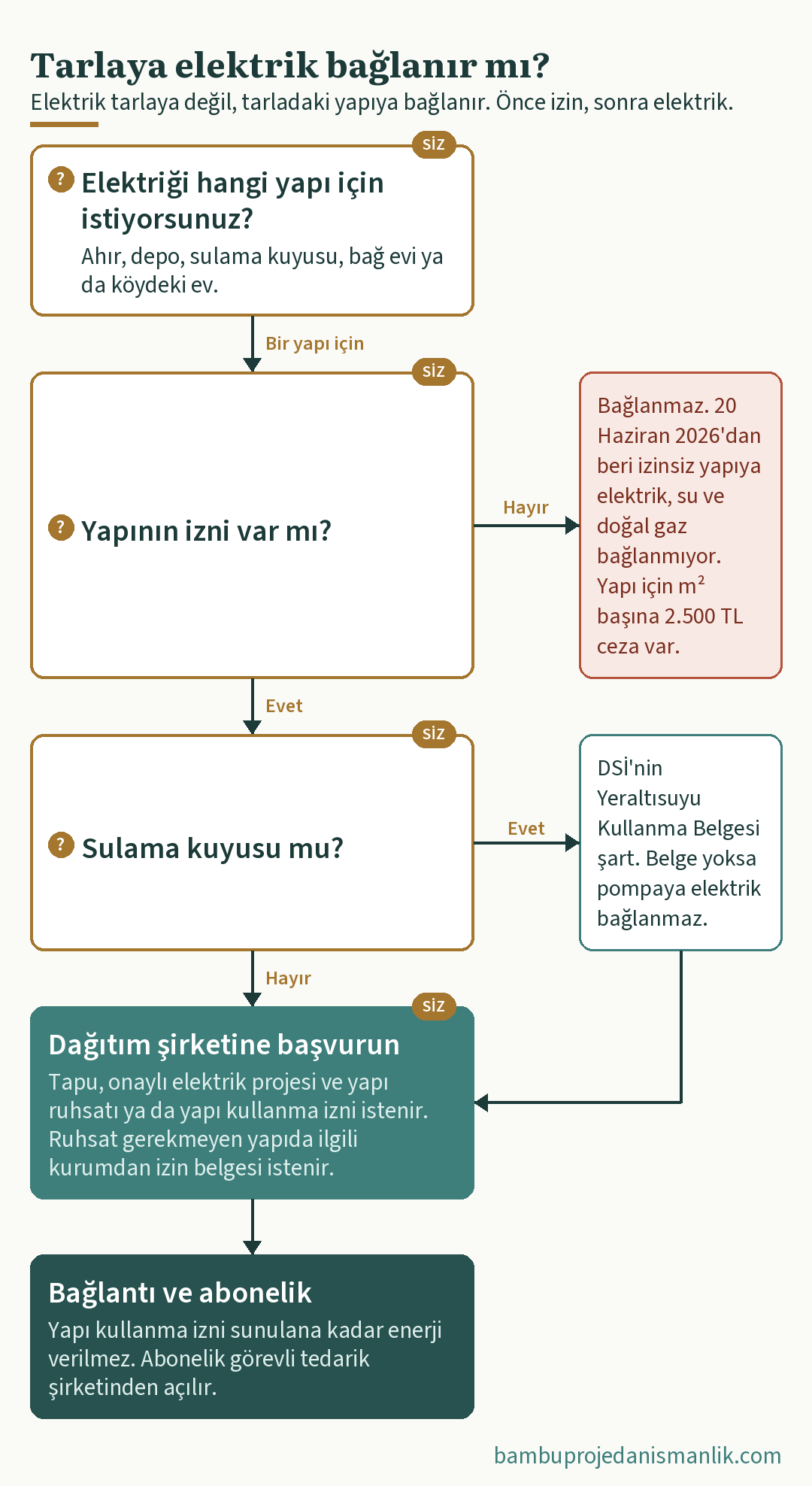
Can an unpermitted building be connected to electricity? What changed in 2026?
No. Law No. 7584, adopted on 11 June 2026, added a new paragraph to Article 21 of Law No. 5403. The paragraph came into force on 20 June 2026. In the words of the Law:
‘No electricity, water or natural gas connections or subscriptions shall be established by the relevant administrations, institutions and organisations for any building or facility constructed without a permit under this Law.’
This rule has three important consequences:
Not only electricity, but water and natural gas will not be connected either.
The fine is imposed on the body that makes the connection. Any administration, institution or organisation that acts in breach of the rules is given an administrative fine of 100,000 TL per subscriber. If the subscription is not cancelled within 30 days of notification of the fine, a further 100,000 TL fine is imposed for every month the subscription continues.
The owner of the building does not escape a fine either. For an unpermitted building, the landowner or the person who damaged the land is given an administrative fine of 2,500 TL for every square metre of the area used; in large plain protection areas (büyük ova koruma alanı) the fine is doubled (Law No. 5403, Article 21). Example: for an unpermitted 40 m² building, 40 × 2,500 = 100,000 TL.
The Zoning Law (İmar Kanunu) contains a rule to the same effect: buildings for which an occupancy permit (yapı kullanma izni) has not been issued or obtained may not benefit from electricity, water and sewerage services until the permit is obtained (Zoning Law No. 3194, Article 31).
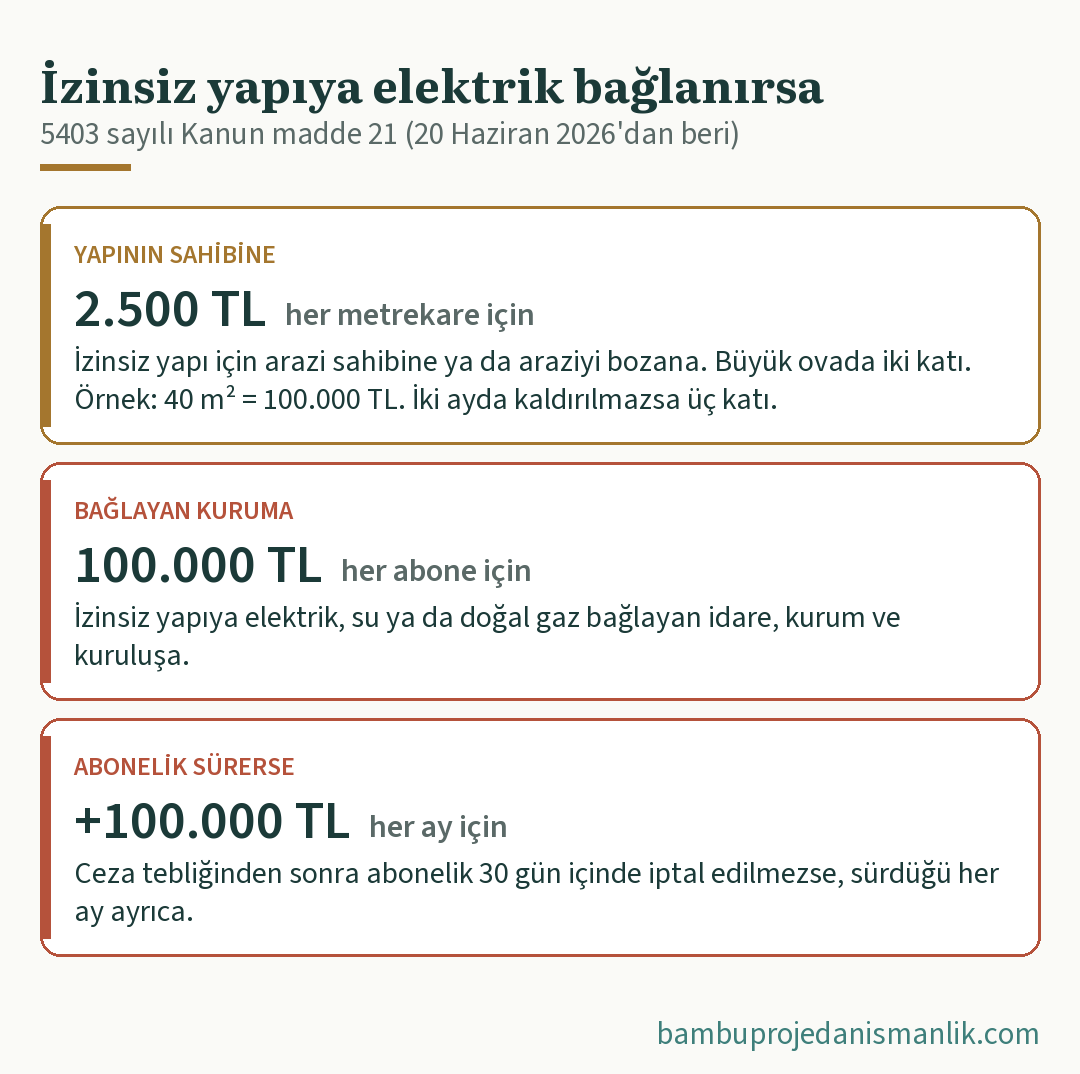
If I fit solar panels, can I use an unpermitted building?
No. The problem is not where the electricity comes from, but the fact that the building has no permit. For an unpermitted building used with panels, a generator or a water tank, the fine of 2,500 TL per square metre and the demolition process apply just the same (Law No. 5403, Article 21).
Solar energy can be used on permitted agricultural buildings. Solar panels on the roof of an agricultural building (rooftop solar plant, çatı GES) and solar panels for irrigation (irrigation solar plant, sulama GES) count as agricultural buildings and are installed with a permit (Regulation on the Protection and Use of Agricultural Land [Tarım Arazilerinin Korunması ve Kullanılması Hakkında Yönetmelik], Article 4). The panel area may be as large as needed to meet the electricity demand of the farming activity (Regulation, Annex 1). We will cover the details in a separate article.
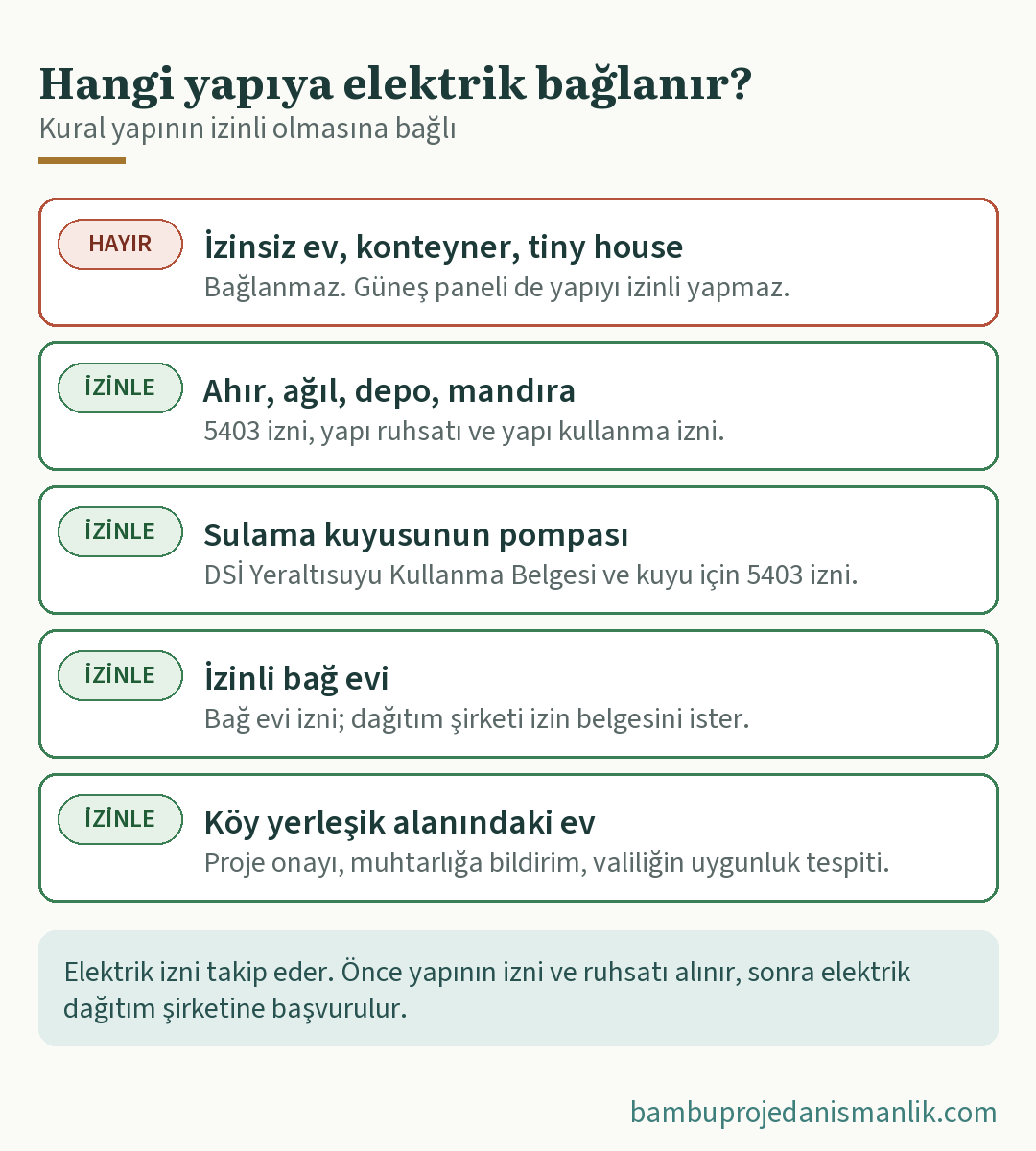
Which buildings can be connected to electricity?
Unpermitted house, container, tiny house: No. Unpermitted buildings are not connected.
Barn, sheepfold, storage building, dairy (agricultural building): Yes, with a permit. A Law No. 5403 permit, a building permit and an occupancy permit are required.
Pump of an irrigation well: Yes, with a permit. DSİ’s Groundwater Use Certificate and a Law No. 5403 permit for the well are required.
Permitted vineyard house: Yes. The vineyard house permit and the permit document requested by the distribution company are required.
House in a village settlement area (köy yerleşik alanı): Yes. Project approval, notification to the village headman’s office (muhtarlık) and a confirmation of compliance from the Governor’s Office (Valilik) are required.
How do you get electricity to a barn or storage building?
Buildings such as barns, sheepfolds, storage buildings and dairies are agricultural buildings (tarımsal amaçlı yapı). For agricultural buildings, the amount of agricultural land needed may be used with the permission of the Governor’s Office, provided that the project is complied with (Law No. 5403, Article 13). Farming and livestock buildings outside village settlement areas must be built with a building permit (Zoning Law, Article 27).
The order is as follows:
YOU: If the land is within municipal boundaries, you apply to the municipality (belediye başkanlığı); if it is outside them, to the special provincial administration (il özel idaresi) (Regulation, Article 5).
MUNICIPALITY / SPECIAL PROVINCIAL ADMINISTRATION: Forwards your application via the TAD Portal to the Provincial Directorate of Agriculture and Forestry (İl Tarım ve Orman Müdürlüğü). You do not carry out this step yourself.
PROVINCIAL DIRECTORATE: A site survey is carried out on the land. The application is assessed on condition that it concerns an agricultural building and that the Soil Conservation Project (Toprak Koruma Projesi) is complied with (Regulation, Article 14). Do not, under any circumstances, start building until you receive a reply.
MUNICIPALITY / SPECIAL PROVINCIAL ADMINISTRATION: Once the permit has been granted, a building permit (yapı ruhsatı) is issued. When the building is finished, an occupancy permit (iskân) is obtained.
YOU: You apply to the electricity distribution company in your area through the application system on the company’s website. The distribution company asks for the title deed record, the approved electrical project and the building permit or occupancy permit (Electricity Market Connection and System Use Regulation [Elektrik Piyasası Bağlantı ve Sistem Kullanım Yönetmeliği], Article 10). You will need to work with an electrical engineer for the approved electrical project.
DISTRIBUTION COMPANY: A connection agreement is concluded. If you applied with a building permit, the facility will not be energised until the occupancy permit has been submitted (same Regulation, Article 13).
YOU: You apply to the designated supply company (görevli tedarik şirketi) for the sale of electricity and have your subscription opened. This application can also be made via the e-Government (e-Devlet) portal; documents such as a copy of your ID or of the title deed are not requested (Electricity Market Consumer Services Regulation [Elektrik Piyasası Tüketici Hizmetleri Yönetmeliği], Article 21).
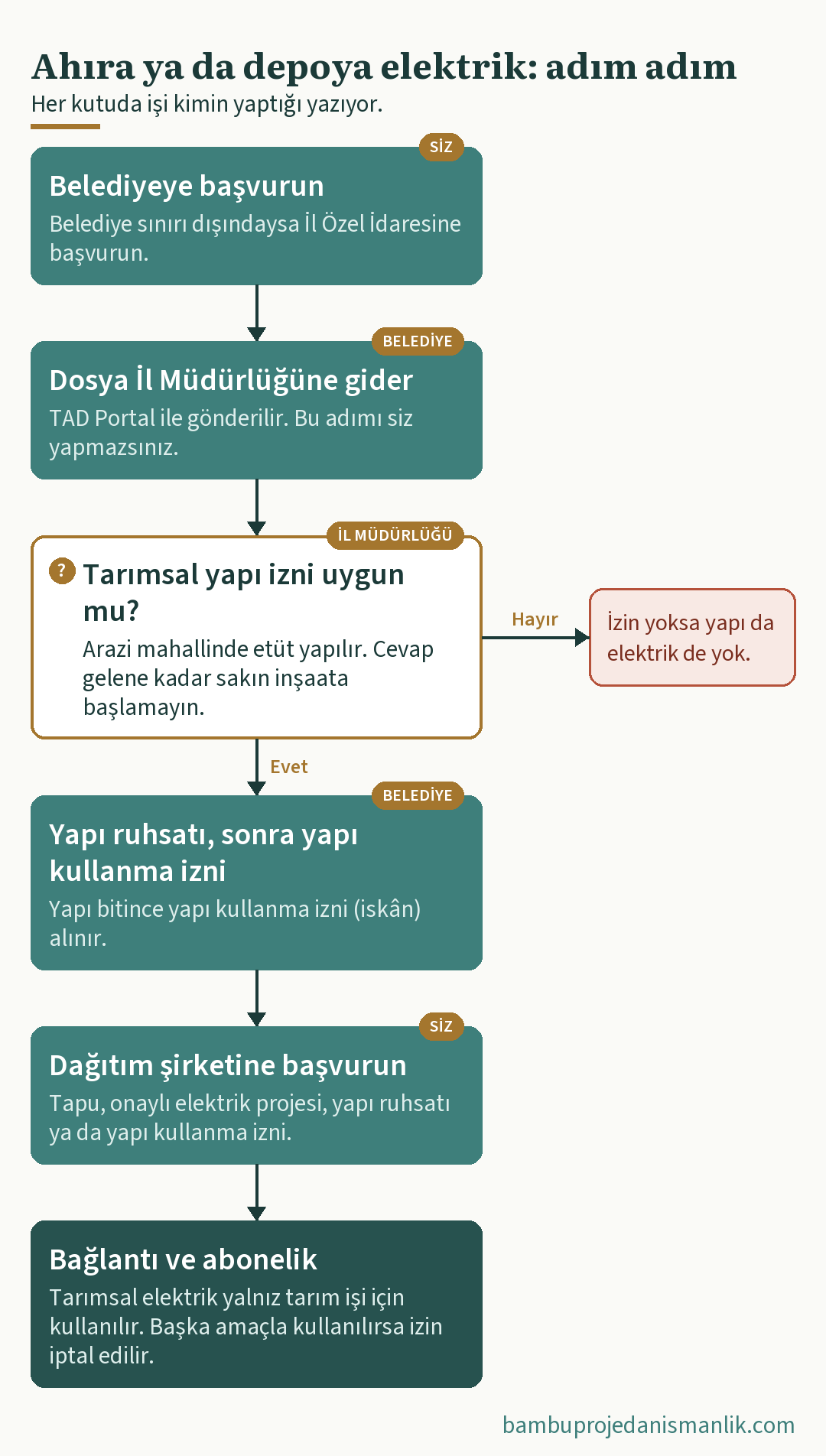
Important: When obtaining a permit for an agricultural building, you give a notarised undertaking (taahhütname). The undertaking states that electricity used under an agricultural electricity subscription will not be used for any other purpose. If it is found to be used for another purpose, or if a building not included in the project is found, the provisions of Law No. 5403 are applied and the permit is cancelled (Regulation, Annex 7). In other words, electricity brought to a barn cannot be used to supply an unpermitted building on the field.
How do you get electricity to an irrigation well pump?
An irrigation well and its pumping facility count as irrigation infrastructure, i.e. as an agricultural building (Regulation, Annex 1). This is why a permit under Law No. 5403 is also required for the well. On the electricity side, two conditions stand out:
No connection without the DSİ certificate. A pump cannot be connected to electricity until the Groundwater Use Certificate, which shows how much groundwater may be abstracted, has been obtained. If consumption exceeds the limit set in the certificate, the distribution company cuts off the electricity within 7 days at the latest upon notification from DSİ (Electricity Market Consumer Services Regulation, Article 48).
Things are easier if the grid is nearby. A request for an agricultural connection from a well that is not subject to a building permit receives a positive opinion if the existing low-voltage grid is suitable and no new investment is needed. If the grid’s capacity has to be increased, the request is met provided that the user bears the cost of this investment (Connection and System Use Regulation, Article 10/A).
To drill a well, the Governor’s Office may grant a temporary permit of up to one year for exploring for irrigation water. If water is found and the well is put into operation, the permit procedures are carried out separately (Regulation, Article 14).
Can a vineyard house be connected to electricity?
A permitted vineyard house can be connected. A vineyard house is a building that a farmer who meets the conditions may build with a permit: at least 20 dönüm (20 decares; 1 dönüm = 1,000 m²) = 20,000 m² (2 hectares) of land is required for a field, and at least 10 dönüm (10 decares) = 10,000 m² (1 hectare) for a vineyard or orchard; the footprint is 30 m². For details, see our article on the conditions for building a house on a field.
No building permit is required for a vineyard house. For buildings that do not require a permit, the distribution company asks for the permit document to be obtained from the relevant authorities in accordance with the legislation (Connection and System Use Regulation, Article 10). A ‘vineyard house’ built without a permit, however, will not be connected to electricity.
Will my house in the village be connected to electricity?
If the house is within the village settlement area, Law No. 5403 does not apply (Zoning Law, Article 27). A building permit and an occupancy permit are not required for these houses; however, approval of the project and notification to the village headman’s office are mandatory. The Governor’s Office determines whether the building complies with technical and health rules (Zoning Regulation for Unplanned Areas [Plansız Alanlar İmar Yönetmeliği], Article 57). The Zoning Law also makes it mandatory to obtain permission from the municipality and the Governor’s Office before these buildings, which are not subject to a building permit, are used (Zoning Law, Article 30).
When you apply for electricity, the distribution company asks, for buildings that do not require a permit, for ‘the permit document to be obtained from the relevant authorities’. Ask the administration and the distribution company which document this is before you apply. For details, see our article on village settlement areas.
If your house is on a field outside the boundary, the rule above applies: if it has no permit, it will not be connected to electricity.
Frequently asked questions
Will my existing subscription be cut off?
The Law states that connections and subscriptions shall not be established for unpermitted buildings and provides for a fine on bodies that act in breach of the rules. If the subscription is not cancelled within 30 days after the body has received the fine, an additional fine is imposed for each month (Law No. 5403, Article 21). The Law contains no separate transitional provision for existing subscriptions. If you do not know the permit status of your building, ask the Provincial Directorate of Agriculture and Forestry and the municipality in writing.
I have a Building Registration Certificate from the zoning amnesty. Will electricity be connected?
Under the Zoning Law, buildings that have obtained a Building Registration Certificate (Yapı Kayıt Belgesi) may, on request, be temporarily connected to water, electricity and natural gas (Zoning Law, Provisional Article 16). There is no provision that expressly governs the relationship between this certificate and the new prohibition in Law No. 5403. For a building on agricultural land, we recommend that you obtain a written opinion on this matter.
Can I run electricity from my neighbour’s subscription?
No. The rule depends on whether the building has a permit, not on whose name the subscription is in. An unpermitted building remains an unpermitted building wherever the electricity comes from, and the procedure for the fine of 2,500 TL per square metre applies. Using electricity from an agricultural electricity subscription for another purpose also leads to the permit being cancelled (Regulation, Annex 7).
My field is far from the village. When will the distribution company connect it?
Places outside residential areas and outside the settled areas of villages and hamlets (mezra) and their surroundings are deemed to be ‘outside inhabited areas’ (meskûn mahal dışı). Connection requests there are met within three years at the latest from the signing of the connection agreement (Connection and System Use Regulation, Article 10/A). Requests based on agricultural activity are exempt from the requirement of ‘at least five or ten points of use’ that applies outside inhabited areas (same Article).
Who do I apply to for electricity?
For the connection, you apply to the electricity distribution company in your area. In the Aegean region these companies differ from area to area; the application is made through the application system on the company’s website. Once the connection has been completed, you apply to the designated supply company for the subscription (sale of electricity).
I only want electricity to irrigate my field. Do I still need a permit?
As the well and pumping facility count as an agricultural building, a permit under Law No. 5403 is required. In addition, DSİ’s Groundwater Use Certificate is mandatory. If you will be irrigating from another source, such as a stream or a pond, the connection request is likewise assessed as a request for agricultural activity (Connection and System Use Regulation, Article 10/A).
If the body that connects the electricity is fined, will anything happen to me?
The 100,000 TL fine relating to the subscription ban is imposed on the body. However, because the building has no permit, you are separately fined 2,500 TL per square metre and required to remove the building within two months. If it is not removed, the fine is tripled; the municipality or special provincial administration demolishes the building and the costs are recovered from you (Law No. 5403, Article 21).
Example: two fields in the same village
In a village in Uşak, Mr Hasan owns a field of 25 dönüm (25 decares) = 25,000 m² (2.5 hectares). He wants to switch to drip irrigation. He has DSİ’s Groundwater Use Certificate for his well. He applied to the special provincial administration for the well and the pump house; his application was forwarded via the TAD Portal to the Provincial Directorate of Agriculture and Forestry, a site survey was carried out on the land and the permit was granted. He then applied to the electricity distribution company. As his field is close to the grid and no new investment was needed, his connection request was approved.
In the same village, Mr Murat placed a 40 m² container on his field without a permit and applied to the distribution company for electricity. Because the building had no permit, electricity was not connected. When the container was discovered, a fine of 40 × 2,500 = 100,000 TL was imposed; if it is not removed within two months, the fine will rise to 300,000 TL.
The difference between the two fields is the permit. Electricity follows the permit; the permit does not follow the electricity.
This article has been prepared for general information purposes on the basis of Soil Conservation and Land Use Law No. 5403 (5403 sayılı Toprak Koruma ve Arazi Kullanımı Kanunu) (Articles 13 and 21; paragraph 6 added by Law No. 7584, Official Gazette (Resmî Gazete) of 20 June 2026, issue 33286), Zoning Law No. 3194 (Articles 27, 30, 31 and Provisional Article 16), the Regulation on the Protection and Use of Agricultural Land (Official Gazette of 4 April 2026, issue 33214; Articles 4, 5 and 14, Annex 1 and Annex 7), the Electricity Market Connection and System Use Regulation (Articles 10, 10/A and 13), the Electricity Market Consumer Services Regulation (Articles 21 and 48) and the Zoning Regulation for Unplanned Areas (Article 57). Every piece of land is different; the final decision rests with the relevant authorities.
At Bambu Proje-Danışmanlık we are based in Denizli and provide project preparation services (Project Technical Report [Proje Teknik Raporu], Soil Conservation Project) for requests from all provinces of the Aegean Region (Denizli, İzmir, Manisa, Aydın, Muğla, Uşak, Kütahya and Afyonkarahisar). We send your report, signed and stamped, by courier to you and/or to the engineer responsible for your file at the relevant Provincial Directorate of Agriculture and Forestry. For your barn, storage building or irrigation well permit, you can get in touch with us via our contact page and take a look at our service regions.