 Bambu Proje-Danışmanlık
Is it illegal to put a caravan on your field? What the law says, and doesn't say, in 2026
The question we were asked most often under our video on tiny houses and containers was this: “So what if I tow a caravan onto my field? What if I park my motorhome there and stay in it at weekends?” In this article we explain, based on the official texts, what the law says and does not say about caravans, and where the risk begins. Part of the subject is not explicitly set out in writing. We clearly mark those parts as “not stated”, and we do not speculate.
Last updated: 19 November 2026. The information is based on the current texts published on mevzuat.gov.tr and in the Official Gazette (Resmî Gazete).
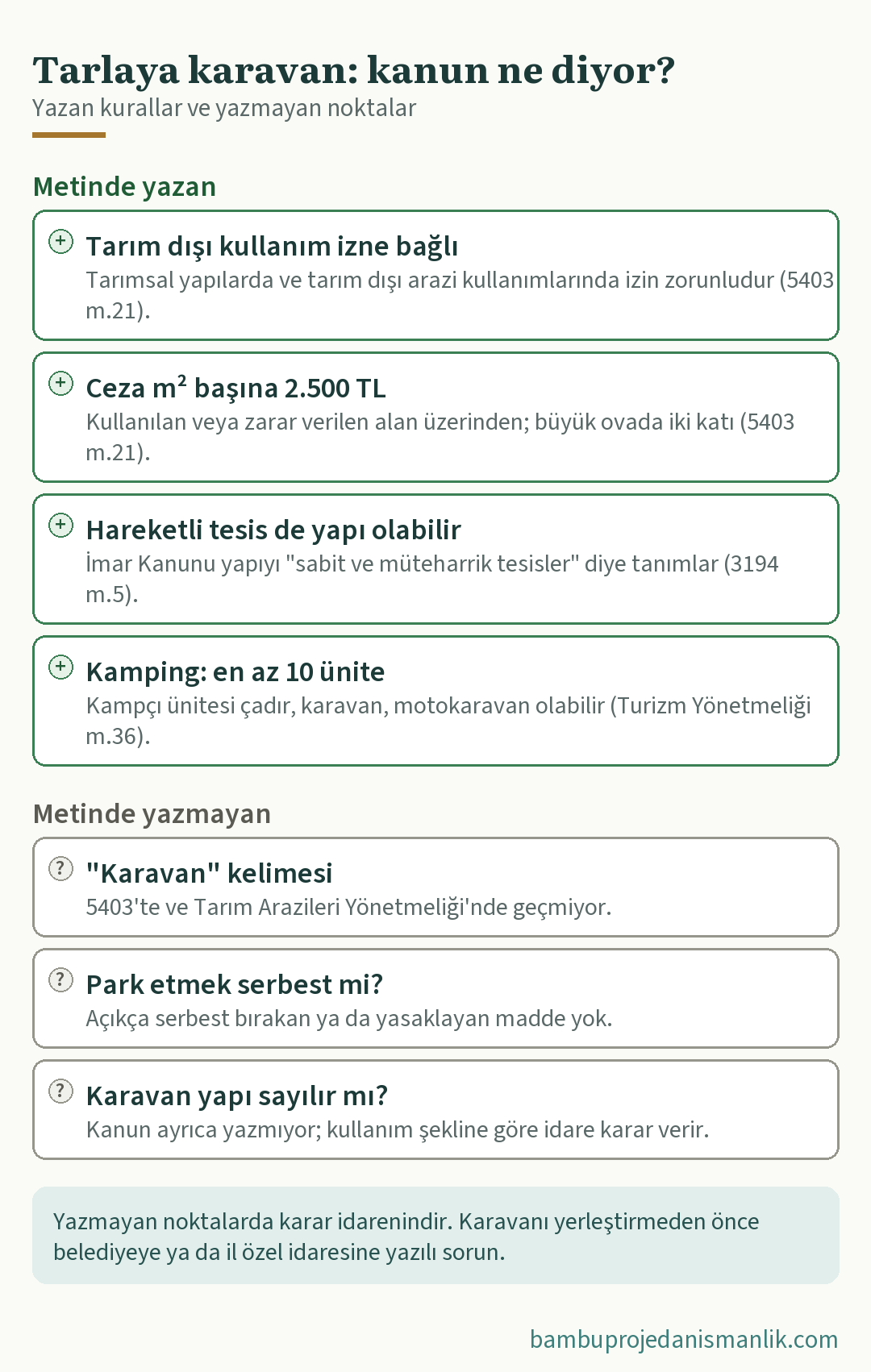
Short answer: The word “caravan” does not appear in the Soil Conservation and Land Use Law No. 5403 (5403 sayılı Toprak Koruma ve Arazi Kullanımı Kanunu) or in the Regulation on the Protection and Use of Agricultural Land (Tarım Arazilerinin Korunması ve Kullanılması Hakkında Yönetmelik). In other words, there is no provision that explicitly allows or explicitly prohibits parking a caravan on a field. However, the Law makes non-agricultural use (tarım dışı kullanım) of agricultural land subject to permission and provides for a fine of 2,500 TL for every square metre of land used without permission. Pouring concrete under the caravan, building a terrace or fence around it, installing a septic tank or water and electricity connections, or living in the caravan permanently can change the situation. Whether this requires permission is decided by the authorities. Before placing a caravan on your field, put your question in writing to the municipality or the Special Provincial Administration (il özel idaresi).
Does the law mention caravans?
No. The word “caravan” does not appear in either of the two main texts governing agricultural land:
Law No. 5403: the words “caravan”, “camp”, “tent”, “accommodation” and “portable” do not appear.
Regulation on the Protection and Use of Agricultural Land (Official Gazette, 4 April 2026, issue 33214) and its annexes: there is no provision on caravans or on people staying overnight. The annex uses the expressions “dismountable” and “tent-type”, but only in the context of temporary shelters for animals.
This does not mean “caravans are allowed”. It only means that the rule is not written under the name “caravan”. The decision is made by looking at how the caravan is used on the land.
How does the law define a caravan?
A caravan is defined not in zoning legislation but in traffic legislation:
Camping vehicle: “A motor vehicle not used for carrying goods, whose interior is fitted with equipment suitable for holidaying, and which can carry as many passengers as it can serve.” (Highway Traffic Law No. 2918 (2918 sayılı Karayolları Trafik Kanunu), Article 3)
Trailer: “A non-motorised vehicle towed by a motor vehicle and manufactured to carry people or goods.” (same article). A towed caravan falls under this definition.
Mobile home: In tourism legislation, this is defined as a vehicle designed to be towed by a motor vehicle, containing a living area, beds, a bathroom and a toilet, and subject to the Highway Traffic Law (Regulation on the Qualifications of Tourism Facilities (Turizm Tesislerinin Niteliklerine İlişkin Yönetmelik), Article 4).
The fact that a vehicle has number plates and is registered for road use does not govern how it may be used on a field. A vehicle registration certificate and a building permit are different documents. Building permits (yapı ruhsatı) are issued by the municipality or the Governor's Office (Valilik) (Article 21 of the Zoning Law, İmar Kanunu).
Does a caravan count as a “building”?
According to the Zoning Law, a building is: “fixed and mobile installations on land and in water, permanent or temporary, public and private, underground and above-ground, including their additions, alterations and repairs” (Zoning Law, Article 5). The Turkish term used, “müteharrik”, means capable of moving. This is why a tiny house on wheels can also count as a building. For details, see our article on containers and tiny houses on agricultural land.
The Law does not separately state whether a caravan falls under this definition. In the authorities' assessment, the decisive factor is the difference between a road-registered vehicle that travels on the roads simply being parked, and a unit whose wheels have been removed, which sits on a concrete base, has connections installed and is lived in permanently. This assessment cannot be derived with certainty from the text. That is why you need to ask in writing.
When does a fine come into play?
Under Law No. 5403, “obtaining permission for agricultural buildings and non-agricultural land uses and complying with soil conservation projects is mandatory” (Article 21). If work starts without permission:
The Governor's Office stops the work entirely.
The landowner or whoever damaged the land is given an administrative fine of 2,500 TL for every square metre of land used or damaged. In large plain protection areas, the fine is doubled.
If the work is not removed within two months, the fine is tripled; the costs of demolition and clean-up are recovered from the person responsible.
Buildings and facilities constructed without permission cannot be connected to electricity, water or natural gas, and no subscription is granted. The institution making the connection faces a fine of 100,000 TL per subscriber. For details, see our article on electricity for agricultural land.
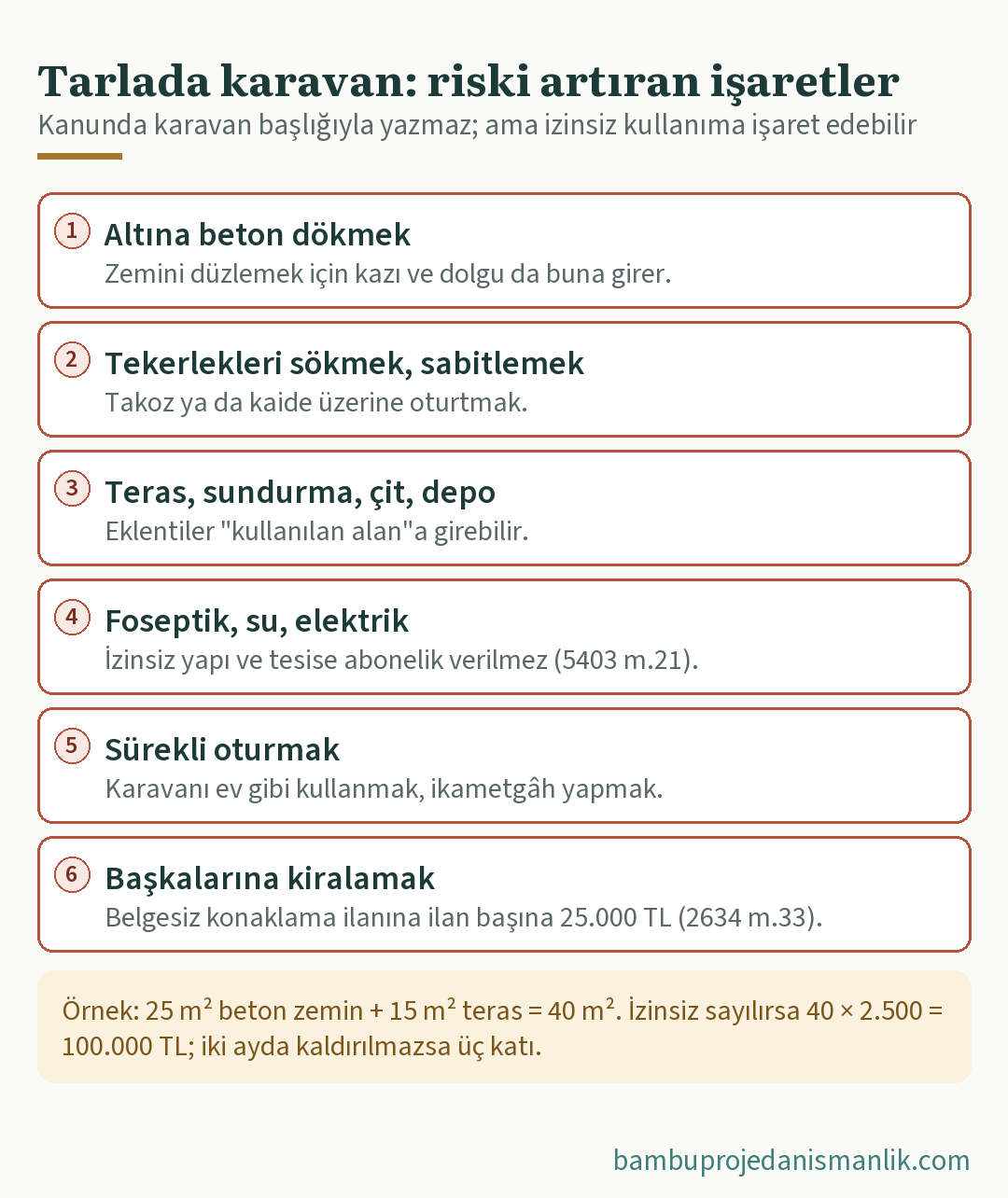
The fine is calculated on the basis of the “land used or damaged”. Even if the caravan itself is a vehicle, concrete poured next to it, a terrace, an access road or a fence can count towards this area. Example: a 25 m² concrete base and a 15 m² terrace together make 40 m²; if this is deemed unauthorised, the fine is 40 × 2,500 = 100,000 TL.
Which signs increase the risk?
The following are not written in the law under a “caravan” heading. But each of them can indicate that the land is being used for non-agricultural purposes or that an unauthorised building or facility has been set up:
Pouring concrete under the caravan, or excavating and filling to level the ground.
Removing the wheels and fixing it on blocks or a base.
Adding extensions such as a terrace, canopy, fence or storage shed.
Digging a septic tank, or setting up water or electricity connections.
Living in the caravan permanently, or using it as your registered address.
Renting the caravan out to others. An unlicensed accommodation business advertising online faces an administrative fine of 25,000 TL per listing (Tourism Incentive Law No. 2634 (2634 sayılı Turizmi Teşvik Kanunu), Article 33).
A note for information: the wording in the Regulation, “dismountable, without pouring concrete, without excavation or filling”, applies only to temporary tent-type shelters for animals and is subject to a signed undertaking. This provision cannot be applied to caravans in which people stay.
Where can you legally stay with a caravan?
The places explicitly regulated for caravans in the legislation are:
Campsites: “Campsites are facilities of at least ten units established in places of natural beauty such as the sea, lakes or mountains, where guests generally meet their own needs for overnight stays, food and drink, rest, entertainment and sport with their own resources.” A camper unit “may consist of a tent, tent trailer, caravan, motorhome or bungalow” (Regulation on the Qualifications of Tourism Facilities, Article 36).
Mobile home facilities: These may only be set up in areas designated in zoning plans (imar planı) for camping or rural and eco-tourism use. In these facilities, “no arrangement may be made that removes the mobility of the accommodation units” (same Regulation, Article 35/A).
Forests and national parks: In areas classed as forest, land may be leased under the relevant legislation solely for building and operating camping areas with tents and caravans (Law No. 2634, Additional Article 5). This leasing is carried out by the relevant authority; individuals cannot set up a camp on their own initiative.
Your own field is not one of these places. If you want to run your field as a camping or caravan site, that is a request for tourism and non-agricultural use; you first need a non-agricultural use permit and a zoning plan.
Can you put a caravan on pasture, highland pasture or forest land?
Pastures, summer pastures and winter pastures “cannot be transferred into private ownership and cannot be used for purposes other than their intended use” (Pasture Law No. 4342 (4342 sayılı Mera Kanunu), Article 4).
Within state forests, “it is prohibited to construct any kind of building, pen or animal shelter, to clear, cultivate or sow fields, and to settle in the forest” (Forest Law No. 6831 (6831 sayılı Orman Kanunu), Article 17). Those who commit the prohibited acts face imprisonment of six months to two years (same Law, Article 93).
There are special permit and leasing routes for camping and caravans in forests and pastures; settling there outside these routes is risky.
Frequently asked questions
If I park my caravan on my field and stay in it at weekends, will I be fined?
There is no provision in the law that explicitly prohibits or allows this. What matters is how the authorities decide whether the land is being used for non-agricultural purposes. If there is concrete, extensions, connections or a permanent stay, the risk increases. Before placing the caravan, ask the municipality – or, if you are outside municipal boundaries, the Special Provincial Administration – in writing, and get the answer in writing.
Does a tiny house with number plates and a registration certificate count as a caravan?
Number plates and a vehicle registration certificate relate to the vehicle's use on the road. They do not make its use on the field authorised; a building permit is a separate document (Zoning Law, Article 21). The Zoning Law also counts mobile installations as buildings (Article 5). If the tiny house is fixed in place and used as a dwelling, a fine for an unauthorised building may apply.
Can I put a solar panel on my caravan?
The Regulation contains a special provision, in the context of agricultural irrigation, for mobile solar panels mounted on a vehicle that have their own approval. This provision does not make staying in a caravan permissible; what matters is not where the electricity comes from but how the land is used.
What if I rent my field out to caravanners?
This is a non-agricultural use and a commercial accommodation activity. A campsite requires the conditions set out in tourism legislation and a zoning plan. An unlicensed accommodation business advertising online faces a fine of 25,000 TL per listing (Law No. 2634, Article 33).
Can I put a caravan on my plot in a village settlement area (köy yerleşik alanı)?
Law No. 5403 does not apply within the boundaries of a village settlement area, i.e. the designated built-up area of a village (Zoning Law, Article 27). However, buildings in village settlement areas require project approval and notification to the village headman's office (muhtarlık). Ask the authorities how a caravan would be assessed there. For details, see our article on village settlement areas.
Is building a vineyard house on a field safer than a caravan?
A vineyard house (bağ evi, a small dwelling on agricultural land) is a building that a producer who meets the conditions can build with permission: on arable land at least 20 dönüm (20 decares; 1 dönüm = 1,000 m²) = 20,000 m² (2 hectares) is required, and in vineyards and orchards at least 10 dönüm (10 decares) = 10,000 m² (1 hectare); the footprint is 30 m². Because it is built with permission, electricity and water can also be connected. For details, see our article on the conditions for building a house on agricultural land.
Example: two caravans
Ahmet Bey's motorhome has number plates and is registered for road use. In spring he drives to his field on a few weekends, parks the vehicle on the dirt track and returns on Sunday evening. He does not touch the ground and sets up no connections. There is no provision in the law that explicitly regulates this; nevertheless, because he had doubts, he sent a written enquiry to the municipality.
Mehmet Bey, on the other hand, removed the wheels of his towed caravan, set it on a 25 m² concrete base, built a 15 m² wooden terrace next to it, had a septic tank dug and started living in the caravan all year round. In this case the land is in fact being used for non-agricultural purposes and an unauthorised building and facility has been set up. If this is detected, a fine of 100,000 TL is imposed for the 40 m² used; if it is not removed within two months, the fine rises to 300,000 TL. Electricity and water cannot be connected to the caravan either.
The difference lies not in the vehicle but in the purpose for which it is used. We all know the difference between parking a vehicle with number plates on your field and removing the same vehicle's wheels, setting it on concrete and using it as a house or hut. Number plates relate to the vehicle's use on the road; they do not determine the purpose for which it is used on a field. That is why, before placing a caravan on your field, put your question in writing to the municipality or the Special Provincial Administration.
This article has been prepared for general information on the basis of the Soil Conservation and Land Use Law No. 5403 (Articles 13 and 21; amendments made by Law No. 7584, Official Gazette, 20 June 2026), Zoning Law No. 3194 (Articles 5, 21 and 27), the Regulation on the Protection and Use of Agricultural Land (Official Gazette, 4 April 2026, issue 33214) and Annex 1, Highway Traffic Law No. 2918 (Article 3), the Regulation on the Qualifications of Tourism Facilities (Articles 4, 35/A and 36), Tourism Incentive Law No. 2634 (Article 33 and Additional Article 5), Pasture Law No. 4342 (Article 4) and Forest Law No. 6831 (Articles 17 and 93). As there is no explicit provision on caravans, the definitive assessment is made by the relevant authorities.
Bambu Proje-Danışmanlık is based in Denizli, and we provide project preparation services (Project Technical Report – Proje Teknik Raporu, and Soil Conservation Project – Toprak Koruma Projesi) for requests from all provinces of the Aegean Region (Denizli, İzmir, Manisa, Aydın, Muğla, Uşak, Kütahya and Afyonkarahisar). We send your signed and stamped report by courier to you and/or to the engineer responsible for your file at the relevant Provincial Directorate of Agriculture and Forestry (İl Tarım ve Orman Müdürlüğü). To find out what you can obtain permission for on your land, you can contact us via our contact page or take a look at our service regions.