 Bambu Proje-Danışmanlık
Law No. 5403 as amended in 2026: what it is, agricultural land rules and penalties
Anyone who buys, sells, divides or builds on agricultural land comes up against the same law: the Soil Conservation and Land Use Law No. 5403 (5403 sayılı Toprak Koruma ve Arazi Kullanımı Kanunu). In this article we explain in plain language what the Law is, why it was introduced, what changed in 2026 and what the penalty is for building without a permit.
Last updated: 27 November 2026. The information reflects the current legislation published in the Official Gazette (Resmî Gazete).
Short answer: Law No. 5403 prevents agricultural land from being used for purposes other than its intended one, from being built on without planning and from being split into small pieces through inheritance. Building on agricultural land, using land for non-agricultural purposes and dividing a field all require a permit. As of 2026, unauthorised use attracts an administrative fine of 2,500 TL per square metre, and unauthorised buildings cannot be connected to electricity, water or natural gas.
What is Law No. 5403?
The Soil Conservation and Land Use Law No. 5403 was adopted on 3 July 2005 and published in Official Gazette No. 25880 of 19 July 2005. The current text of the Law is available at mevzuat.gov.tr. The Law derives its authority from the Constitution: Article 45 of the Constitution makes it the State's duty to prevent agricultural land, meadows and pastures from being misused and destroyed.
The essence of the Law can be summed up in one sentence: the purpose for which a piece of land may be used, and on what conditions, is decided not by personal preference but within a system of scientific surveys, classification and permits.
The Law's definition of agricultural land is not limited to fields that are being cultivated today: land that is suitable for agricultural production, or that could be made suitable through improvement, is also agricultural land (Article 3 of the Law). That is why the idea ‘I don't farm my field, so it doesn't count as agricultural land’ is wrong.
Why was Law No. 5403 introduced?
Soil is a resource that takes centuries to form and that no investment can bring back once it has been lost. While a single centimetre of fertile topsoil takes hundreds of years to form, that same layer can be destroyed by unplanned development in a single construction season.
From the 1950s to the early 2000s, Türkiye lost millions of dönüm (1 dönüm = 1,000 m²) of agricultural land from production as a result of haphazard urbanisation, industrial plants built on fertile plains, fragmentation through inheritance and erosion. Before the Law there was no comprehensive regulation in this area; the relevant provisions were scattered across different pieces of legislation. As a result, fertile plains were turned into industrial and residential areas, even land in which the State had invested in irrigation was opened up to development, and fields were split through inheritance into pieces too small to farm.
Law No. 5403 regulates these three problems – misuse, unplanned development and the fragmentation of land – under a single roof.
What changed in Law No. 5403 in 2026?
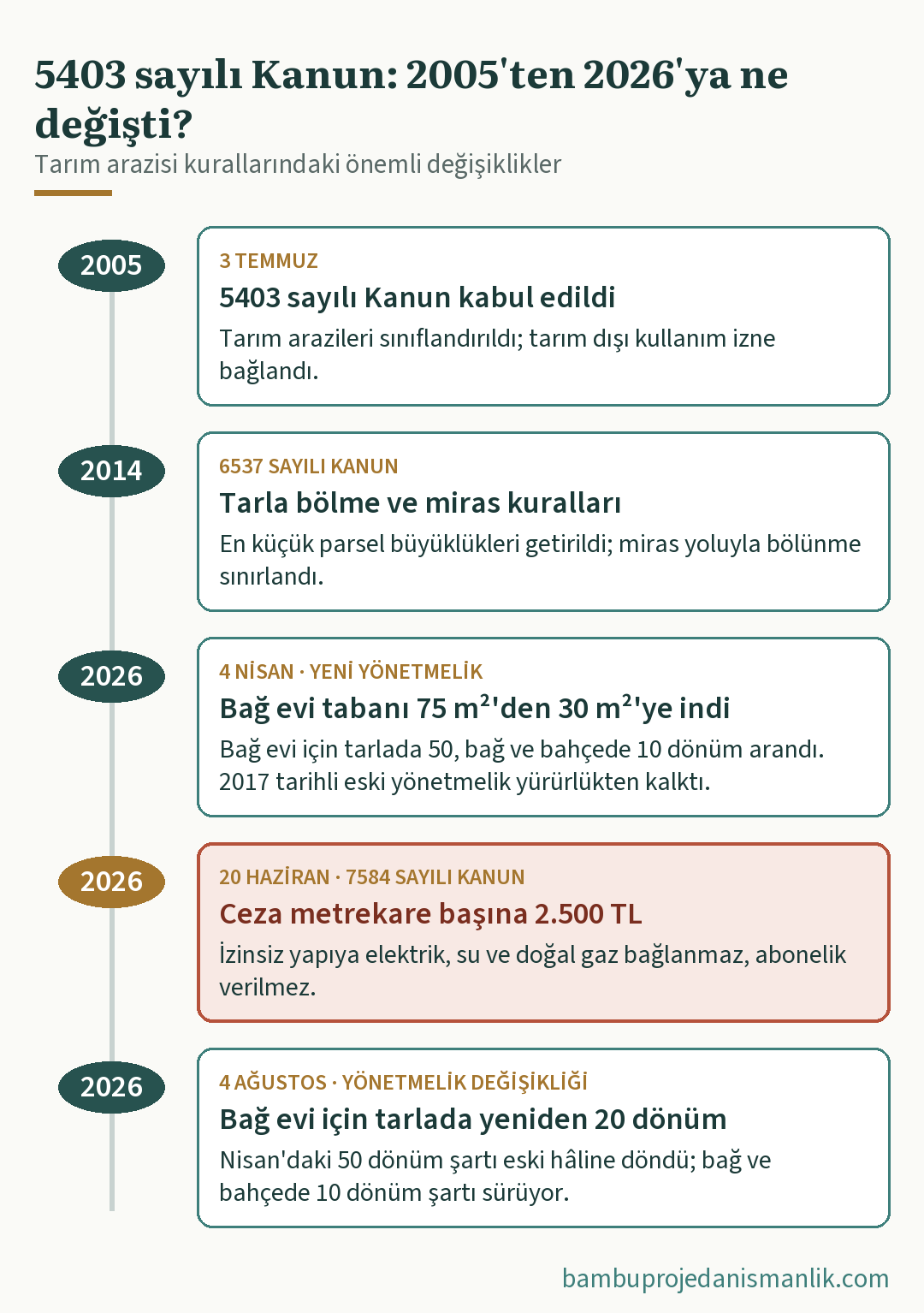
Since 2005 the Law has been updated in line with needs and requirements, and its application has also been shaped by regulations, circulars and instructions. The most important recent changes are as follows:
2014, Law No. 6537: the division of agricultural land and its distribution through inheritance were regulated anew.
4 April 2026, new Regulation: the Regulation on the Protection and Use of Agricultural Land (Tarım Arazilerinin Korunması ve Kullanılması Hakkında Yönetmelik), published in Official Gazette No. 33214, repealed the previous regulation of 2017. The footprint of a vineyard house (bağ evi – a small house that may be built on agricultural land under specific conditions) was reduced from 75 m² under the old rules to 30 m². The land size required for a vineyard house on planted agricultural land (vineyards, orchards) rose from 5 dönüm to 10 dönüm.
20 June 2026, Law No. 7584: the fine for unauthorised use was raised from 10 TL to 2,500 TL per square metre. Connecting unauthorised buildings to electricity, water and natural gas, and opening utility accounts for them, was prohibited; an authority that fails to comply with this ban faces a fine of 100,000 TL per subscription. The same Law prohibited cooperatives subject to Cooperatives Law No. 1163 from acquiring ownership or limited rights in rem in areas subject to Law No. 5403; agricultural cooperatives now require the Ministry's permission (Article 8, final paragraph, of the Law).
4 August 2026, amendment to the Regulation: the April Regulation required 50 dönüm (5 hectares) of land on a field for a vineyard house. With the amendment published in Official Gazette No. 33330, this requirement went back to 20 dönüm (2 hectares), as it had been before. In other words, the requirement for fields remained the same as before; for vineyards and orchards it became stricter, and the vineyard house itself became smaller. The same amendment provided that applications made before 4 April 2026 are to be assessed under the old (2017) regulation.
What are the classes of agricultural land?
The Law's first task is to classify land according to scientific criteria. The Law divides agricultural land into four classes (Articles 3 and 8 of the Law):
- Absolute agricultural land (mutlak tarım arazisi): land used for, or suitable for, agriculture whose soil properties do not limit yields relative to the local average and which has no, or only very slight, topographic limitations such as slope. - Special crop land (özel ürün arazisi): land on which not every crop will grow because of soil or slope limitations, but on which special plant products or aquaculture products can be produced. - Planted agricultural land (dikili tarım arazisi): land on which perennial trees, shrubs or bush-type plants suited to the area (such as orchards and vineyards) are cultivated. - Marginal agricultural land (marjinal tarım arazisi): land on which, because of soil and slope limitations, only traditional farming with tillage is possible. Requests for non-agricultural use (tarım dışı kullanım) are assessed on these lands first; ground-mounted solar power plants, however, are only considered on dry marginal land. Alongside these four classes there are two further protection categories:
Irrigated agricultural land (sulu tarım arazisi): land on which the water needed by plants is supplied from a water source in sufficient quantity and in a controlled way. Being irrigated or dry is a characteristic separate from the class: a dry field can also be absolute agricultural land.
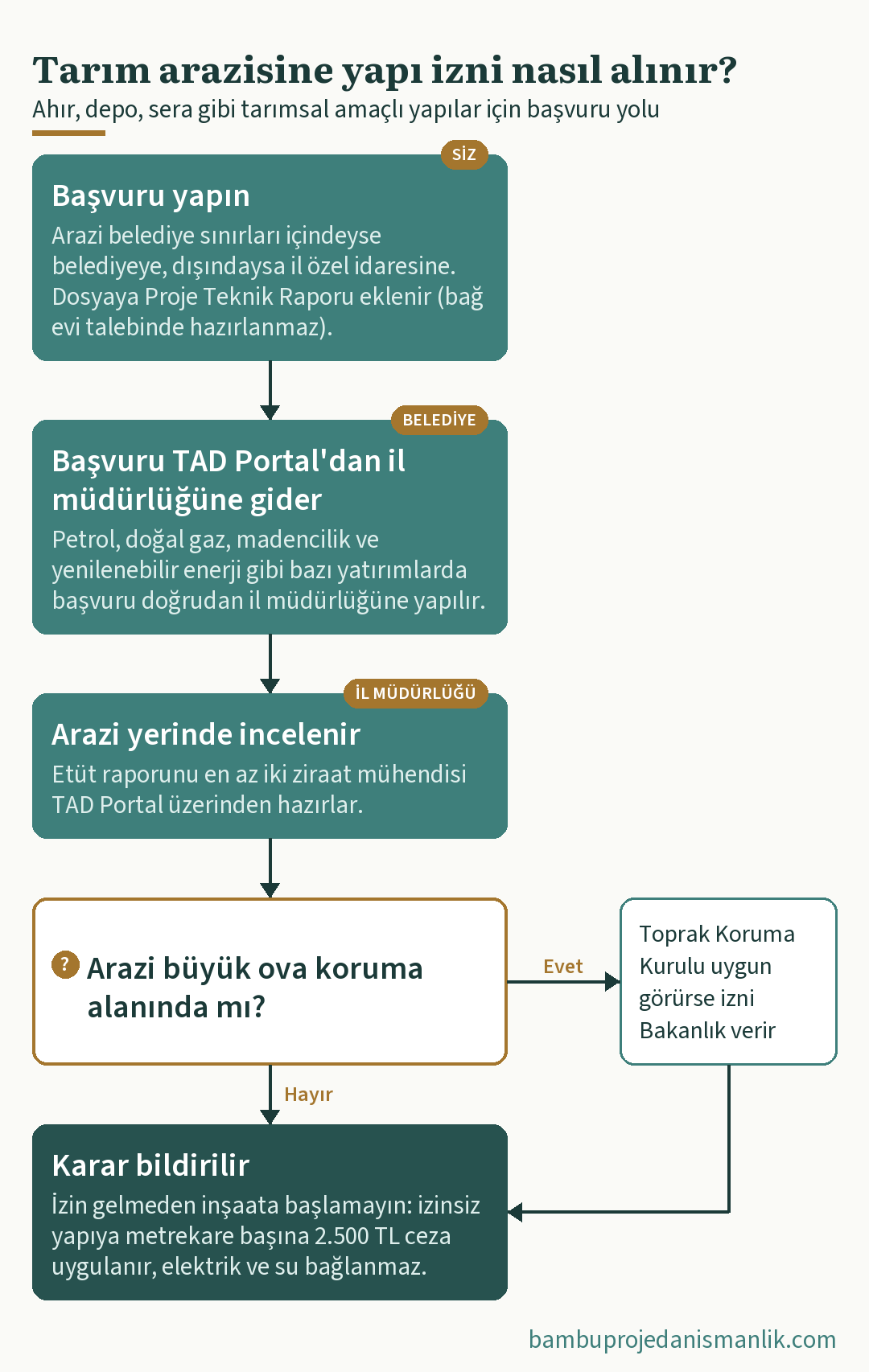
Large plain protection area (büyük ova koruma alanı): plains declared by Presidential Decree which have high production capacity but where soil loss is rapid because of erosion, pollution or misuse. On these plains, agricultural land may as a rule not be used for other purposes; even agricultural buildings may only be built with the favourable opinion of the Soil Conservation Board (Toprak Koruma Kurulu) and the Ministry's permission (Article 14 of the Law). Details in our article on large plain protection areas.
The class of a piece of land is determined by the land survey report (arazi etüt raporu). Under Article 6 of the Regulation, the survey report is prepared via the TAD Portal by at least two agricultural engineers who have completed the Ministry's in-service training, on the basis of an on-site inspection, and is approved by the provincial directorate.
What is the minimum size, in dönüm, for dividing a field?
Agricultural land cannot be subdivided (parcel subdivision, ifraz) below the sufficient-income agricultural land size (yeter gelirli tarımsal arazi büyüklüğü) of the district in which it lies. These sizes are listed province by province and district by district in List (1) annexed to the Law (Article 8/A of the Law). Across Türkiye, the sizes in the list fall within the following ranges:
Irrigated agricultural land: between 50 and 100 dönüm (decares), depending on the district
Dry agricultural land: between 120 and 200 dönüm (decares), depending on the district
Planted agricultural land (vineyards, orchards): 10 dönüm (decares)
Land under protected cultivation (greenhouses): 3 dönüm (decares)
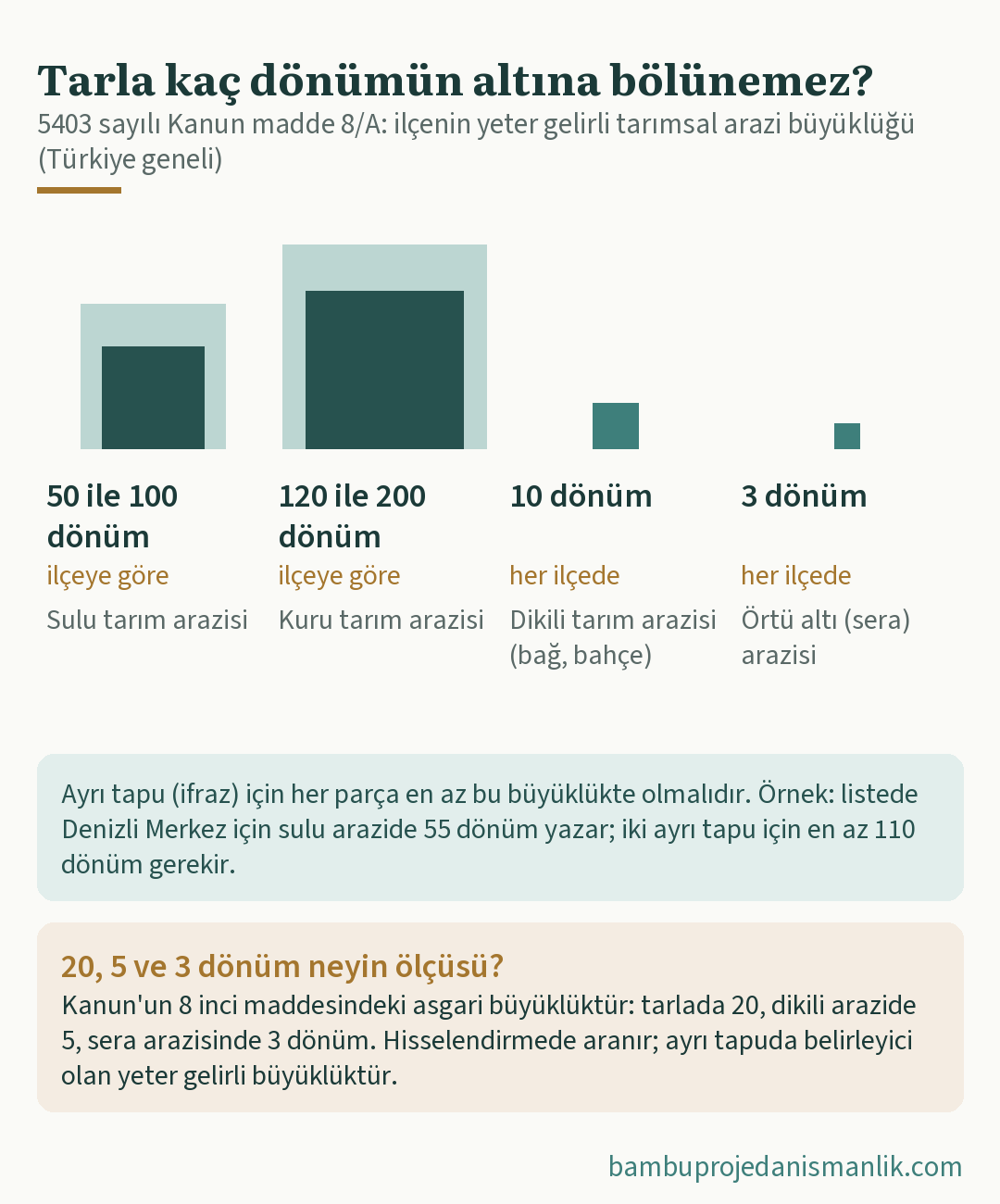
You can find the figure for your own district in this list or from the Provincial or District Directorate of Agriculture and Forestry (İl veya İlçe Tarım ve Orman Müdürlüğü). Every piece resulting from the division must be at least this size. For example, the list gives 55 dönüm for irrigated land in central Denizli (Denizli Merkez): for the field to be divided into two separate title deeds (tapu) it must be at least 110 dönüm, and for three separate title deeds at least 165 dönüm. In the calculation, agricultural plots belonging to the same person that form an economic unit are assessed together; for non-adjacent plots, the test is that they are less than 3 kilometres apart and that the plots exceed a certain size (1 dönüm under protected cultivation, 5 dönüm for planted land, 10 dönüm for irrigated and dry land) (Article 7 of the Regulation on the Transfer of Ownership of Agricultural Land).
What do 20, 5 and 3 dönüm measure? These are the minimum agricultural land sizes set out in Article 8 of the Law: 20 dönüm (2 hectares) for absolute, marginal and special crop land, 5 dönüm (0.5 hectares) for planted agricultural land and 3 dönüm (0.3 hectares) for land under protected cultivation. The Ministry may increase these sizes. Since the sufficient-income sizes in the list are not smaller than these, it is the sufficient-income size that is decisive for separate title deeds (subdivision). The minimum size, on the other hand, applies to division into shares (hisselendirme): if the agricultural land owned is above the sufficient-income size, it may be divided into shares of the minimum size or larger, provided it does not fall below that size; agricultural land below the sufficient-income size cannot be divided into shares (Article 6 of the same Regulation). Nor can the number of shares and shareholders be increased below the minimum size (Article 8 of the Law).
Subdivision, division into shares, assignment of shares, conversion of joint ownership into ownership in shares or its transfer, transfer by succession as ownership in shares, partition and change of the land's registered designation all require the Ministry's permission (Article 8/B of the Law); the exact calculation is made at the Provincial or District Directorate of Agriculture and Forestry. Inherited agricultural land, too, may as a rule not be divided and distributed below these sizes.
Can you build on agricultural land?
Yes, but only buildings required for agricultural production, and only with a permit. Under the Law, agricultural land of any class may be used for agricultural buildings to the extent needed, with the permission of the Governor's Office (Valilik), provided the project is complied with (Article 13 of the Law).
Article 4 of the Regulation lists agricultural buildings (tarımsal amaçlı yapı): livestock and aquaculture facilities, greenhouses, producers' storage buildings, dairies, flour mills, drying facilities, seedling and sapling production facilities, vineyard houses, rooftop solar power plants as ancillary structures of an agricultural building, solar power plants for irrigation and the like. The document that justifies the request for these buildings is the Project Technical Report (Proje Teknik Raporu), whose format is laid down in an annex to the Regulation (Annex 16). No Project Technical Report is prepared for vineyard house requests, however (Annex 16); we have explained the conditions for a vineyard house in our article on the conditions for building a house on a field.
Applications are made under Article 5 of the Regulation: if the land lies within municipal boundaries, you apply to the municipality; if it lies outside them, to the special provincial administration (il özel idaresi). These bodies forward the application to the provincial directorate via the TAD Portal (Agricultural Land Assessment and Information System – Tarım Arazileri Değerlendirme ve Bilgilendirme Sistemi). For certain investments outside the remit of the municipality and the special provincial administration, such as oil, natural gas, mining and renewable energy, the request is forwarded directly to the provincial directorate via the TAD Portal (Article 5 of the Regulation).
A permit under Law No. 5403 does not take the place of a building permit. After the 5403 permit, a building permit (yapı ruhsatı) or the authority's approval must be obtained separately under zoning legislation. A permit for an agricultural building becomes invalid if no building permit is obtained within two years of its notification (Article 16 of the Regulation).
Can agricultural land be used for non-agricultural purposes?
As a rule, absolute agricultural land, special crop land, planted agricultural land and irrigated agricultural land may not be used for non-agricultural purposes. Under Article 13 of the Law, permission may be granted only where no alternative site is available and the Soil Conservation Board approves, in the following cases:
strategic defence needs,
the need for temporary settlements after a natural disaster,
oil and natural gas exploration and production activities,
mining activities for which the relevant ministry has issued a public interest decision,
plans and investments for which ministries have issued a public interest decision,
road infrastructure and superstructure investments carried out in the public interest,
investments relating to the use of renewable energy resource areas,
geothermal-heated high-tech greenhouse investments.
Agricultural land outside these four classes may be allocated to non-agricultural use by Governor's Offices, provided soil conservation projects are complied with. Even where permission is granted, if excavation, filling or construction poses a risk of soil loss on surrounding land, a Soil Conservation Project (Toprak Koruma Projesi) including measures such as terracing, planting and drainage must be prepared and approved.
What is the Soil Conservation Board?
Every province has a Soil Conservation Board of at least nine members, chaired by the governor (Article 10 of the Regulation). The Provincial Director of Agriculture and Forestry is deputy chair; representatives of the Ministry of Treasury and Finance, public institutions, the municipality or special provincial administration, universities and civil society organisations sit on the Board. The Board assesses the requests for non-agricultural use that come before it, together with the alternative sites identified in the survey report, and decides on them.
Under the April 2026 Regulation (Article 12), requests for agricultural buildings outside large plains, and certain non-agricultural requests on dry marginal land where the survey report finds that agricultural integrity is not impaired, are decided directly by the Governor's Office without being placed on the Board's agenda. Requests that would disrupt the integrity of land consolidation are rejected by the Governor's Office without being placed on the Board's agenda.
What is the penalty for building on agricultural land without a permit?
Under Article 21 of the Law, if land is used without a permit or contrary to its permit:
The Governor's Office halts the work; if the building has been completed, it may not be used.
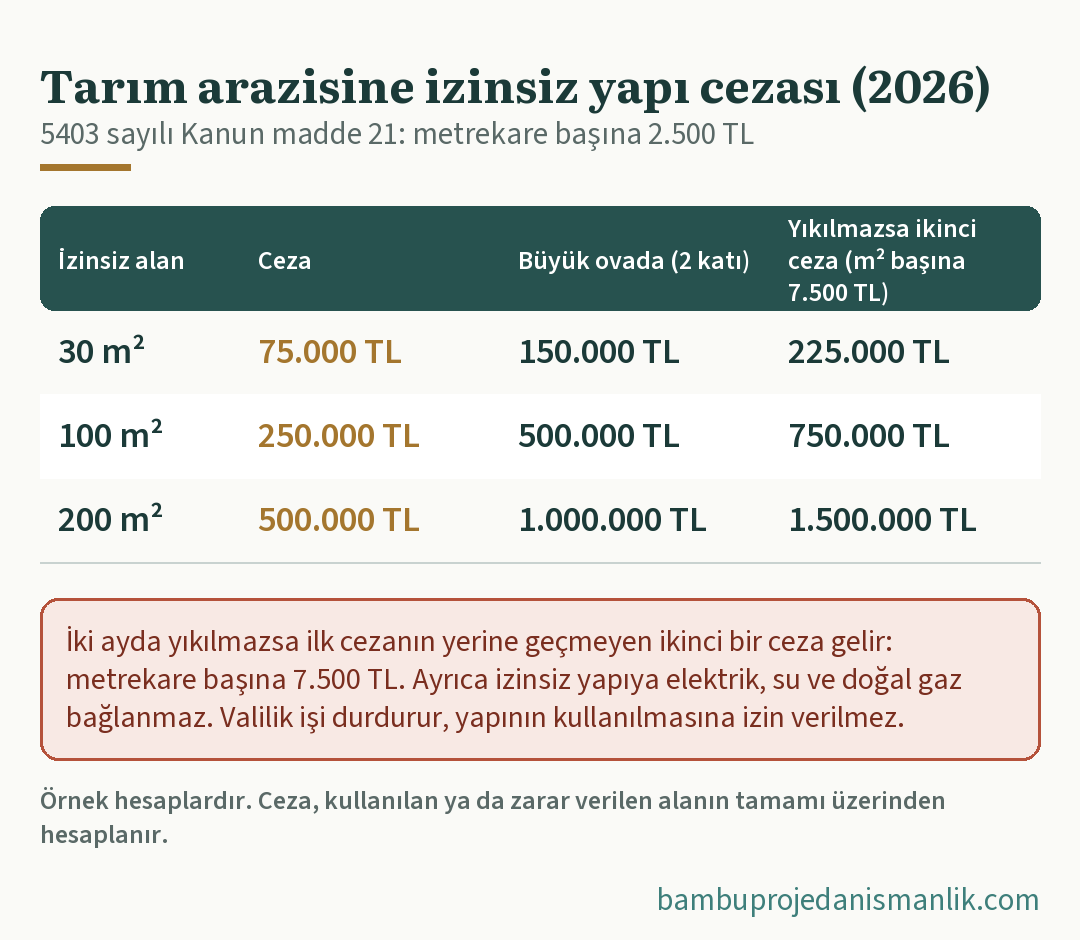
An administrative fine of 2,500 TL for every square metre of the area used or damaged is imposed. The area is not just the footprint of the building; the entire area used, including concrete surfaces, courtyards, roads and fill, is counted. For example, if 100 m² has been used without a permit, the fine is 250,000 TL. This amount applies to 2026; administrative fines are increased at the start of each calendar year by the revaluation rate (Article 17/7 of Misdemeanours Law No. 5326). The rate has been announced as 27.83% (Official Gazette of 24 November 2026, Tax Procedure Law General Communiqué Serial No. 599); accordingly, from 1 January 2027 the amount per square metre will be 3,195 TL (319,500 TL for 100 m²).
In large plain protection areas the fine is doubled; in the same example the fine would be 500,000 TL.
A person who applies and obtains the necessary permit within one month of notification of the fine may be allowed to complete the work or use the building. This route only works for a building that is eligible for a permit (such as a barn, storage building or vineyard house that meets the conditions); a building that cannot be permitted will not be legalised this way.
A person who does not apply, or whose permit is refused, is given two months to demolish the building and restore the land to a condition suitable for agriculture. If the buildings are not demolished and the land is not restored within this period, the Governor's Office halts the activity and the fine of 2,500 TL per square metre is this time applied at three times the amount, i.e. 7,500 TL per square metre (750,000 TL for 100 m²). This is a second fine that does not replace the first. The building is then demolished by the municipality or special provincial administration within one month; the costs of demolition and clearance are recovered from those responsible.
Paying the fine does not make the building authorised; the permit or demolition process runs separately.
If the administrative fine is paid within one month of notification, a 25% reduction applies (Article 17/6 of Misdemeanours Law No. 5326). Payment does not take away the right to object.
The deadline for objecting to the fine is short: an application must be made to the criminal judgeship of peace (sulh ceza hâkimliği) within 15 days of notification (Article 27 of Law No. 5326). The one-month permit application does not extend this deadline; check the correct route of appeal in the notification letter.
Buildings erected without a permit are not connected to electricity, water or natural gas, and no utility accounts are opened for them. Authorities, institutions and organisations that fail to comply with this ban are fined 100,000 TL per subscription; if the subscription is not cancelled within 30 days of notification of the fine, a further fine of 100,000 TL is imposed for each month it continues (Article 21 of the Law). Details in our article on electricity for fields.
These penalties are imposed under Law No. 5403. Under the Zoning Law (İmar Kanunu), a building without a permit may additionally be sealed and demolished and a zoning fine imposed (Articles 32 and 42 of Law No. 3194).
We explain the one-month application route after notification of the fine for a house built without a permit, and what happens to the house, in our video on fines for illegal houses. The financial risk of a building started without a permit is so great that it bears no comparison with the effort and cost the permit process requires.
How does Law No. 5403 protect landowners?
Although at first glance the Law may look like a set of rules that ties landowners' hands, what it actually protects is the landowner. Thanks to classification, the productive quality of the land is officially documented; damage to your soil from unplanned development on neighbouring parcels is prevented; the value of irrigation investments is preserved; and agricultural land keeps its production value in the face of short-term speculation on building plots.
Key terms in Law No. 5403
Subdivision (ifraz): the division of a parcel at the land registry into more than one parcel. The limit for subdivision is the district's sufficient-income agricultural land size (Article 8/A of the Law).
Agricultural building: a building required for agricultural production that directly serves production (Article 4 of the Regulation). A dwelling does not fall within this scope; a vineyard house does, subject to certain conditions.
Non-agricultural use: allocating land to a purpose other than agriculture, such as housing, industry, energy or tourism; it is subject to the exceptions in Article 13 of the Law.
Survey report (etüt raporu): the report that establishes the class and characteristics of the land through on-site inspection, prepared via the TAD Portal by at least two agricultural engineers (Article 6 of the Regulation).
Public interest decision (kamu yararı kararı): a decision required for certain non-agricultural requests, taken by the relevant ministry or jointly by ministries.
TAD Portal: the Agricultural Land Assessment and Information System; the electronic system through which applications and assessments are processed.
Large plain protection area: a plain declared by Presidential Decree in which agricultural land is protected most strictly.
Three examples: how the Law works in practice
Example 1: A barn request. A farmer who wants to build a fattening barn on a 15-dönüm (15-decare) field is requesting an agricultural building, which is not caught by the exceptions in Article 13. The farmer applies with a Project Technical Report and its annexes through the municipality or (if the land is outside municipal boundaries) the special provincial administration. If the land is not in a large plain protection area, the request is examined by the provincial directorate and the permit is granted by the Governor's Office (Article 14 of the Regulation). If it is within a large plain protection area, the request is placed on the agenda of the Provincial Soil Conservation Board; if the Board approves, the permit is granted by the Ministry (Article 14 of the Law, Article 15/1-a of the Regulation).
Example 2: A request to build a house on a field. The same farmer's wish to build a detached house in a corner of the field is a non-agricultural use. On absolute or irrigated agricultural land, such a request is as a rule not granted. However, a small building that falls within the definition of a vineyard house may be permitted as an agricultural building if the property meets the necessary conditions. This farmer's 15-dönüm field, however, does not meet the 20 dönüm required for a vineyard house on a field.
Example 3: A proposal for a solar power plant on the land. An energy company's proposal to install a solar power plant on fertile irrigated agricultural land comes to nothing in the face of paragraph 7 of Article 7 of the Regulation: if the land is not in the dry marginal class, the request is not placed on the Board's agenda. On dry marginal land, by contrast, if agricultural use and the integrity of land consolidation are not disrupted, the request is assessed by the Governor's Office without going to the Board, and permission may be granted subject to a Soil Conservation Project (Article 13 of the Law, Article 12 of the Regulation).
Land consolidation and combating erosion
Although the Law is better known for its permit and penalty provisions, the side of it that strengthens production is at least as important. Land consolidation (arazi toplulaştırması) is a public programme that reorganises fragmented, scattered parcels into workable blocks together with a network of roads and irrigation. The Regulation expressly requires, as an assessment criterion for non-agricultural requests, that the integrity of the consolidation project is not disrupted. Knowing the consolidation status of your land is therefore part of the application.
Combating erosion, meanwhile, is a constant aim of soil conservation projects and land-use planning: protecting vegetation cover on sloping land, terracing and drainage are how the Law's protective approach is put into practice on the ground.
What should landowners do?
Know your land: find out from the Provincial or District Directorate of Agriculture and Forestry what class it is, whether it lies in a large plain protection area and whether it is covered by a land consolidation project. When buying land, check the annotations section of the title deed: a property found to have been used without a permit is annotated ‘used for purposes other than those of Law No. 5403’ (5403 sayılı Kanunun amacı dışında kullanılmıştır) (Article 20 of the Regulation).
Name what you want to do correctly: is your planned use an agricultural building or a non-agricultural use? The process and outcome of the two are completely different.
Prepare a complete file: the Project Technical Report and the documents listed in the annexes to the Regulation determine how long the process takes and how it turns out.
Do not start building before the permit arrives: the fine is 2,500 TL per square metre, it is doubled in large plain protection areas, and unauthorised buildings are not connected to electricity, water or natural gas.
The provisions of Law No. 5403 do not apply within the boundary of a village settlement area (köy yerleşik alanı – the designated built-up area of a village) (Article 27 of the Zoning Law). We explain the conditions for building a house in a village in a separate article and in the 5403 Visual Guide Part 3 video.
Frequently asked questions
When was Law No. 5403 enacted?
The Soil Conservation and Land Use Law No. 5403 was adopted on 3 July 2005 and entered into force on publication in the Official Gazette of 19 July 2005. The Law was most recently amended by Law No. 7584, published on 20 June 2026.
How much is the fine for an unauthorised building on agricultural land in 2026?
An administrative fine of 2,500 TL is imposed for every square metre of the area used. For an unauthorised 100 m² building the fine is 250,000 TL; in a large plain protection area this amount is doubled. If the building is not demolished within the two-month period given, a second fine of three times the first is imposed and the building is demolished. The amounts apply to 2026 and rise at the start of each year by the revaluation rate. The fine is based on the amount in force on the date the offence was committed; if the construction date cannot be established, the date of detection is used (Article 21 of the Regulation). The amount of 2,500 TL has applied since 20 June 2026.
Can a house on agricultural land be connected to electricity and water?
A building that has a 5403 permit and is fit for use under zoning legislation can be connected. Since 20 June 2026, Law No. 5403 has also expressly prohibited connecting buildings erected without a permit to electricity, water and natural gas and opening utility accounts for them. Details in our article on electricity for fields.
What is the minimum size, in dönüm, for dividing a field?
Agricultural land cannot be divided below the sufficient-income agricultural land size of the district in which it lies. This size is listed district by district in the list annexed to the Law; across Türkiye it is 50 to 100 dönüm for irrigated land, 120 to 200 for dry land, 10 for planted land and 3 dönüm for greenhouse land. Plots belonging to the same person that are less than 3 kilometres apart are assessed together in the calculation if they exceed a certain size. The often-quoted 20, 5 and 3 dönüm are the minimum sizes: they apply directly to division into shares; they are also the lower limit for subdivision, but because the sufficient-income size is larger, that is the decisive figure for subdivision.
Can agricultural land be sold in shares?
It depends. If the land is below the district's sufficient-income size, it cannot be divided into shares. If it is above that size, it may be divided into shares, provided the land held does not fall below that size and each share is at least the minimum size (20 dönüm for fields, 5 for planted land, 3 dönüm for greenhouse land). The number of shares and shareholders cannot be increased below the minimum size. Division into shares requires the Ministry's permission; consult the Provincial or District Directorate of Agriculture and Forestry before the transaction. When buying a share, also remember that the other co-owners have a right of pre-emption and that building on a field held under a shared title deed (hisseli tapu – co-ownership in undivided shares) requires the consent of all co-owners (Articles 692 and 732 of the Turkish Civil Code).
Can a vineyard house be built on agricultural land?
Yes, under certain conditions: at least 20 dönüm (20 decares) of land is required on a field and at least 10 dönüm (10 decares; previously 5 dönüm) in a vineyard or orchard; the footprint of the vineyard house may be no more than 30 m² (it was 75 m² under the old regulation) and its height no more than 2 storeys. Details in our article on the conditions for building a house on a field.
Can a container or prefabricated house be placed on a field?
The fact that a structure is a container, prefabricated or movable does not make a permit unnecessary. Nor does it matter whether you use the container as a house, store or shed: a structure placed on agricultural land requires a permit under Law No. 5403. Unauthorised use attracts an administrative fine of 2,500 TL per square metre, and such structures are not connected to electricity, water or natural gas. Details in our article on containers, prefabricated houses and tiny houses; for caravans, see our article on caravans on fields.
Can shares in a field be sold as hobby gardens?
No. The small shares sold as ‘hobby gardens’ are far below the minimum size in the Law (20 dönüm for fields); below this size, land cannot be divided into shares and the number of shares and shareholders cannot be increased. Nor can a field be divided below the district's sufficient-income size. Selling small pieces in shares under the name of hobby gardens is therefore not possible. Sheds and similar structures placed in a hobby garden also require a permit. Anyone who divides a field into de facto shares that cannot be registered at the land registry and transfers possession of them through membership or partnership via a private-law legal entity (such as a company or association), or acts as an intermediary in this, thereby causing the integrity of the land to be broken up and the land to be used for other purposes, faces imprisonment of 1 to 3 years and a judicial fine of 100 to 1,000 daily units (Article 21 of the Law). Details in our article on hobby gardens.
Can you build in a large plain protection area?
On large plains, agricultural land may as a rule not be used for other purposes. The Ministry of Agriculture and Forestry may grant permission for agricultural buildings, and for activities for which the Ministry of Agriculture and Forestry and the ministry concerned with the request have jointly issued a public interest decision, provided no alternative site is available and the Soil Conservation Board gives a favourable opinion (Article 14 of the Law). A favourable opinion from the Board is not enough on its own; the permit is granted by the Ministry. Details in our article on large plain protection areas.
This article has been prepared for general information purposes on the basis of the [Soil Conservation and Land Use Law No. 5403](https://www.mevzuat.gov.tr/mevzuat?MevzuatNo=5403&MevzuatTur=1&MevzuatTertip=5) (including the amendments made by Law No. 7584, published in Official Gazette No. 33286 of 20 June 2026), the Regulation on the Protection and Use of Agricultural Land published in Official Gazette No. 33214 of 4 April 2026, and the amendment to this Regulation published in Official Gazette No. 33330 of 4 August 2026. Every piece of land is different; the definitive assessment is made by the relevant authorities.
Bambu Proje-Danışmanlık is based in Denizli, and we provide project preparation services (Project Technical Report, Soil Conservation Project) for requests from all provinces of the Aegean Region (Denizli, İzmir, Manisa, Aydın, Muğla, Uşak, Kütahya and Afyonkarahisar). We send your signed and stamped report by courier to you and/or to the engineer responsible for your file at the relevant Provincial Directorate of Agriculture and Forestry. If you have any questions about your land, you can reach us via our contact page and take a look at our service regions.